Cost and how to choose
DIY vs Professional Outdoor Blind Installation: An Honest Comparison
6 min read
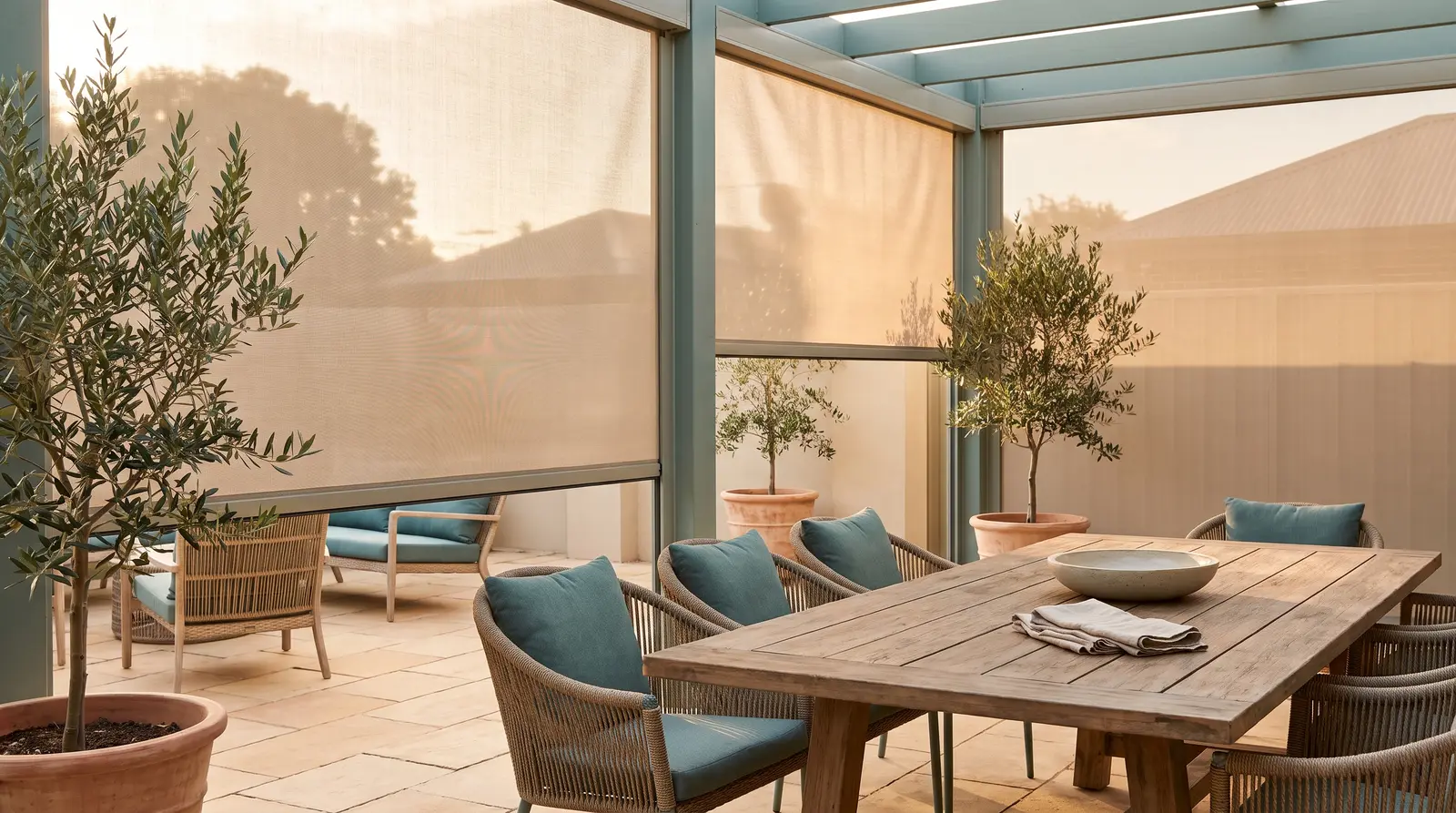
DIY outdoor blinds save $150 to $400 per opening in labour, which is real money on a 3 opening patio. The honest limit is this: a competent DIYer can fit a small mesh or strapped cafe blind into sound timber at ground level, and should not attempt a track-guided system, anything over 3 metres wide, anything motorised, or anything requiring work at height.
Key takeaways
- The saving is $150 to $400 per opening, not the whole install cost. Materials are the bulk of the price.
- Fixing into brick, render or timber of unknown condition is where DIY installs fail, and it is the failure that damages your house.
- Track-guided, motorised, wide-span and elevated installs belong with a professional.
- A DIY install almost always voids the manufacturer's install warranty. Confirm before you buy.
What you actually save
Split a typical $650 cafe blind into its parts and the picture becomes clear.
| Component | Roughly |
|---|---|
| Fabric, tube, hardware | $350 to $450 |
| Manufacture and made-to-measure | included above |
| Install labour | $150 to $400 |
Supply-only kits sit at $250 to $400 for a standard opening. On 3 openings, DIY saves you somewhere between $450 and $1,200. That is worth a weekend if the job is within your capability, and worth nothing at all if you have to call someone to fix it.
Note that the saving does not scale up with the blind. A $1,800 track-guided blind is not $1,200 of labour, it is expensive hardware plus a precision install, and the cost breakdown for Adelaide outdoor blinds shows how little of a premium blind is labour in the first place. The percentage saving on DIY shrinks exactly as the difficulty rises, which is a useful signal in itself.
What a competent DIYer can genuinely do
You are on solid ground if all of the following are true:
- The opening is under 3 metres wide with a drop you can reach comfortably from stable footing at ground level.
- The blind is a mesh, shade or strapped cafe blind, not track-guided.
- It is manual, with no electrical work involved.
- You are fixing into sound, exposed structural timber (a pergola beam or post you can see and assess).
- You own or can hire a decent drill, a long spirit level, and a laser or string line.
- You have a second person for the whole job.
Within those bounds, fitting a cafe blind is a legitimate home project: mark your bracket positions dead level, verify the measurement twice, pre-drill, fix, hang, tension the straps evenly. The most common DIY mistake at this level is not structural, it is measuring the opening at one point instead of 3, then discovering the frame is 15 mm out of square.
Where DIY installs actually fail
Almost every failed DIY outdoor blind comes down to the fixing, not the blind.
Fixing into brick. A blind under wind load exerts serious leverage on its brackets. Anchors sized for a picture hook will pull out of mortar joints, and they will take a piece of the brick with them. Old Adelaide double brick with soft lime mortar is particularly unforgiving, and it is what a great many Unley, Norwood and Prospect homes are built from.
Fixing into render. This is the single biggest trap. Render looks like a solid wall and is not. A fixing that grabs only the render layer will hold beautifully for 6 months and then let go in the first strong westerly, usually taking a dinner-plate of render with it. The repair costs more than the install saved. Finding and reaching the solid substrate behind the render is a skill, and it is the reason professionals charge what they charge.
Fixing into timber of unknown condition. A pergola beam that looks fine can be soft with rot or borer where it is fixed or where water has sat. A professional tests it. A DIYer usually does not.
Fixing into Colorbond fascia. There is frequently nothing structural behind it. Blinds fixed to fascia alone tear it.
Getting it out of level. A cafe blind that is 10 mm out will roll unevenly and wear at one edge. A track-guided blind that is out of plumb will bind in the channel and eventually jam.
What to leave to a professional, without exception
Any work at height. Second-storey balconies, high verandah beams, steep Adelaide Hills blocks. We are not going to set out ladder or height-access instructions here, because the honest answer is that this work belongs with someone who has the right equipment and training. SafeWork SA publishes the framework that applies to working at height in this state, and falls remain one of the most common causes of serious injury in home renovation.
Anything electrical. Motorised blinds need a licensed electrician to terminate the supply. This is not a grey area, it is a legal requirement, and unlicensed electrical work will invalidate your home insurance.
Track-guided systems. The tolerance is unforgiving. Both channels must be plumb and parallel across the full drop, and the fabric edge has to engage cleanly. A few millimetres of error produces a blind that binds. This is the most common job we see homeowners attempt and then pay someone to redo.
Wide spans over 3 metres. Heavy, awkward, and the bracket loading is significant.
Structural work. If the pergola needs bracing to take the load, that is a different trade.
The warranty question people miss
Most manufacturers warrant fabric and hardware separately from installation. Self-installing a supply-only blind typically leaves you with the fabric warranty and no install warranty at all, which means any fault traceable to the fixing is yours.
More importantly, if a DIY-fixed blind pulls out and damages the wall, the blind warranty is irrelevant. You are looking at a render or brickwork repair.
You keep your rights under the ACCC consumer guarantees on the product itself regardless, but those guarantees cover the goods being of acceptable quality, not your fixing method. Read the supplier's install conditions before you buy, not after.
The middle option most people overlook
You do not have to choose between full DIY and full professional. A practical split: do the demolition and removal of old blinds yourself, clear and prepare the area, and have the installer do the measure, manufacture and fix. That takes the $80 to $200 removal line off the quote and leaves the part that matters with someone insured to do it.
The other sensible middle path is doing the easy openings yourself in mesh, and having the exposed side done properly in a track-guided system. That is often the best value in the whole decision, and the patio enclosure budget post covers how to sequence it.
Working out whether the saving is worth it
Price the professional route first so you know what you are comparing against. Check the published Adelaide price bands, run your openings through the outdoor blind cost estimator, and then decide whether $150 to $400 per opening is worth your weekend and the fixing risk. For many small mesh blinds in sound timber, it is. For a sealed enclosure, it is not close.
If you do go professional, compare the quotes properly with our comparison guide and take the installer question list to the measure.
We pass your enquiry to a local Adelaide installer for a written quote at no cost. Check their licence and ask for a certificate of currency before you book. Get a free quote and see what the professional route actually costs before you commit to a weekend.