Folding arm awnings
Folding Arm Awnings in Adelaide
A folding arm awning puts shade over a deck, courtyard or window that has no roof above it, then folds flat against the wall when you want the sun back. No posts, no permanent structure, and the space returns to full light in winter. We pass your enquiry to a local Adelaide awning installer for a free quote.
What a folding arm awning is
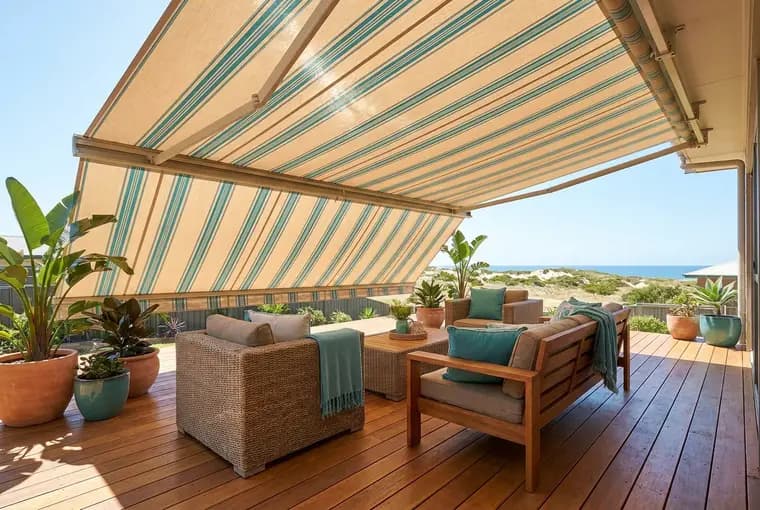
A folding arm awning is a retractable fabric canopy that cantilevers out from a wall on 2 or more spring-loaded articulated arms. There are no posts and nothing touching the ground, so the area underneath stays completely open. Extended, it shades the space. Retracted, it rolls back into a cassette or against the wall and effectively disappears.
That retractability is the whole proposition. A pergola or verandah shades the same area every day of the year, including the July afternoons when you would rather have the sun on the deck and the warmth through the windows. An awning gives you shade only when you ask for it, which in a climate with Adelaide's seasonal swing is a meaningful difference.
Where an awning beats a fixed structure
Awnings solve the no-roof problem. Outdoor blinds solve the open-sides problem. These are the situations that call for the first.
Open decks and courtyards
Creates shade over an area with no roof at all, without building a permanent structure or applying for approval.
West-facing windows
Shades the glass itself, which stops heat before it reaches the room rather than after.
Cafe and shop frontages
Extends usable trading area over a footpath, with the option to fold away outside trading hours.
Spaces you want back
Retracts completely, so the winter sun reaches the same area you were shading in January.
Fabric, frame and operation choices
- Acrylic canvas versus PVC-coated fabric. Solution-dyed acrylic breathes, holds colour well under Adelaide UV and is the usual residential choice. PVC-coated polyester is fully waterproof and harder-wearing, and suits commercial frontages.
- Full cassette, semi-cassette or open. A full cassette encloses the roll and the arms when retracted, which protects the fabric and adds years of life. An open unit is cheaper but the fabric collects dust and weathers faster.
- Manual crank or motorised. A crank is reliable and costs less. A motor with remote or wall-switch control makes daily use effortless and is close to essential on wide units.
- Wind and sun sensors. A wind sensor retracts the awning automatically when a gust threshold is passed. In Adelaide this protects the unit on days nobody is home to wind it in.
- Pitch adjustment. A steeper pitch sheds water and blocks low afternoon sun better. A shallower pitch preserves head height at the front edge.
- Front valance. A short drop at the leading edge blocks the low western sun the awning itself passes under. Cheap to add and the most common regret when omitted.
Adelaide conditions, sizing and cost
Adelaide sun angles matter when sizing an awning. Through summer the sun is high, so a 2.5m to 3m projection shades a deck for most of the day. In late afternoon, when the sun drops low in the west, that same awning shades very little unless it has a front valance or a drop screen. Homeowners in the western and coastal suburbs run into this most, and it is worth raising at the measure rather than after install.
Wind is the practical limit. Awnings have no support at the outer edge, so a gully wind off the hills or a fast southerly change will damage an extended unit. This is why a wind sensor is the option worth paying for in this city, and why a fixed verandah, or outdoor blinds on a structure you already have, is the more robust answer on a genuinely exposed site such as an Adelaide Hills deck.
Coastal installations at Henley Beach, Grange and West Lakes need marine-grade fixings and a fabric that copes with salt film. A fresh-water rinse a few times a year keeps the arm joints moving and stops salt building up in the cassette.
Expect $1,400 to $4,500 supplied and installed. Width, projection, cassette type and motorisation drive nearly all of that spread, with a wide motorised full-cassette unit sitting at the top of the band.
| Product | Adelaide price band |
|---|---|
| Folding arm awning (supplied + installed) | $1,400 to $4,500 |
Indicative, supplied and installed. Compare against every blind type in the Adelaide outdoor blind cost guide.
Simple and free
How the referral works
You want your outdoor space to work in every season. We are the guide that passes your enquiry to a local installer and gives you the questions to ask, so the decision is easy.
Tell us what you need
Answer a few quick questions about your space, the blind type and your suburb. It takes under a minute.
We pass your enquiry to a local installer
We pass your enquiry to a local Adelaide installer who covers your area. If we can't find one for your suburb, we'll let you know.
Get your free quote
The installer measures on site and quotes. Check their licence and insurance, then decide. No pressure, no obligation.
If a roof is not the missing piece
Where you already have a pergola or verandah and the problem is sun and wind coming in from the sides, these are the products to look at instead.
Outdoor blinds
The complete outdoor blind category for Adelaide homes and venues. Tell us what you need and we pass your enquiry to a local installer.
Learn moreAlfresco & patio blinds
Enclose a patio or alfresco so you use it in every season. We pass your enquiry to a local Adelaide installer who measures and quotes on site.
Learn moreRelated Adelaide services
- Cut the heat at the glass with Adelaide roller shutters - an awning shades the deck, but the windows themselves are where most of the summer heat load actually enters the house.
Free & no obligation
Get a free quote from local Adelaide installers
Answer a few quick questions and we'll pass your enquiry to a local installer who covers your area. You get a free quote and choose. We never do the work ourselves.
- Local Adelaide installers
- A licence and insurance checklist for you
- Adelaide-owned and run
- You choose who to book
- Free and no obligation
FAQ
Folding arm awnings in Adelaide: common questions
Standard residential systems project roughly 2m to 4m from the wall, and larger commercial units reach further. The projection is limited by the arm length and by how much wall height you have above the opening, since the awning needs enough drop to shed water and clear head height at the front. An awning projecting 3m over a deck shades it comfortably for most of the afternoon.
They are a fair-weather product and should be retracted in strong wind, because the fabric acts as a sail with nothing supporting the outer edge. Most quality units are rated to a light to moderate breeze only. A wind sensor on a motorised awning retracts it automatically, which is the single most valuable option in Adelaide given how quickly a spring gully wind arrives.
An awning creates shade where there is no roof, so it suits an open deck, courtyard or a window with nothing above it. Outdoor blinds close in the sides of an area that already has a roof. If your problem is that a space has no cover at all, an awning solves it. If your problem is sun and wind coming in sideways under an existing pergola or verandah, blinds are the answer.
Yes, and the fixing method is the critical part of the job. The awning cantilevers a substantial load off the wall, so brackets must be anchored into structural brickwork or a timber or steel member, never into render alone or into the top course of a veneer skin. A competent installer inspects the wall construction at the measure and will say plainly if a mounting bar or additional support is needed.
Very little, but not none. Keep the fabric clean and always retract it dry so mildew does not form in the roll. On a motorised unit the limit settings occasionally need resetting, and the arm joints benefit from a check every few years. Fabric is the part that wears first in Adelaide, and a good acrylic canvas holds colour for around 8 to 10 years before fading becomes noticeable.