Alfresco and patio enclosures
Best Outdoor Blinds for a Coastal Adelaide Home
6 min read
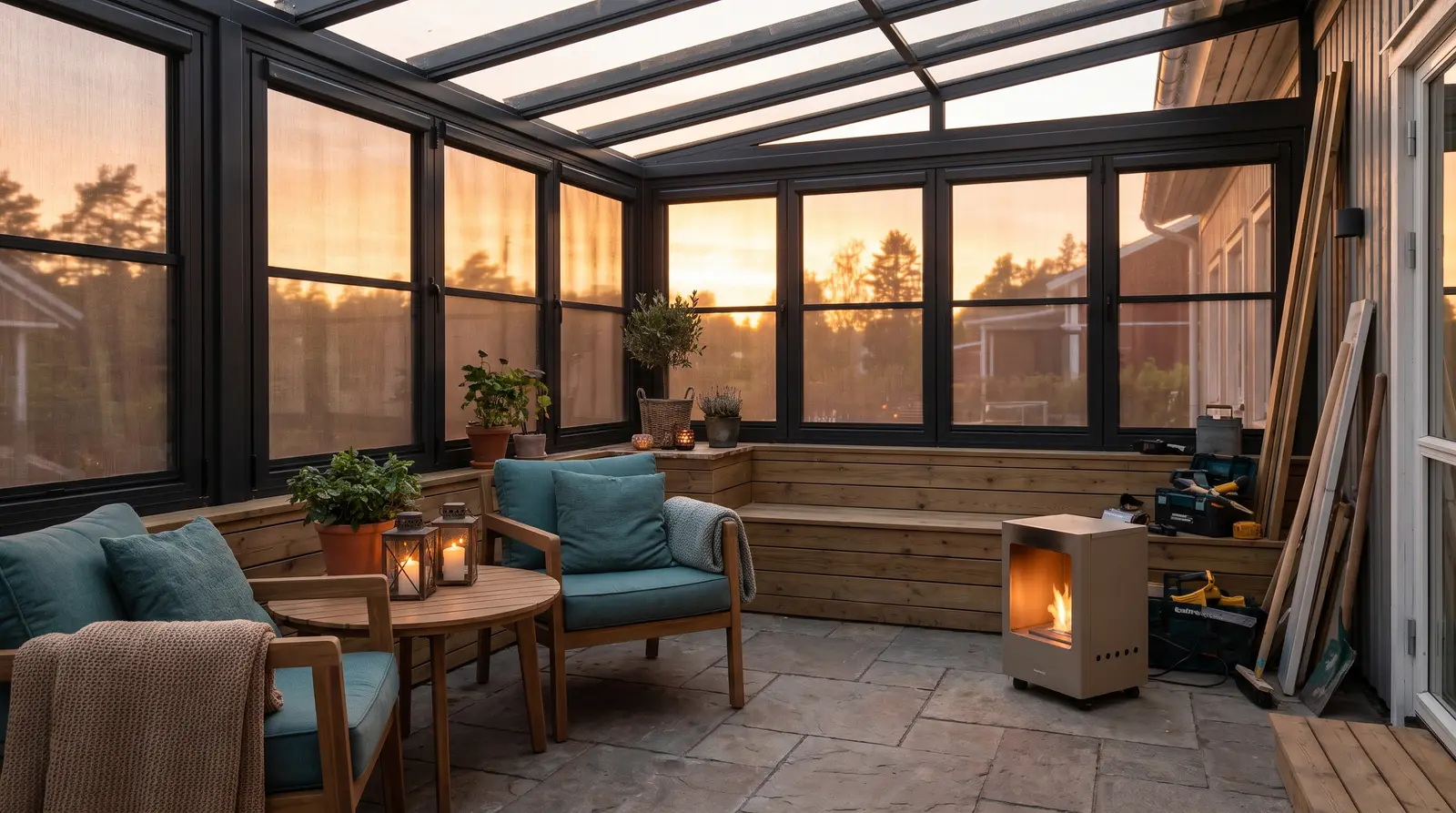
The best coastal outdoor blinds for Adelaide are track-guided systems with marine-grade 316 stainless fixings, thick powder-coated aluminium hardware and a rinse-down routine. Salt is the whole story on this coast: it does not attack the fabric so much as the fasteners, springs and tracks, and standard hardware that lasts 12 years in Burnside fails in 4 at Henley Beach.
Key takeaways
- Specify 316 marine-grade stainless for every screw, rivet, bracket and spring within about 1km of the water. 304 stainless is not enough at Glenelg or Henley Beach.
- Salt accelerates abrasion on clear PVC. A fortnightly freshwater rinse is the single highest-value maintenance habit on the coast.
- Marine-grade powder coating on aluminium tracks and headboxes is a paid option worth taking, and it protects the warranty.
- The afternoon sea breeze is a daily 25km/h to 40km/h load. Sealed track-guided systems handle it, strapped cafe blinds fatigue.
What salt actually does to an outdoor blind
Coastal failure is almost never the fabric giving out first. It is the metal.
Airborne salt settles on every surface, absorbs moisture from the air overnight, and forms a conductive electrolyte film. Where 2 dissimilar metals touch, an aluminium track and a steel screw for instance, that film drives galvanic corrosion. The screw head swells, the aluminium around it powders white, and eventually a bracket lets go under load.
At Glenelg, Henley Beach, Semaphore, Grange, Brighton and Seacliff, homes within a few hundred metres of the beach sit squarely in what marine standards classify as a severe corrosion zone. West Lakes is slightly different but not exempt: the lake system carries salt water, and waterfront homes there see the same chemistry with less direct wave-driven spray.
The second effect is abrasive. Salt crystals and fine beach sand ride the sea breeze and settle on the blind. Roll a clear PVC blind up with that on it and the crystals drag across the surface under pressure, scoring it. This is why coastal clear PVC goes cloudy years earlier than the same product inland.
Specify the hardware, not just the blind
This is where coastal quotes separate, and it is the part homeowners rarely ask about.
Fixings: 316 stainless, not 304. Both are stainless, but 316 contains molybdenum and resists chloride pitting far better. Within about 1km of the coast, 304 fasteners will show tea staining within a year or 2 and can pit through in 5. Ask for 316 explicitly on screws, rivets, bolts, brackets and the bottom-bar hardware.
Springs and internal components. The spring assembly inside the tube is the part nobody sees until it fails. Coastal-specification systems use coated or stainless spring components. A blind that stops holding position at year 4 usually has a corroded spring, not a fabric problem.
Powder coating. Standard architectural powder coat is fine inland. Coastal work should use a marine-grade or superdurable powder coat system over correctly pre-treated aluminium. Many manufacturers make coastal coating a condition of the warranty within a set distance of the sea, so getting it wrong voids cover as well as failing earlier.
Track profile. Heavier extruded aluminium tracks with thicker wall sections tolerate the salt film and the wind load better than thin-wall economy profiles.
Have a look at the track-guided blind detail on the alfresco service page, and how to enclose an alfresco in Adelaide for the system comparison generally.
The sea breeze is a daily load, not an event
Inland Adelaide homes get strong wind occasionally. Coastal homes get it every summer afternoon.
The gulf sea breeze builds most summer afternoons and commonly runs 25km/h to 40km/h on the western beaches, arriving from the south-west. That is not dramatic weather, but it is relentless, and it is exactly the load that fatigues a strapped cafe blind. Every gust pulls on the same 6 straps and the same 6 eyelets, thousands of times a season, and eventually the eyelet tears out or the strap webbing gives.
Track-guided outdoor blinds hold the blind edge in a channel down the full height, so wind load transfers into the track and the structure rather than into a handful of fabric points. On the coast that is not a preference, it is the difference between a blind that lasts and one that does not. Budget $900 to $2,000 per opening track-guided against $450 to $900 for cafe blinds, and understand what the gap buys.
For the honest picture on how wind performance is determined, read outdoor blinds and wind rating. The Bureau of Meteorology's Adelaide Airport wind observations give you a realistic sense of the afternoon pattern on the western beaches.
Fabric choices on the coast
Clear PVC still works near the sea, but it demands the maintenance routine below. Expect 6 to 8 years of good clarity on the coast against 8 to 10 inland, and longer if you rinse consistently.
Mesh is more forgiving. It does not go cloudy, it hides salt residue, and the open weave lets the sea breeze through rather than presenting a solid surface to it. On an exposed western elevation at Henley Beach or Semaphore, mesh on one opening and track-guided PVC on the others is a common and sensible split. Clear PVC vs mesh covers the trade-off in full.
UV is the other coastal factor. Reflected light off water and pale sand adds meaningfully to the UV dose on a beachfront blind compared with an inland one facing the same direction, and ARPANSA's UV index data shows Adelaide summer readings sitting in the extreme band for hours at a stretch. Higher-grade PVC with a UV-stabilised formulation is worth the upcharge here.
The maintenance that actually extends life on the coast
Most of the work is done by 3 habits.
Rinse fortnightly with fresh water. Hose the fabric, the tracks and the bottom bar. This removes the salt film before it does anything. It takes 5 minutes and it is the single most effective thing a coastal owner can do.
Dry the PVC off. Adelaide mains water is hard, so letting a blind air-dry in the sun leaves mineral spotting on top of the salt problem. A soft microfibre wipe-down solves it.
Never roll up dirty. Salt and sand on a rolled blind is a grinding paste. Rinse first, then roll.
Add an annual check of the fixings. Look for tea staining, white powdering around screw heads, or any bracket that has movement in it. Caught early, a corroded fixing is a $150 fix. Left alone it becomes a blind on the ground after a gusty afternoon.
What to ask before you sign a coastal quote
Put these 4 questions to every installer quoting a beachside job:
- Are all fixings 316 marine-grade stainless?
- Is the powder coat a marine-grade system, and does the warranty require it at my distance from the coast?
- What are the spring and internal components made of?
- What does the warranty say specifically about coastal installations and required maintenance?
An installer who answers all 4 without hesitating has done this before. One who has not thought about it is quoting you an inland blind for a beachfront house.
We pass your enquiry to a local Adelaide installer who works on the western beaches, so ask them to specify coastal hardware. Get a real quote for your address: get a free quote, or price the project first with the alfresco enclosure cost estimator.