Alfresco and patio enclosures
Turning a Patio Into an All-Weather Room in Adelaide
6 min read
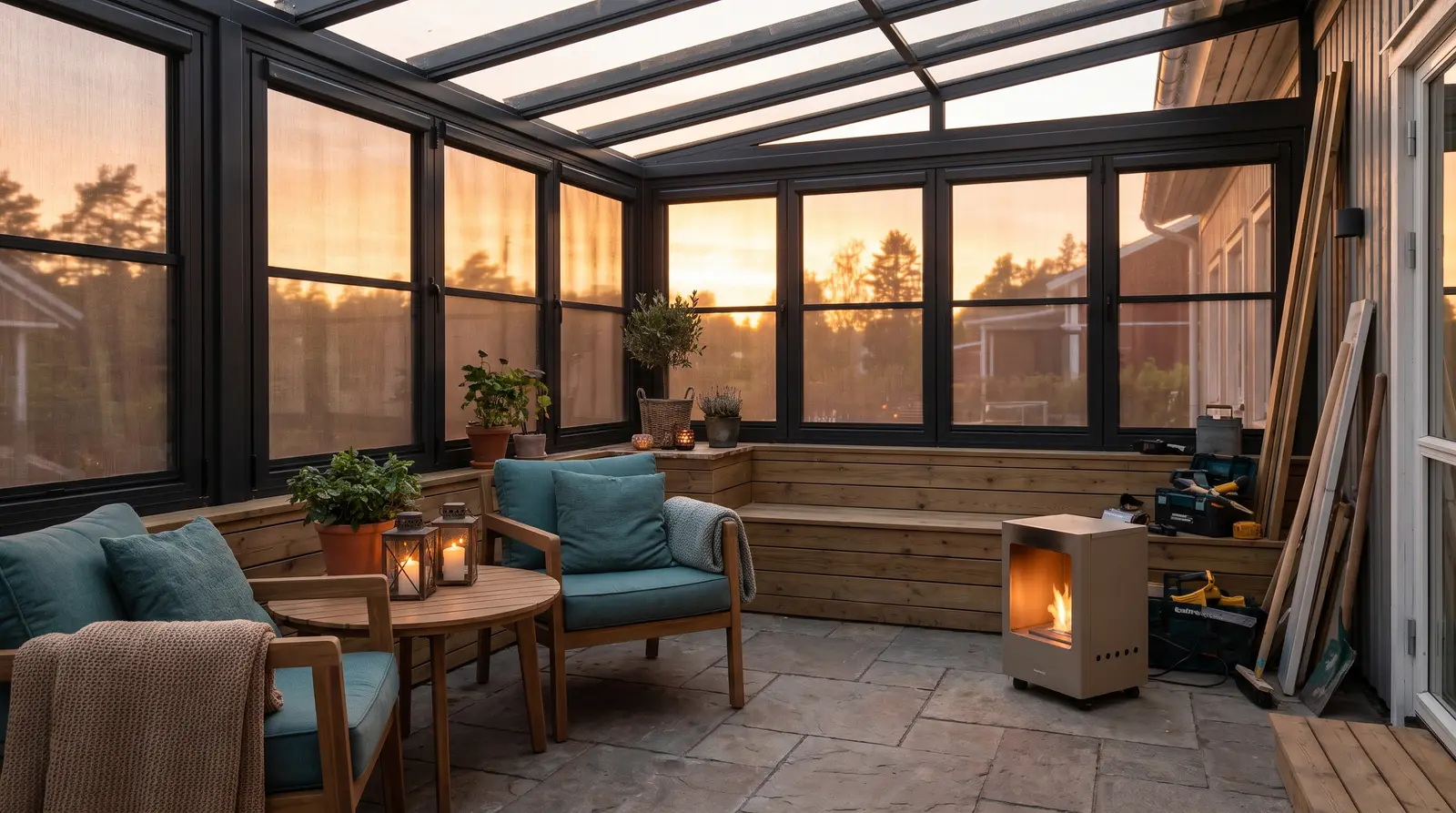
An all-weather patio is a patio you use in July, not just a shaded spot for summer. Getting there in Adelaide takes 3 things: outdoor blinds that seal on both edges, a way to add heat, and somewhere for moisture to escape. Done properly the whole conversion sits between $3,500 and $9,000 for a standard 3 to 4 opening space.
Key takeaways
- Sealed track-guided outdoor blinds are the foundation. Strapped cafe blinds create shelter, not an all-weather room.
- Budget $3,500 to $9,000 for the blind work, then $400 to $2,500 more for heating, flooring and lighting.
- Adelaide winters are mild but wet and windy: the enemy is the westerly front, not the temperature.
- Leave one opening you can roll up. A fully sealed patio with no airflow gets damp in winter and unbearable in February.
What "all-weather" actually means in Adelaide
Adelaide does not have a hard winter. Overnight minimums sit around 8 degrees in the city and a few degrees lower in the foothills, and daytime maximums in July still average about 16, as the Bureau of Meteorology's Adelaide climate averages confirm. The problem is never raw cold. It is wind-driven rain arriving on a south-westerly front, and the draught that pulls whatever warmth you have out of the space.
That reframes the whole project. You are not insulating a room. You are stopping air movement. Once the air stops moving, a patio holds heat surprisingly well, and a modest heater does the rest.
It also means the standard is achievable. Most Adelaide patios can become genuinely usable 11 months a year without building walls and without touching the existing roof. Retractable blinds fitted to a patio that already holds approval usually do not require development approval in their own right, but that is a general pattern rather than a determination on your property: the rules vary by council and by site, and heritage, character-overlay or street-facing work is treated differently again. Confirm your own position with your council and check PlanSA before you sign anything, and read alfresco enclosure council approval in SA for what the process actually involves. Start with how to enclose an alfresco for the system-by-system detail, or go straight to the alfresco and patio blind page to compare installers.
Stage 1: seal the openings properly
This is the stage that decides whether the rest works.
Track-guided outdoor blinds hold the blind edge in an aluminium channel down both sides, so there is no gap for wind to get behind. That is the difference between a patio that stays warm and one that just looks enclosed. Clear PVC in a track-guided system runs $900 to $2,000 per opening, and a motorised version $1,600 to $3,200.
Strapped cafe blinds at $450 to $900 per opening are a real product with a real use, but they are not this project. The side edges are open, the bottom bar is fixed by hand, and in a 40km/h gust the fabric moves. Fine for a sheltered courtyard in Prospect. Not fine for a west-facing patio in Seaford or an exposed deck in Stirling.
Two details separate a good seal from a mediocre one. First, the headbox needs to close against the beam or fascia, because a 20mm gap at the top undoes everything below it. Second, the bottom bar needs to land on a level surface. Adelaide paving often falls away from the house for drainage, which is correct, but it means the bottom bar sits proud at one end unless the installer scribes or packs it.
Stage 2: add heat that suits a sealed space
Once the space holds air, heating gets cheap. A patio that leaks needs a radiant heater running flat out. A sealed one warms up with far less.
Radiant electric strip heaters mounted to the beam are the most common Adelaide choice, roughly $250 to $700 each installed, and they heat objects and people rather than air, which suits a space that still gets opened up. Gas patio heaters are cheaper to buy and produce moisture as they burn, which matters more once you have sealed the space. If you go gas, ventilation is not optional.
The heating an enclosed alfresco post covers sizing and running costs in detail. For an independent view of running costs and efficiency, Energy.gov.au has comparison guidance that is not tied to any retailer.
Stage 3: ventilation, or you will regret it
Adelaide has 2 seasons that punish a sealed patio.
In February, a fully closed clear PVC enclosure under a Colorbond roof becomes an oven by 2pm. In July, warm humid air from a heater and 6 people meets a cold PVC surface and condenses, and you get water running down the inside of the blinds.
The fix is simple and cheap. Keep at least one opening operable so you can roll it up, or specify one mesh panel instead of PVC on a sheltered side, and fit a ceiling fan under the patio roof. A fan on low in winter pushes warm air back down and stops the stratification that makes your feet cold while your head is warm.
Stage 4: floor, light and finish
This is the stage that turns an enclosed patio into a room people actually sit in.
Existing exposed aggregate or plain concrete works fine once it is sealed, and sealing a 20 square metre patio costs a few hundred dollars in materials if you do it yourself. Outdoor-rated tiles or composite decking over the top run $60 to $140 per square metre supplied. Skip indoor timber. Adelaide's swing from 40 degree summer days to damp winters moves it.
Lighting is the cheapest upgrade with the biggest effect. Warm downlights in the patio beam, or a run of festoon on a dimmer, changes the space more than another $1,000 of hardware will.
What it costs end to end
A realistic Adelaide budget for a standard 3-opening attached patio, roughly 5m by 4m:
| Item | Indicative cost |
|---|---|
| 3 track-guided clear PVC openings | $3,000 to $5,500 |
| Adding a 4th opening in mesh | $350 to $750 |
| Radiant heater, installed | $250 to $700 |
| Ceiling fan, installed | $250 to $500 |
| Floor sealing or outdoor tiles | $300 to $2,800 |
| Lighting | $200 to $900 |
Full track-guided enclosures across 3 to 4 openings sit in the $3,500 to $9,000 band. The spread is real, and it comes down to opening widths, whether anything is motorised, and how square the existing structure is. Character-home verandahs in Unley and Norwood sit at the top of the band because almost nothing is standard. Newer estate alfrescos sit at the bottom because everything is.
Where most conversions go wrong
The common failure is doing stage 1 cheaply and then paying for it in every stage after. A strapped enclosure that lets wind through will never hold heat, so the heater runs harder, so the running cost climbs, and the space still gets abandoned in July. If the budget only stretches to sealing 2 openings properly this year, seal 2 openings properly and leave the third for next year. Half a good enclosure beats a whole cheap one.
The second failure is treating it as a fabric decision instead of a structural one. Ask the person quoting where they are fixing, what the span is, and what happens at the bottom bar. If they cannot answer standing in your patio, that is the answer.
Next step
We pass your enquiry to a local Adelaide installer who measures on site and quotes per opening, so you can stage the work rather than commit to everything at once. Run your numbers through the alfresco enclosure cost estimator, then request a free quote to compare real prices for your space. If you are weighing materials, clear PVC vs mesh is the next thing to read.