Alfresco and patio enclosures
Alfresco Blind Ideas for Small Adelaide Courtyards
6 min read
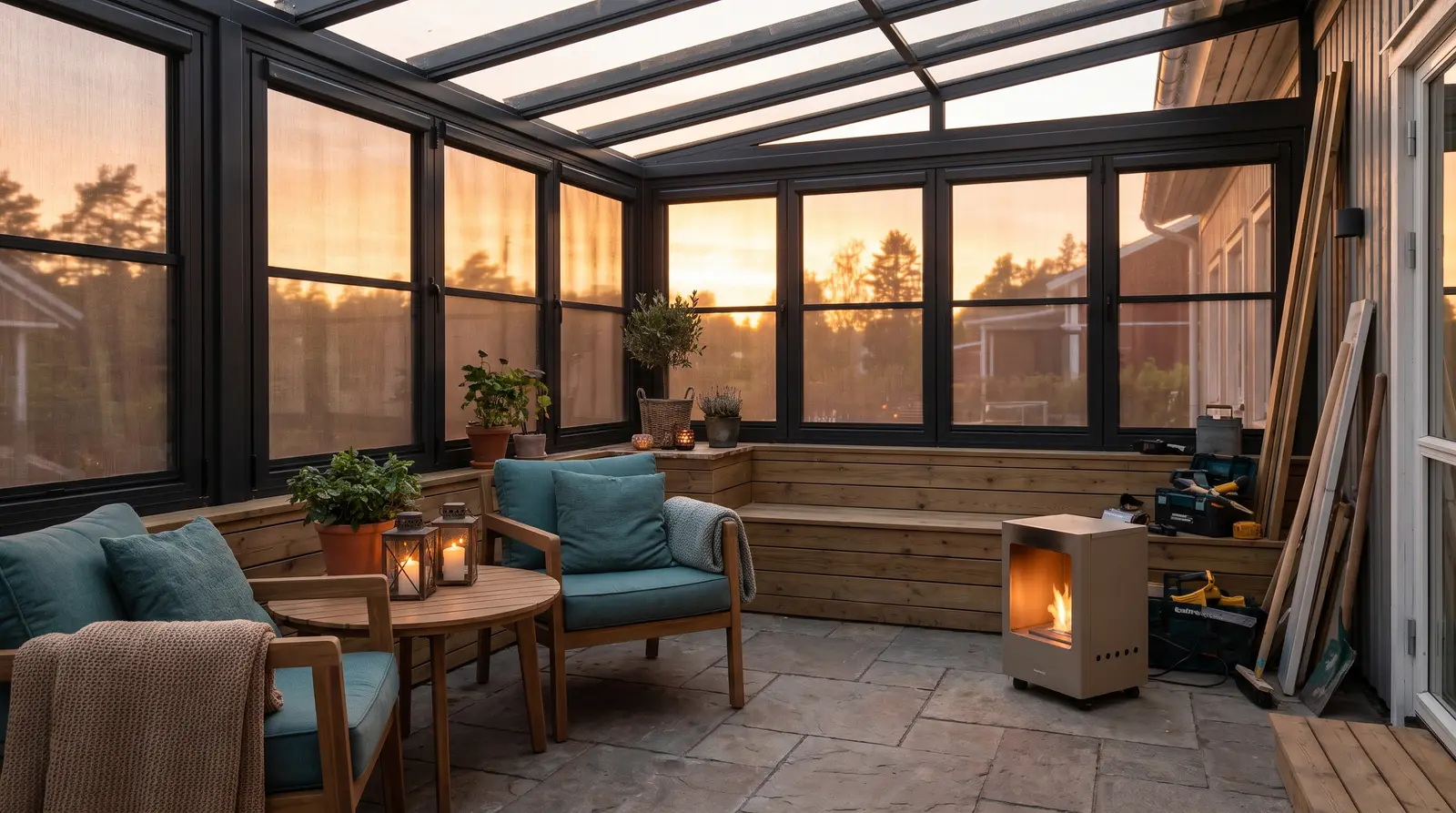
Courtyard blinds turn a small Adelaide courtyard into usable space year-round, and the trick in a compact area is restraint: enclose 2 sides rather than 4, keep the material clear rather than opaque, and use dark hardware so the frame disappears. A 2-opening courtyard enclosure typically runs $1,200 to $3,000 supplied and installed.
Key takeaways
- In a small courtyard, enclosing every side makes it feel like a shed. Two sealed sides plus 2 open ones usually works better.
- Clear PVC preserves the sense of space. Mesh and opaque canvas make a compact courtyard feel smaller.
- Dark powder-coated hardware recedes; white and cream draw the eye to the frame and shrink the space visually.
- Expect $450 to $900 per opening for cafe blinds, $900 to $2,000 for track-guided, and $1,200 to $3,000 for a typical 2-opening courtyard.
The Adelaide courtyard, specifically
Adelaide has 2 distinct courtyard types and they need different treatment.
The first is the rear courtyard on a character villa or bungalow through Prospect, Unley, Norwood, Thebarton and Bowden. Usually 3m to 5m across, bounded by a return wall, a fence and often a lean-to verandah. Brick everywhere, hard surfaces, and a west or north-west aspect that turns it into a heat sink from December to March. With Adelaide summer maximums regularly clearing 35 degrees according to Bureau of Meteorology climate averages, a paved courtyard radiates heat well after sunset. These spaces are already partly enclosed, so adding blinds to 1 or 2 openings converts them properly.
The second is the compact courtyard on a modern townhouse or infill development, common through the inner north and inner west. Smaller again, often 3m by 3m, boundary walls on 2 sides, and a small alfresco under the roofline. Almost always overlooked by a neighbour.
Both benefit from blinds, but the second type is where the boxed-in risk is real, because you are already surrounded.
Idea 1: enclose 2 sides, not 4
The instinct is to close everything. In a courtyard under about 20 square metres, that is usually wrong.
A courtyard bounded by 2 solid walls only has 2 openings to begin with. Sealing both leaves you in a closed box with no cross-ventilation, which in an Adelaide February is unpleasant and in winter causes condensation.
Enclose the side that carries the weather, typically the west or south-west, and the side you sit against. Leave the rest open or fit something that rolls up easily. You get shelter without losing the feeling of being outside, which is the reason the courtyard exists.
Full system detail is in how to enclose an alfresco in Adelaide, and the alfresco and patio blind page covers what Adelaide installers fit most often.
Idea 2: use clear PVC, not opaque fabric
In a large alfresco you can afford to lose some transparency. In a 3m courtyard you cannot.
Clear PVC keeps sightlines running through to the fence, the planting and the sky, so the space still reads as open even when the blinds are down. Opaque canvas or heavy shade fabric on a small courtyard creates a solid wall a metre from where you are sitting, and the space feels half its actual size immediately.
If glare is the problem, tinted PVC is the compromise. It costs the same as clear, cuts western glare hard, and still lets you see through. On a west-facing Prospect courtyard that takes full 4pm sun, tinted usually beats clear. The clear PVC vs mesh comparison works through the whole trade-off.
Idea 3: go dark on the hardware
Small spaces punish visual clutter, and blind hardware is visual clutter unless you hide it.
Dark powder-coat, Monument, Woodland Grey or matt black, recedes into shadow. White or cream hardware reads as a bright frame around every opening, and in a small courtyard those frames dominate.
Match the channel colour to the fence, the pergola or the window frames rather than to the house walls. Where the courtyard has dark boundary fencing, dark tracks vanish against it completely.
Idea 4: pick the system for the space, not the brochure
Courtyards are the one place where cafe blinds genuinely compete with track-guided systems.
A courtyard enclosed by walls on 2 sides is sheltered. Wind that would tear a strapped blind apart on an exposed Seaford patio or a Stirling deck largely does not reach a rear villa courtyard in Norwood. At $450 to $900 per opening against $900 to $2,000 for track-guided, cafe blinds can be the right economic call here.
There are 2 things that push you back to track-guided even in a courtyard. First, if the courtyard opens to a wide side passage, wind funnels down it and hits the blind hard. Second, if you want the space genuinely usable in July, only a sealed edge stops the draught.
The straightforward test: stand in the courtyard on a windy winter afternoon. If it is still and calm, cafe blinds are viable. If your hair moves, seal it properly.
Idea 5: solve the small stuff that makes a courtyard work
Drainage. Water running off a sealed blind lands in a small space with limited fall. Adelaide courtyards are often paved to a single grate, and if the blind sits outside the fall line you get ponding. Check where the water goes before installation, not after the first storm.
Ventilation. One roll-up opening or a ceiling fan. In a small enclosed courtyard the temperature swing is faster than in a big alfresco, so a fan does disproportionate work.
Lighting. A run of festoon or 2 warm wall lights transforms a small courtyard more cheaply than any hardware. Budget $200 to $600.
Planting against the fence. The cheapest way to stop a compact courtyard feeling boxed in is to give the eye something green to land on beyond the blinds. Clear PVC and planted boundaries work together, and Green Adelaide's urban greening guidance has sensible species suggestions for hot, reflective courtyard conditions.
Privacy at night. Clear PVC does nothing for privacy after dark, and in an overlooked townhouse courtyard that matters. Tinted PVC helps a little. A planted screen or a slatted section on the overlooked side helps more.
What a courtyard enclosure costs in Adelaide
| Scenario | Indicative cost |
|---|---|
| 1 cafe blind, sheltered courtyard | $450 to $900 |
| 2 cafe blinds | $900 to $1,800 |
| 2 track-guided clear PVC blinds | $1,800 to $4,000 |
| Typical 2-opening courtyard, all in | $1,200 to $3,000 |
| Adding a ceiling fan and lighting | $450 to $1,100 |
Courtyard openings tend to be narrow, 2.5m to 3.5m, which keeps them at the lower end of each band. Narrow blinds are lighter, need less tube and bottom bar, and are quicker to fit. This is one of the few situations where a small space genuinely costs proportionally less.
Character homes are the exception. Original verandah posts in Unley and Norwood are rarely square or evenly spaced, so fabrication time goes up even when the openings are small.
Where to start
Measure the openings, decide which one carries the weather, and get a price per opening rather than one lump sum, so you can do the important side now and the second side later.
We pass your enquiry to a local Adelaide installer who quotes on site, which matters in a courtyard where a 40mm out-of-square post changes the fabrication. Compare the alfresco and patio blind options, estimate your project with the alfresco enclosure cost estimator, or read turning a patio into an all-weather room if you want the space usable through winter.