Alfresco and patio enclosures
Outdoor Blinds for a Second-Storey Balcony in Adelaide
5 min read
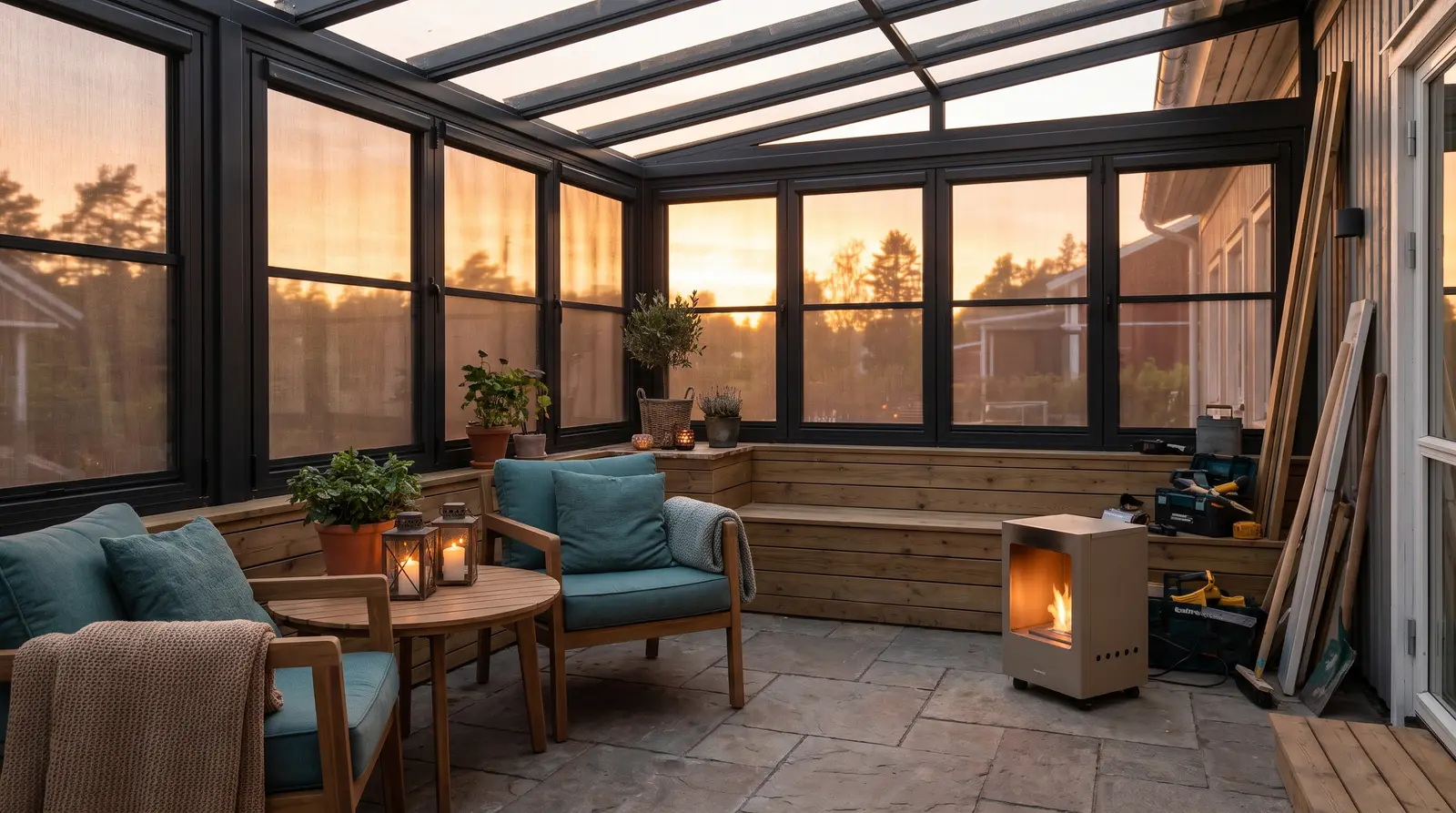
Balcony outdoor blinds work well on Adelaide second-storey balconies, but the job is not the same as a ground-floor patio. Wind speed at 6m is meaningfully higher than at ground level, fixing points are often render over lightweight framing rather than solid structure, and access adds cost. Track-guided systems are effectively the only sensible choice at height, at $900 to $2,000 per opening plus an access allowance.
Key takeaways
- Wind is stronger and more turbulent at balcony height. Strapped cafe blinds are a poor fit above ground floor.
- The fixing substrate matters more than anything else. Rendered lightweight balustrades often need a structural backing plate.
- Access adds $200 to $800 to a typical job depending on whether a ladder, scaffold or lift is needed.
- Apartments, townhouses and community-titled properties need body corporate approval before anything is ordered.
Wind at height changes the brief
Wind speed increases with height above ground, and it also becomes more turbulent as it comes off the roofline and around the building. A second-storey balcony at 5m to 7m routinely sees noticeably stronger and gustier conditions than the patio directly below it.
In Adelaide that shows up in 2 patterns. Summer afternoons on the western side of town bring the gulf sea breeze, which at Glenelg, Henley Beach and West Lakes commonly runs 25km/h to 40km/h and hits upper-level balconies hardest. Winter brings south-westerly fronts with genuine gusts behind them, which the Bureau of Meteorology's Adelaide climate and wind observations record through the colder months.
The practical consequence: a strapped cafe blind on a second-storey balcony fails early. Every gust loads the same handful of straps and eyelets, and at height that happens far more often than on a sheltered ground-floor patio. Track-guided outdoor blinds transfer load into a continuous channel and the structure behind it, which is the reason they dominate balcony work. The alfresco and patio blind page covers the systems, and outdoor blinds and wind rating explains how installers actually determine what a given opening can take.
The fixing substrate is the real question
On a ground-floor patio you usually have timber posts or steel columns to fix to. On a balcony you often do not.
Rendered lightweight balustrade. Common on newer Adelaide townhouses and apartments from the last 20 years. Render over blueboard or lightweight framing looks solid and holds almost nothing structurally. Fixing a blind track into it without finding the framing behind, or without adding a backing plate, produces a track that pulls out in the first serious gust. This is the number one balcony failure and it is entirely preventable.
Solid brick or blockwork balustrade. Common on 1990s and earlier builds around Prospect, Norwood and the older coastal suburbs. Good fixing, provided the installer uses appropriate masonry anchors and avoids fixing into a perp joint.
Steel or aluminium balustrade posts. Fine to fix to, but the post has to be checked for what it is actually bolted to. Balustrade posts are engineered to resist people leaning on them, not to carry a wind-loaded blind.
Timber posts under a balcony roof. The easiest case, and the most like a normal patio.
Any installer quoting a balcony should be telling you what they are fixing into and how, not just what the blind costs. If they have not looked behind the render, they are guessing.
Strata and body corporate approval
This stops more balcony projects than anything technical.
If your property is a strata title, community title or has a body corporate, altering the external appearance of the building almost always requires approval, and outdoor blinds change the external appearance. That approval is separate from anything council related. The SA Government's guidance on strata and community titles explains how owner and corporation responsibilities are divided, which is the framework your request will be assessed under.
Get it in writing before you order. Blinds are custom-manufactured to your openings and are not returnable, so an approval that arrives after fabrication is an expensive problem. In practice the body corporate will usually want to know the colour, the material, whether the blinds are retractable, and whether all owners fitting blinds will use a consistent specification.
Planning consent is a separate question again, and it varies by council and property. Our general guidance on alfresco enclosure council approval in SA sets out what to check and where, and you should confirm your own situation with your council.
What it costs on a balcony
| Item | Indicative cost |
|---|---|
| Track-guided clear PVC blind, per opening | $900 to $2,000 |
| Motorised track-guided blind, per opening | $1,600 to $3,200 |
| Mesh or shade blind, per opening | $350 to $750 |
| Access allowance (ladder, scaffold or lift) | $200 to $800 |
| Structural backing plate or bracket fabrication | $150 to $500 per opening |
Access is the line item people are not expecting. If the balcony is reachable from inside, the cost is minimal. If the track has to be fixed from the outside face, or the balcony overlooks a driveway or a garden bed where a scaffold cannot sit, it climbs.
Motorising is worth more on a balcony than on a patio. A 4m clear PVC blind is heavy, and reaching over a balustrade to work a bottom bar at height is genuinely awkward. Many balcony jobs that would be manual downstairs get motorised upstairs for exactly that reason. Wind sensors are also worth asking about on exposed sites, since they retract the blind automatically when gusts exceed a set threshold.
Design details that matter at height
Keep spans sensible. Wind load rises with area, and a wide blind at height carries substantially more force than the same blind at ground level. Installers often split a balcony opening that they would run as a single span downstairs. That is a good sign, not a cost grab.
Drainage. Water running off a sealed balcony blind lands on the balcony floor. Check that the floor drains away from the door threshold, because a balcony that ponds against a sliding door will find its way inside.
Privacy versus view. Balconies overlook things, and neighbours. Tinted PVC or a mesh with a darker exterior gives daytime privacy while keeping the outlook from inside. If the view is the point, how to keep the view when you enclose a patio applies equally at height.
Colour. Match the powder coat to the existing balustrade or window frames. Dark hardware disappears against a balcony far better than white.
Before you commit
Get the body corporate approval sorted, then have someone stand on the balcony, check what is behind the balustrade, and quote per opening including access. A balcony quote produced from a photo is not a quote.
We pass your enquiry to a local Adelaide installer who measures on site and specifies the fixing method before they price the blind. Request a free quote to compare, or price the whole enclosure first with the alfresco enclosure cost estimator.