Alfresco and patio enclosures
How to Keep the View When You Enclose a Patio
6 min read
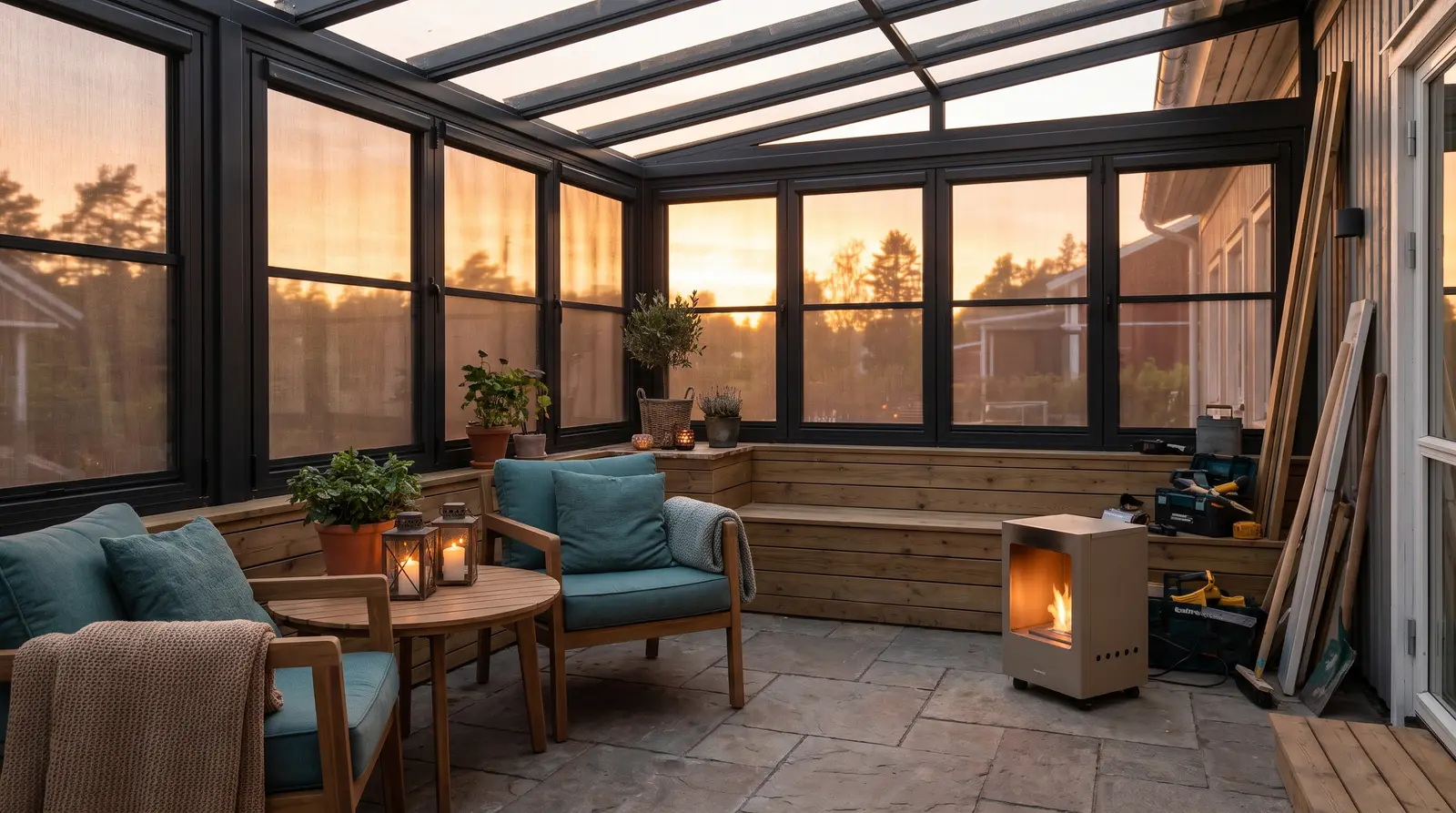
Clear alfresco blinds keep the view when you enclose a patio, provided you get 3 things right: the PVC grade, how the openings are split, and how the blind is cleaned and rolled. Choose well and you keep the outlook you paid for. Choose badly and you are looking through a cloudy sheet by year 4.
Key takeaways
- Wide single spans preserve the view far better than 2 narrower blinds with a post-width join in the middle.
- Track-guided systems have slim side channels and no straps or buckles cluttering the sightline.
- Cloudiness is caused by abrasion and hard-water marks, not age. How you clean and roll the blind decides how long it stays clear.
- Tinted PVC costs the same as clear and solves western glare, at a small cost to colour accuracy.
Why some enclosures kill a view and others do not
The material is rarely the problem. Residential clear PVC at 0.7mm to 0.8mm is genuinely transparent when new, and good quality product stays close to that for years.
What ruins a view is everything around the PVC: thick side channels, a deep headbox sitting in the eyeline, straps and buckles crossing the opening, and most of all an unnecessary vertical join where 2 blinds meet.
If your patio looks out over the Hills from a foothills home in Mitcham or Blackwood, or across a reserve, or just over a garden you spent 10 years on, those joins are what you will notice every day.
The alfresco and patio blind page covers the systems Adelaide installers use, and how to enclose an alfresco walks through the whole project.
Get the spans right first
This is the single biggest lever on the finished look.
Most track-guided systems handle a single blind up to around 5m to 6m wide in clear PVC, depending on the tube, the bottom bar and how exposed the site is. Under that width you get one uninterrupted sheet. Above it, the installer splits the opening and you get a vertical channel, usually 40mm to 60mm wide, sitting in the middle of your outlook.
So the question to ask when quoting is direct: what is the widest single blind you will run on this opening, and where does the split fall if you split it? A good installer will place a necessary split on an existing post rather than in open air, so the interruption lines up with structure you already look past.
Where a split is unavoidable, ask about aligning it with the sightline from where you actually sit. A join that lands behind the dining table is far less intrusive than one dead centre.
Choose the system that shows the least hardware
Track-guided outdoor blinds win on view for a structural reason. The blind edge runs in a slim aluminium channel fixed to the post or wall, so there is nothing crossing the opening. No straps, no eyelets, no bottom-bar clips, no rope. You look through glass-clear PVC framed by 2 vertical lines that mostly disappear against the posts, particularly if the channels are powder-coated to match the existing structure.
Cafe blinds, at $450 to $900 per opening against $900 to $2,000 for track-guided, are the cheaper route, but the strapping is visible. Every strap, buckle and turn-clip is a small dark object in your outlook, and there are typically 4 to 8 of them per blind.
If the view is a primary reason for the enclosure, that price gap is the difference you are actually paying for. It is the same reasoning behind turning a patio into an all-weather room: the sealed system costs more and delivers something the cheap one structurally cannot.
Colour-match the hardware, and go dark
This is the detail most people get wrong.
Instinct says white channels look lighter and less obtrusive. In practice the opposite is true. White and cream hardware catches the eye in bright Adelaide daylight and reads as a bright frame around your view. Dark powder-coat, Monument, Woodland Grey or matt black, recedes into shadow and effectively disappears.
Match the channel colour to the existing posts, or to the darkest element of the structure. If your patio has Monument Colorbond, use Monument channels.
Clear or tinted
Tinted PVC costs about the same as clear and is worth serious thought on a western Adelaide opening.
Clear PVC gives you true colour and maximum brightness. On a west-facing patio at 4pm in January, that means glare bad enough that you close the blind or leave the space, which defeats the purpose.
Tinted PVC, usually a light grey or bronze, cuts glare substantially while keeping the view fully readable. You lose some colour accuracy, and a garden looks slightly flatter. The trade is usually worth it on the western face and not worth it on a north or east opening.
The clear PVC vs mesh comparison covers the third option, mesh, which preserves airflow but gives you a filtered silhouette rather than a real view. If keeping the outlook is the point, mesh is not the answer on your best opening.
Keep it clear: the maintenance that actually matters
Clear PVC does not go cloudy from age. It goes cloudy from abrasion and mineral deposits, and both are avoidable.
Abrasion happens when you roll the blind up with grit on it. Every roll drags dust across the surface under pressure, creating fine scratches that scatter light. That is what cloudiness is. Adelaide's summer dust and, on the coast, salt crystals make this worse. The fix is to hose the blind down before rolling it up for any extended period.
Mineral marks come from Adelaide's hard mains water. Metropolitan supply carries a meaningful dissolved-solids load, and SA Water publishes the hardness figures for each supply zone. Hose a blind, let it dry in the sun, and you get spotting that etches in over time. Always dry the PVC off with a soft cloth rather than letting it air dry.
What to never use: methylated spirits, solvents, glass cleaner containing ammonia, scourers, pressure washers, or anything with a scrubbing texture. Warm water, a drop of mild detergent, and a soft microfibre cloth is the whole regime. Do it every 2 to 3 months and a clear blind still looks close to new at year 8.
Never roll a blind up wet and leave it for weeks. PVC creases against itself, and creases in clear PVC are permanent and highly visible.
What a view-first enclosure costs
For a 3-opening Adelaide alfresco where all 3 stay clear and unsplit:
| Item | Indicative cost |
|---|---|
| Track-guided clear PVC, per opening | $900 to $2,000 |
| Motorised, per opening | $1,600 to $3,200 |
| Full 3 to 4 opening enclosure | $3,500 to $9,000 |
| Colour-matched powder-coat hardware | Usually included, confirm it |
Wide openings sit at the top of each band because the tube, bottom bar and tracking all have to be heavier to run a single span cleanly. That extra cost is exactly what buys you the uninterrupted view, so it is the one place not to trim.
Before you sign
Ask any installer quoting your patio: how wide is each single blind, where does any split land, what colour is the hardware, and what is the PVC gauge. Those 4 answers tell you what your view will look like in 5 years.
We pass your enquiry to a local Adelaide installer who measures on site. Ask them exactly where a join would fall on your openings. Get a free quote, or price the whole project first with the alfresco enclosure cost estimator. Standards Australia publishes the AS 1170.2 wind loading standard that installers work to when sizing wide spans, which is why span limits are not arbitrary.