Alfresco and patio enclosures
Heating an Enclosed Alfresco in Adelaide: Blinds Plus Heaters
6 min read
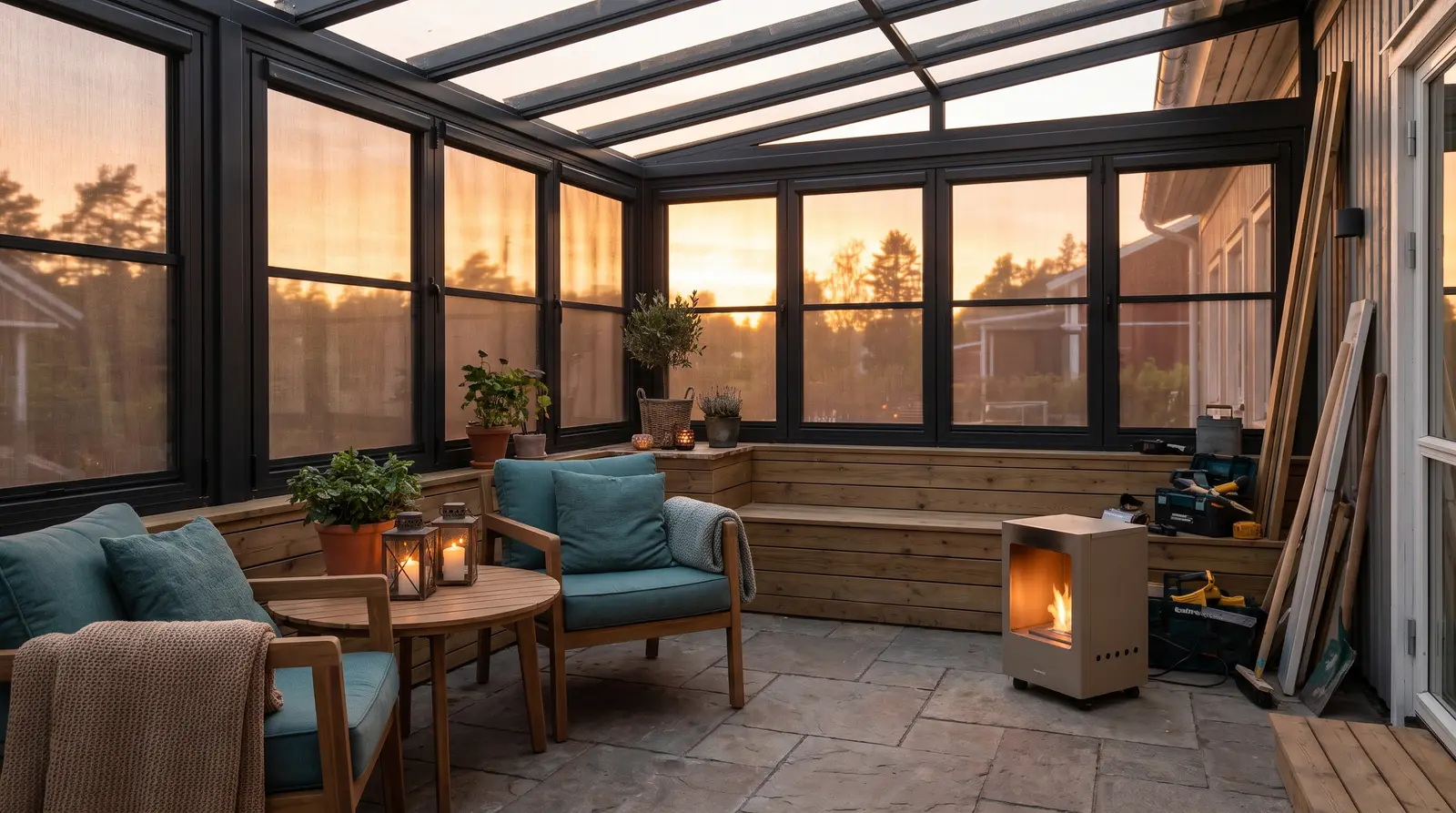
Enclosed alfresco heating works in Adelaide because our winters are mild and wet rather than genuinely cold. Seal the openings with track-guided outdoor blinds first and a single 2,400W radiant heater will hold a standard 20 square metre alfresco comfortable through July. Skip the sealing and no heater will keep up.
Key takeaways
- Sealing comes first. A draughty enclosure needs roughly twice the heating output of a sealed one.
- Radiant electric strip heaters mounted to the beam are the standard Adelaide choice: $250 to $700 installed, around $0.60 to $0.90 an hour to run at 2,400W.
- Gas patio heaters are cheaper to buy but release moisture as they burn, which causes condensation on clear PVC in a sealed space.
- Allow roughly 100W to 130W of radiant output per square metre in a properly sealed alfresco.
Seal it before you heat it
Adelaide's July average maximum sits near 16 degrees and the overnight minimum near 8, a few degrees lower through Stirling, Aldgate and the foothills. That is not cold enough to need serious heating. What makes an Adelaide alfresco unusable in winter is air movement: a south-westerly front pushing through an open side strips heat as fast as you add it.
That is why the blind system matters more than the heater. Track-guided outdoor blinds capture the blind edge in an aluminium channel down both sides, so there is no gap for wind to get behind. Strapped cafe blinds leave the side edges open, and in a 40km/h gust the heat you are paying for goes straight out.
The practical effect is large. A sealed 20 square metre alfresco holds temperature with about 2,400W of radiant output. The same space with 2 unsealed edges needs closer to 4,800W and still feels draughty at ankle height. Sealing properly is cheaper than doubling the heating and paying to run it every winter.
Full detail on the systems is in how to enclose an alfresco in Adelaide, and the alfresco and patio blind page covers what Adelaide installers fit. If you are costing the whole conversion, turning a patio into an all-weather room sets out the stages.
Radiant electric: the default for a sealed alfresco
Radiant heaters warm objects and people directly rather than heating the air, which suits a space that still gets opened up. Turn one on and you feel it in 30 seconds, and losing some air out an opening does not reset your progress.
Mount them on the patio beam or the underside of the roof, angled at the seating area, not the walkway. Height matters: 2.2m to 2.7m is the usual range, and too high wastes output while too low creates a hot spot.
Costs in Adelaide:
| Item | Indicative cost |
|---|---|
| 1,800W to 2,400W radiant strip heater, supplied | $180 to $450 |
| Electrician to hard-wire and switch | $150 to $400 |
| Running cost at 2,400W | About $0.60 to $0.90 per hour |
Sizing rule: allow 100W to 130W per square metre in a well-sealed alfresco. A 5m by 4m space is 20 square metres, so 2,000W to 2,600W, which is one good 2,400W unit or 2 smaller units spread across the seating zone. Two smaller heaters usually feel better than one large one because the coverage is more even.
Short-wave halogen units glow bright orange and are cheap. Medium-wave and carbon-fibre elements cost more, glow far less, and are much more pleasant to sit under for 3 hours. In an enclosed space where you are looking at the heater all evening, that difference is worth the extra $100.
For independent running-cost comparisons across heating types, Energy.gov.au is the useful non-retailer reference.
Gas: cheaper to buy, worse in a sealed space
Free-standing gas mushroom heaters and 9kg bottle units are cheap and produce a lot of heat. In an open or partly open alfresco they are perfectly reasonable.
In a fully sealed clear PVC enclosure they cause 2 problems.
The first is moisture. Burning LPG produces water vapour, roughly a litre of water for every litre of gas burned. In a sealed space that vapour has nowhere to go until it hits the cold inner face of your clear PVC blinds and condenses. You get water running down the inside of the blinds, damp cushions and a musty smell.
The second is combustion safety. Any unflued gas appliance consumes oxygen and produces combustion products. Manufacturers specify minimum ventilation for exactly this reason, and a fully enclosed alfresco with all blinds down may not meet it. If you use gas, keep at least one opening partly up, follow the manufacturer's ventilation requirement, and never run a bottle heater in a fully closed space.
If you want gas heat in a genuinely sealed alfresco, the correct answer is a flued outdoor gas fireplace installed by a licensed gas fitter, not a portable bottle unit. Gas work in South Australia must be done by a licensed gas fitter, and you can check a licence through Consumer and Business Services before anyone touches an appliance.
Managing condensation
Even without gas, an enclosed Adelaide alfresco in winter will get some condensation. Warm moist air from people, food and a kettle meets 8 degree PVC and gives up its water.
There are 3 things that control it.
Airflow: a ceiling fan under the patio roof, running low and in winter mode, keeps air moving and stops the warm layer sitting at the roof while the PVC surface stays cold. It also pushes warm air back down, which makes the heater feel more effective.
A gap: leaving one blind up 100mm to 200mm at the top gives moisture a way out and costs very little heat.
Surface temperature: heavier gauge PVC and a warmer space both reduce it. This is another reason radiant heating suits an enclosure. It warms surfaces, including the blind itself.
Do not seal it and forget summer
The same enclosure that holds heat in July becomes a problem in February. A fully closed clear PVC alfresco under a Colorbond roof on a 40 degree Adelaide day gets hotter inside than out.
Every enclosure that gets used year-round has a summer plan: one opening in mesh instead of PVC, or blinds you can roll up in seconds, plus a fan. That is worth designing in at quote stage rather than retrofitting. Clear PVC vs mesh covers how to split the materials across your openings.
What the whole thing costs
A realistic Adelaide budget for a 20 square metre alfresco taken from open patio to heated winter room:
| Stage | Indicative cost |
|---|---|
| 3 track-guided clear PVC openings | $3,000 to $5,500 |
| 2,400W radiant heater, installed | $250 to $700 |
| Ceiling fan, installed | $250 to $500 |
| Full 3 to 4 opening enclosure, all in | $3,500 to $9,000 |
Run the numbers for your own space with the alfresco enclosure cost estimator before you request quotes. We pass your enquiry to a local Adelaide installer who measures on site. Ask them which openings genuinely need sealing, which is the decision that sets your heating bill for the next decade. Get a free quote to compare.