Cafe blinds, clear PVC and track-guided
Cafe Blinds for Hospitality: Footpath and Courtyard Dining
5 min read
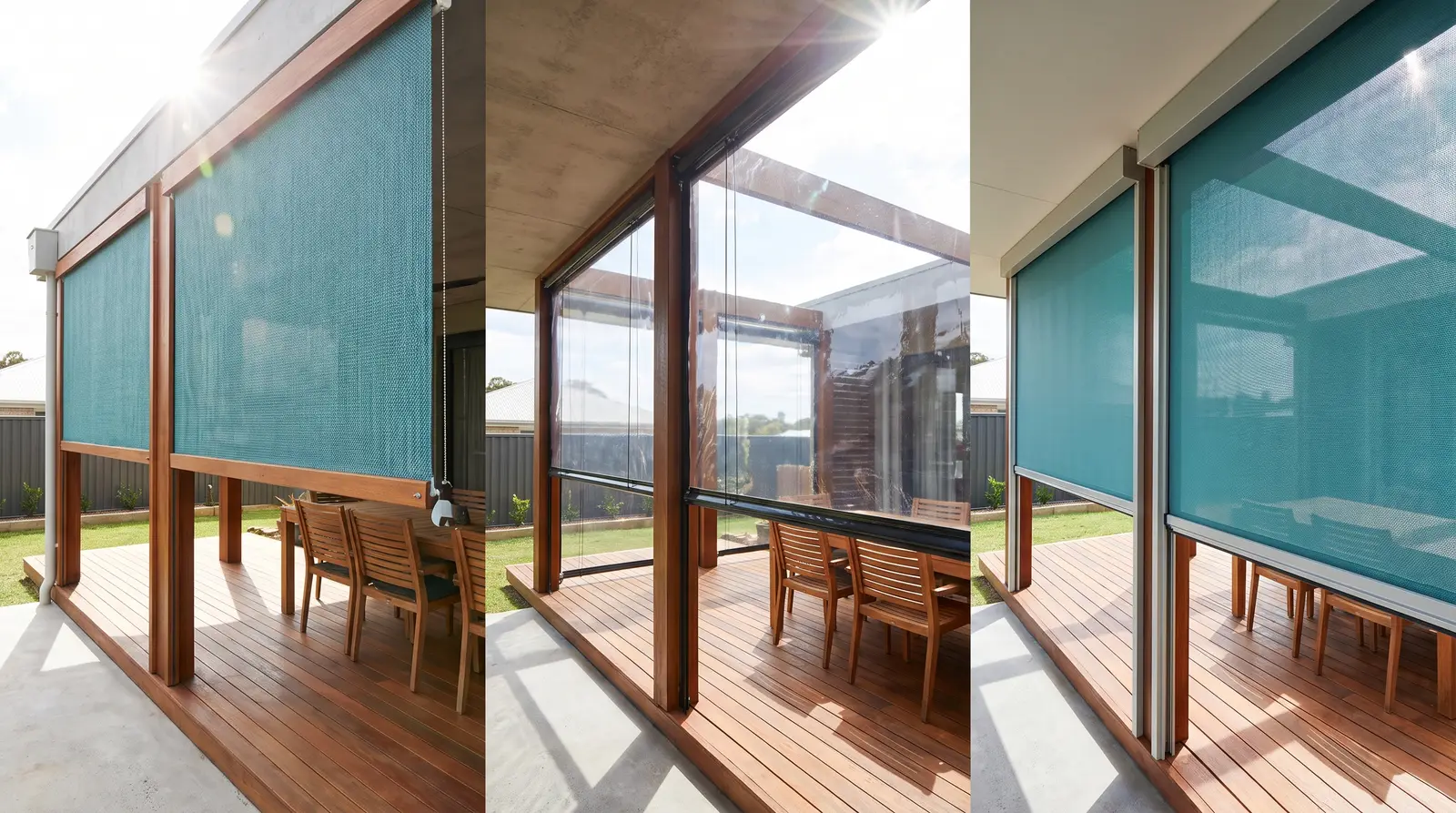
Commercial cafe blinds keep footpath and courtyard tables trading through wind, rain and cold, which is the difference between 12 covers and 0 on a wet Thursday. This is the operational guide: what to confirm with your council, how to specify for a commercial duty cycle, and how to run them day to day.
Key takeaways
- Confirm outdoor dining and structure requirements with your own council before ordering. Requirements differ by council and by street.
- Commercial blinds move twice a day, every day. Specify 0.8mm minimum and stainless hardware.
- Budget $450 to $900 per opening strapped, $900 to $2,000 for a sealed track-guided system.
- Build a 60-second open and close routine into opening and closing checklists, or staff will stop using them.
Step 1: check the permit position with your council first
Outdoor dining on a public footpath is licensed by the local council, and anything you attach, erect or drop over that area typically forms part of what the council assesses. Requirements vary between councils and sometimes between streets within one council area, so treat this as a conversation to have before you take quotes, not after.
The kinds of things councils commonly look at include the clear pedestrian path width you must maintain, whether fixings can go into a footpath or a heritage facade, how the enclosure interacts with the building line, wind and stability arrangements, and whether an enclosed area changes the classification of your licensed area.
If you trade in the city, start with the City of Adelaide's business permits and licences information. If you are in Norwood, Unley, Prospect, Glenelg or anywhere else in metropolitan Adelaide, go to your own council. For anything that starts to look like a permanent structure rather than a retractable blind, the SA Planning Portal is the reference point for whether development approval is in play.
We are not a permit authority and we do not give a definitive position on your site. Confirm it in writing with your council, then quote the job.
Step 2: specify for a commercial duty cycle
A home patio blind might move 40 times a year. A venue blind moves 700 times a year. Specify accordingly:
- PVC gauge: 0.8mm minimum. Below that, daily rolling creases and clouds the panel within a season and it looks tired in your street-front photos.
- Hardware: stainless, not zinc-plated. Especially on the coast at Glenelg or Henley Square, but also in the city where fixings are cleaned frequently.
- Eyelet spacing: 300mm, not 500mm. Closer spacing spreads the load and stops hems tearing.
- Reinforced hems on all 4 edges, with double stitching at every corner.
- Rope-and-pulley or spring roller, not bungee-only. Staff need to open a blind one-handed while carrying something.
- Headbox or hood if the blinds live stowed during trading hours. It protects the roll and it looks finished.
- Branding: printed logos and street numbers on the base band are common and cheap at manufacture time, expensive later.
Material choice depends on what the blind is doing. Clear PVC keeps passers-by able to see a full room, which is itself marketing. Tinted PVC cuts glare on a west-facing frontage. Acrylic mesh is cooler and cheaper but hides your room from the street. The trade-offs are set out in the cafe blinds guide.
Step 3: choose strapped or guided honestly
Strapped cafe blinds are the standard hospitality fit and they are fine on protected frontages: an arcade, a laneway, a courtyard with buildings on 2 sides. They cost $450 to $900 per opening and any competent operator can work them.
Track-guided blinds are worth the step up in 3 situations. First, exposed corner sites where wind gets a run at the frontage. Second, where you want the area genuinely sealed so heaters work and the space trades as an indoor room in winter. Third, where staff turnover is high, because a guided blind takes 5 seconds and needs no explanation while straps need training and get done badly. Guided systems run $900 to $2,000 per opening, or $1,600 to $3,200 motorised.
Motorisation deserves a serious look for venues. A single wall switch that closes 4 blinds at once removes the "nobody wanted to go out in the rain to unclip them" problem entirely, and it removes a manual handling task from staff. Check your obligations as an employer with SafeWork SA if staff will be operating blinds at height or in wind.
Step 4: write the daily routine into your checklists
The blinds only earn revenue if they get used. Put them on the open and close lists:
Opening: check the forecast. If gusts are forecast above about 40km/h, plan to keep strapped blinds stowed or fully down and fastened, never half-down. Roll dry panels only. Clear the tracks or the bottom rail path of last night's leaf litter.
During service: blinds go down when rain starts, not when the first table complains. Nominate one person per shift who owns it.
Closing: stow dry, or leave down and fully fastened if wet. A wet panel rolled and left for a fortnight grows mould in the fold lines that never fully cleans out.
Weekly: wash the panels. Warm water, pH-neutral detergent, soft microfibre. Never ammonia glass cleaner, metho or a scourer, all of which permanently haze clear PVC. Full method in clear PVC blinds: pros, cons and care.
Twice a year: vacuum tracks, dry-silicone the moving parts, check every eyelet and strap. One pulled eyelet is a $120 repair. The torn panel it becomes is a full replacement.
Step 5: know the numbers before you commit
Indicative Adelaide supplied-and-installed bands:
- Cafe blind, clear or tinted PVC, per opening: $450 to $900
- Track-guided clear PVC blind, per opening: $900 to $2,000
- Motorised track-guided blind, per opening: $1,600 to $3,200
- Full enclosure across 3 to 4 openings: $3,500 to $9,000
- Repair to a track, strap or PVC panel: $120 to $600
A typical 3-bay frontage in commercial-spec strapped blinds lands around $1,800 to $2,700. The same frontage guided and motorised is closer to $5,000 to $9,000. Work it against covers: if enclosing the frontage protects even 10 covers on 60 marginal-weather days a year, the payback arithmetic is usually short.
Ask every quote for gauge in millimetres, hardware material, eyelet spacing, warranty terms on fabric and hardware separately, and a lead time. Commercial fabric is often a 3 to 5 week make.
Getting quotes
If you are choosing between systems, the cafe blind vs track-guided selector narrows it fast. If your job is a verandah rather than a footpath area, the product selection is different and is covered in outdoor blinds for restaurants and cafes.
When your council position is confirmed, request a free quote. We pass your enquiry to a local Adelaide installer who does commercial frontages. Ask to see similar jobs, and ask them to measure and price each bay on site.