Cafe blinds, clear PVC and track-guided
Best Outdoor Blinds for a Restaurant or Cafe Verandah
6 min read
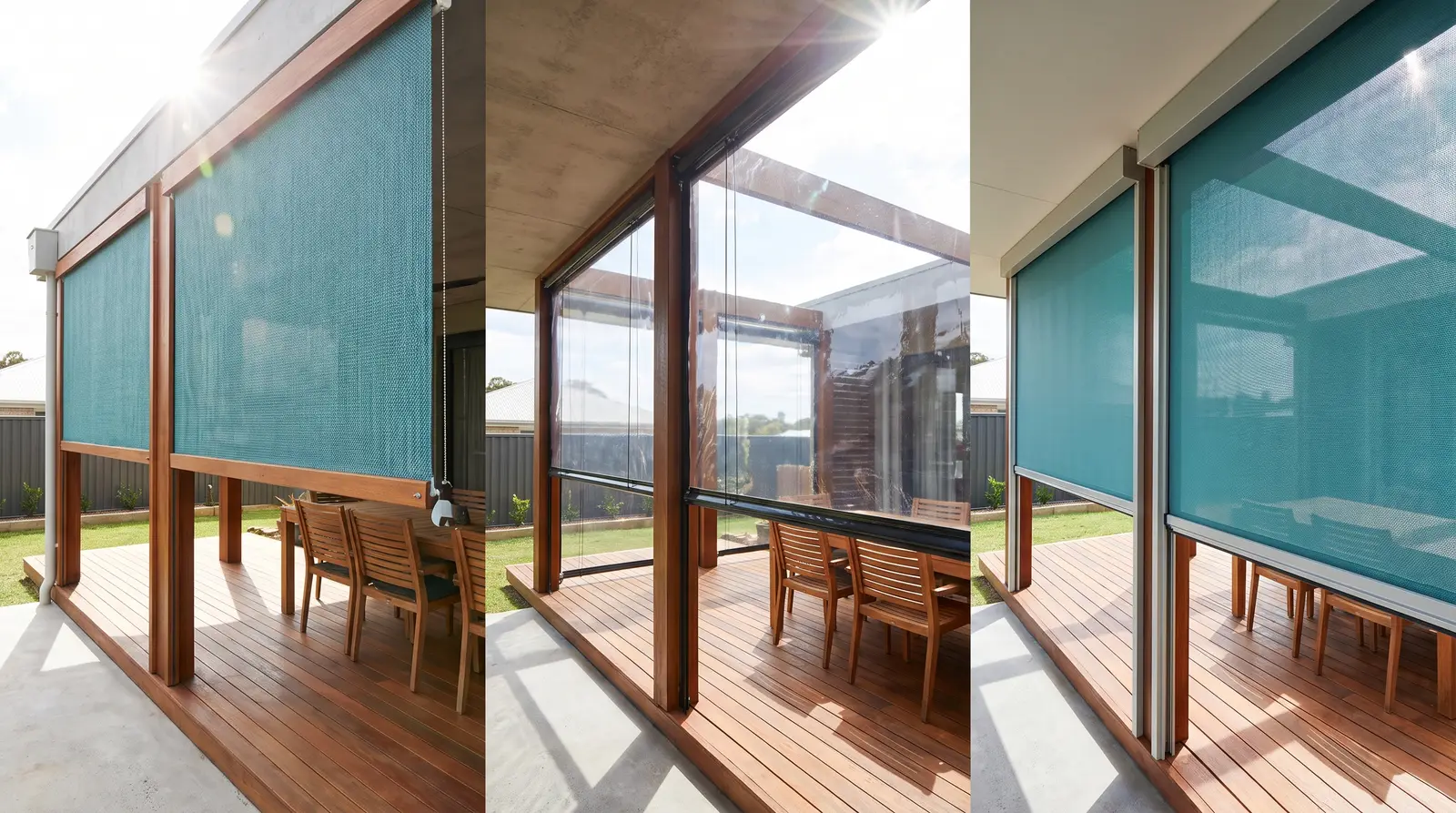
The best restaurant outdoor blinds for a verandah are the ones matched to each elevation individually: sealed track-guided panels where wind and rain arrive, tinted or mesh where the afternoon sun does, and clear PVC where diners need the view. Specifying one product across the whole run is the mistake that makes a verandah unusable.
Key takeaways
- Specify per elevation, not per building. A verandah rarely faces one way.
- Long verandah runs need splitting into 3m to 4m bays with structural uprights.
- A sealed enclosure is what makes gas or electric heating economic in winter.
- Budget $450 to $900 per bay strapped, $900 to $2,000 sealed, $3,500 to $9,000 for a full run.
Start with what a verandah actually has to do
A verandah is not a footpath dining area. It is roofed, it is usually on private land, it often runs the full length of the building, and it is frequently the highest-margin seating in the venue because it is the seating people ask for. The blinds are not there to make it a temporary shelter. They are there to make it a room that trades 12 months a year.
That changes the brief in 3 ways. The enclosure has to seal well enough for heating to work. It has to look considered from the street, because the verandah is the venue's shopfront. And it has to survive a commercial duty cycle without the operator thinking about it. If your dining area is on a public footpath rather than a verandah, the requirements are different and are covered in cafe blinds for hospitality.
Specify each elevation separately
Walk the verandah and note which way each bay faces. Then apply this:
| Elevation | What arrives | Specification |
|---|---|---|
| West | Low afternoon glare, extreme heat from 3pm | Mesh top with a clear vision strip, or mid grey tinted PVC |
| North | High summer sun, useful winter sun | Light grey tinted PVC, sealed system |
| East | Morning sun, mild conditions | Clear PVC, strapped is acceptable if sheltered |
| South | Cold, wind, driving winter rain | Clear PVC on a sealed track-guided system |
A typical Adelaide corner venue ends up with 2 or 3 different specifications across one verandah, and that is correct. The material trade-offs are covered in detail in tinted vs clear PVC blinds.
Adelaide's climate makes the western elevation the one to get right. Summer means a run of days in the high 30s and low 40s, and the Bureau of Meteorology's Adelaide records also show gusts above 60km/h in every month of the year. A full clear PVC panel on a west-facing bay will cook a table of 4 by 4pm and no amount of tint alone fixes it.
Span: split the run before the installer does
A long verandah is not one blind. Practical single-panel limits are about 4m to 5m wide for a track-guided blind and about 5m for a strapped cafe blind before the middle bows. A 12m verandah therefore becomes 3 or 4 bays with structural uprights between them.
That is a design decision, not just an engineering one. Where the uprights land determines where the tables go, whether the pass-through from the door works, and where the sightlines from the street break. Sort it on a plan before quoting. Retrofitting a post into the middle of a 6-top is expensive and annoying.
Where a bay has to stay clear of a post (an entry, a service path), a wider single panel in a heavier profile with a motorised roller is the usual answer, at $1,600 to $3,200 for that bay.
The fabric decisions that affect the dining room feel
Clarity sells tables. A grimy or hazed panel makes an otherwise good room look neglected from the street. Specify 0.8mm marine-grade PVC minimum, and extruded polished sheet rather than pressed calendered if the budget allows, because the optical clarity difference is visible from 3m away. Care method matters just as much: warm water, pH-neutral detergent and a soft microfibre cloth only, because ammonia glass cleaner and metho permanently haze clear vinyl.
Mesh hides your room. Acrylic-coated mesh is cheaper and cooler, but a passer-by cannot see a full, warm room behind it. On a frontage bay that is a marketing cost, not a saving. Use mesh on side and rear elevations, clear on the street face.
Colour the hardware, not just the fabric. Powder-coated tracks, headboxes and bottom bars matched to the building trim are a small percentage of the job and they are the difference between "enclosed" and "fitted out".
Branding at manufacture. Printed logos, street numbers or a base band in venue colours cost very little added at the welding stage and a lot afterwards.
Sealing, heating and winter trade
The commercial argument for a sealed system is heating economics. An open or strapped verandah with 10mm to 40mm gaps at every panel edge bleeds heat continuously, and radiant heaters end up warming the street. A sealed track-guided enclosure holds the heat, so 2 heaters do the work of 5 and a July evening at 9C trades as normal covers.
The sealing detail matters more than the brand: head flashing or a headbox so water does not track back along the beam, a weighted bottom bar with a rubber seal, and a plan for the uneven verandah floor. Those junctions are where verandah enclosures actually leak, and they are explained in how track-guided blinds seal against wind and rain.
Enclosing also cuts street noise noticeably, which on a busy road is worth as much to the diner as the temperature.
A note on approvals
Verandah blinds on private land are usually a simpler proposition than a footpath enclosure, but enclosing a dining area can still touch on building, fire egress or licensed-area questions, particularly if you are closing a space in permanently rather than fitting retractable blinds. Requirements differ by council. Confirm your position with your own council (the City of Adelaide if you trade in the CBD) and check the SA Planning Portal for whether development approval applies. Do that before you commit to a specification, not after.
Budget tiers for a verandah run
- Entry, sheltered bays only: strapped cafe blinds at $450 to $900 per bay. A 4-bay verandah lands around $1,800 to $3,600.
- Standard, mixed specification: sealed track-guided on the exposed bays, strapped on the protected ones. A 4-bay verandah typically $2,500 to $5,500.
- Full sealed enclosure: track-guided across the run at $900 to $2,000 per bay, or $3,500 to $9,000 for a full 3 to 4 bay enclosure.
- Motorised: add roughly $700 to $1,200 per bay. Worth it on frontage bays and anything over 4m.
- Ongoing: repairs to a track, strap or PVC panel run $120 to $600, and a repanel at 7 to 10 years costs far less than a new system.
Ask every quote to name the edge system, the PVC gauge in millimetres, the bay widths, the hardware finish, the lead time and the warranty terms on fabric and hardware separately. Commercial fabric is commonly a 3 to 5 week make, so quote in autumn if you want the verandah sealed for winter.
If you are choosing between a strapped and a sealed system, the cafe blind vs track-guided selector resolves it in 5 questions.
When you have your bays mapped, request a free quote. We pass your enquiry to a local Adelaide installer who does venue verandahs. Ask to see similar jobs, and ask them to price each bay on its own elevation.