Cafe blinds, clear PVC and track-guided
A Guide to Cafe Blinds for Adelaide Homes and Venues
5 min read
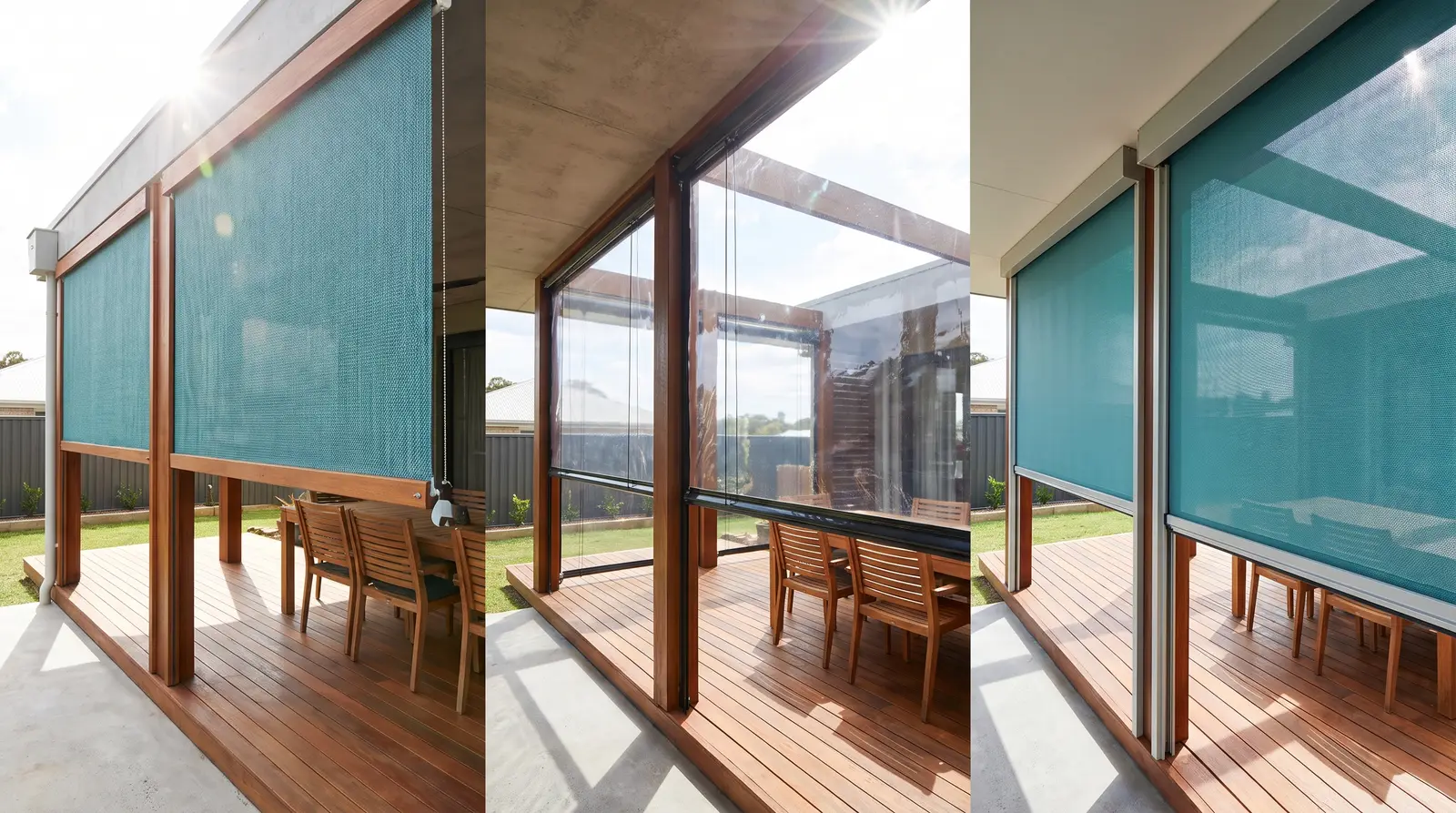
Cafe blinds are roll-down outdoor blinds made from a welded PVC or mesh panel that is fastened at the base and sides with straps, eyelets or turn buttons. This cafe blinds guide covers how they work, what they cost in Adelaide ($450 to $900 per opening), where they belong and where they do not.
Key takeaways
- Cafe blinds are the fastest and cheapest way to close a sheltered opening.
- The straps hold only at the fixing points, so edge gaps of 10mm to 40mm are normal.
- Specify 0.7mm or 0.8mm marine-grade PVC. Under 0.6mm creases permanently.
- On exposed western and Hills openings, a track-guided system is the better spend.
How a cafe blind is built
The panel starts as a roll of clear PVC, tinted PVC or acrylic-coated mesh. Sections are high-frequency welded together, then hemmed on all 4 edges with a reinforcing band. Brass or stainless eyelets are punched through the hem at regular spacing, usually every 300mm to 500mm.
At the top the panel either hangs from a fixed rail, sits on a spring roller, or runs on a rope-and-pulley. Rope-and-pulley is the classic cafe fit-out: 2 ropes run through the eyelets and over pulleys at the head, so the blind concertinas up when you haul the rope and drops flat when you release it. Spring rollers roll the panel around a tube and give a tidier stowed appearance.
At the bottom, a webbing strap with a buckle, a turn button screwed into the post, or a bungee hook pulls the panel taut. That is the entire mechanism, which is exactly why it is cheap, easy to repair and easy to live with. Full detail on the material itself is in clear PVC blinds: pros, cons and care.
Choosing the material and gauge
The gauge decides how long the blind stays looking new:
- 0.5mm to 0.6mm. Entry-level. Light and cheap. Creases at every fold and the crease never comes out. Only worth it on small openings under about 2m that are stowed rarely.
- 0.7mm to 0.8mm. The Adelaide standard. Marine-grade, UV-stabilised, holds its shape through a 42C day and does not go brittle in a July cold snap. Expect 7 to 10 years of good clarity.
- 1.0mm and above. Premium and very clear, mostly used on wide venue frontages. Heavy enough that the head fixings and any spring have to be specified for the weight.
Mesh sits alongside PVC as an option. Acrylic-coated mesh at around 95% block cuts sun and most wind, sheds light rain, and stays far cooler under a west-facing verandah than clear vinyl does. Many Adelaide homes end up with mesh on the western opening and clear PVC where the view matters. If glare is your main issue, a light grey tint costs nothing extra to specify and takes the edge off low afternoon sun.
Spans, drops and honest limits
- Width: up to about 5m works. Past that the middle of the panel bows badly in wind no matter how tightly you strap it.
- Drop: 2.4m to 3m is normal. Longer drops add weight and make daily rolling a 2-person job.
- Edge gap: plan for 10mm to 40mm at each side. Cafe blinds are a wind and rain reducer, not a seal.
- Wind: above roughly 40km/h gusts the panel flexes hard and the eyelets take the load. Repeated gusting is what eventually tears a hem.
Those limits are not a flaw, they are the design. A cafe blind that is asked to behave like a sealed enclosure will fail early and the owner will blame the product.
Where cafe blinds suit an Adelaide property
They work well on courtyards that are already boxed in on 2 or 3 sides, which describes a lot of Prospect, Unley and Norwood rear yards, and our courtyard blind ideas go through the layouts that keep a compact space feeling open. They work on suburban verandahs at Marion, Mitcham and Morphett Vale where the job is blocking afternoon sun and drizzle rather than sealing out a gale. They work on venue frontages that come down each evening and roll up each morning.
They are the wrong call on exposed sites. Hills decks around Stirling and Aldgate cop funnelled gully wind, and coastal frontages at Glenelg, Henley Beach and West Lakes get a strong sea breeze most summer afternoons plus airborne salt that accelerates corrosion on cheap fixings. The Bureau of Meteorology's Adelaide records confirm gusts above 60km/h occur in every month. On those sites the money is better spent on a guided system, as compared in cafe blinds vs clear PVC vs track-guided.
What cafe blinds cost in Adelaide
Indicative supplied-and-installed bands:
- Cafe blind, clear or tinted PVC, per opening: $450 to $900
- Alfresco mesh or shade blind, per opening: $350 to $750
- Repair to a track, strap or PVC panel: $120 to $600
A 2.5m sheltered opening in 0.7mm clear PVC with rope-and-pulley sits near the bottom of the band. A 4.5m opening in 1.0mm clear with a powder-coated headbox and colour-matched hardware sits near the top. Fixing into brick or rendered masonry costs more than fixing into timber posts.
Be careful with quotes priced per square metre with no gauge stated. Ask for gauge in millimetres, eyelet spacing, hem reinforcement, and whether the fixings are stainless. Stainless matters within a few kilometres of the coast.
Living with them: the practical bits
Roll them up dry. PVC stored damp for weeks develops mould spots along the fold lines that will not fully clean out. Never fold clear PVC across itself in cold weather, roll it. Clean with warm water and a soft cloth only. Ammonia-based glass cleaners, methylated spirits and abrasive pads all attack the plasticiser and turn a clear panel milky within a season.
Check the eyelets and hem stitching each spring. A single pulled eyelet caught early is a $120 repair. Left alone through a windy October it becomes a torn panel and a full replacement. Keep your invoice and written warranty terms: under Australian Consumer Law, goods must be of acceptable quality and last a reasonable time, and fabric and hardware are usually warranted separately. And do not leave a cafe blind half-down in a wind warning: a partly-rolled panel behaves like a sail.
Cafe blinds for a venue
Hospitality use changes the calculation, because a venue blind is opened and closed daily by staff, is on public display, and often sits over a council-permitted footpath area. Those requirements are covered separately in cafe blinds for hospitality, including why venue frontages usually justify heavier gauge and better hardware than a home patio.
If a cafe blind is the right fit, see what is involved on the cafe blinds service page. If you are still deciding between strapped and guided, the selector tool resolves it in 5 questions. When you want real numbers, we pass your enquiry to a local Adelaide installer who measures on site.