Cafe blinds, clear PVC and track-guided
Track-Guided Outdoor Blinds Explained: How the System Works
6 min read
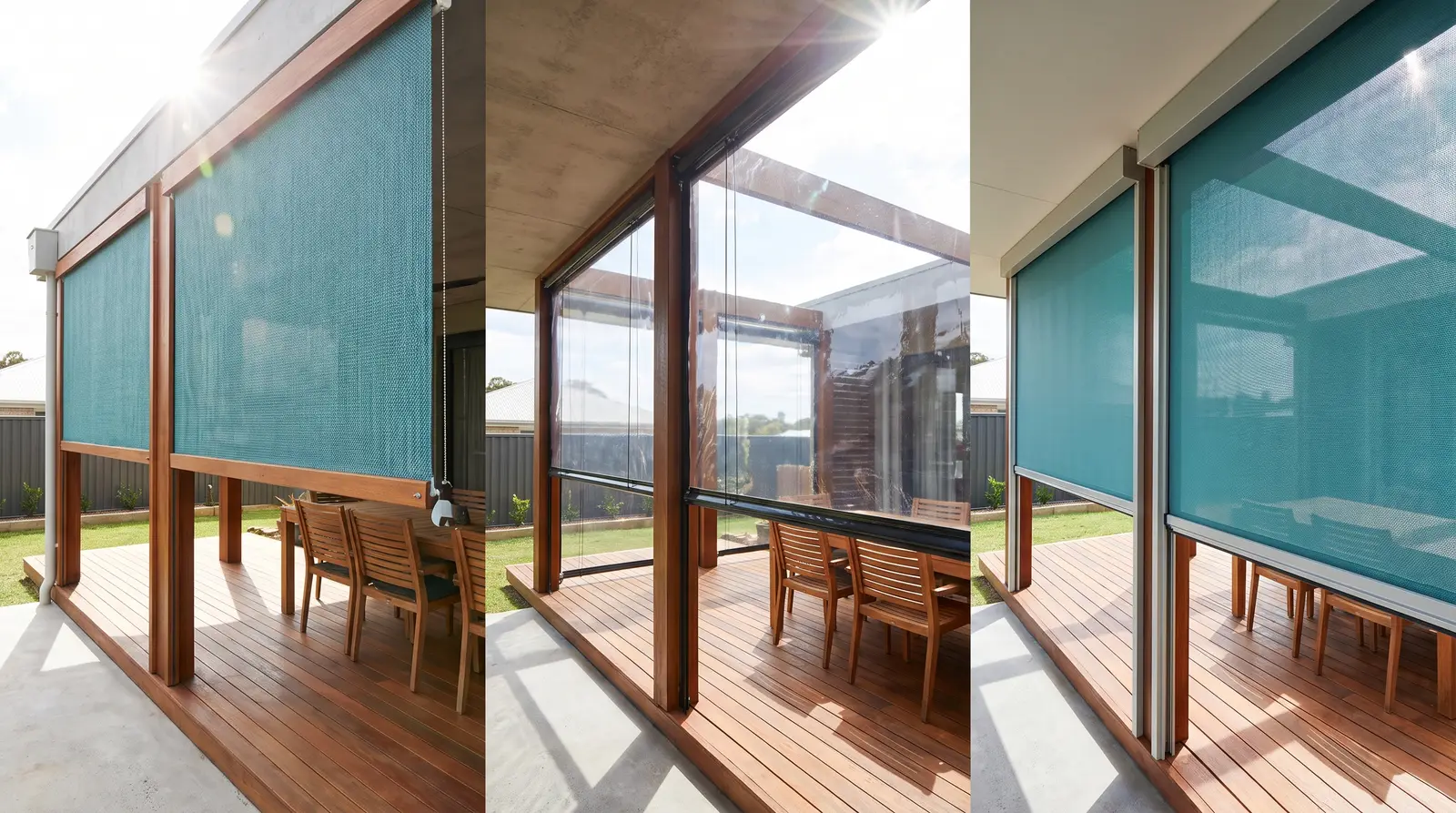
Track-guided outdoor blinds are outdoor blinds whose vertical edges run captive inside aluminium side tracks, so the panel cannot lift, flap or blow out. That single mechanical difference is what turns an open patio into a sealed, usable room, and it is why the system costs more than a strapped cafe blind.
Key takeaways
- The panel edge carries a welded spline that slides inside a channel in the side track.
- A spring balance holds the blind at any height, so it stops halfway with one hand.
- Adelaide pricing runs $900 to $2,000 per opening manual, $1,600 to $3,200 motorised.
- Practical single-panel span is about 4m to 5m wide before a centre post or a split is needed.
The 4 parts that make it work
The spline-welded edge. Both vertical edges of the panel are high-frequency welded to a continuous polyester or PVC bead, often called a keder or a spline. It looks like a thin rope sewn into a hem. That bead is thicker than the slot it runs through, so the fabric physically cannot pull out sideways.
The side tracks. Extruded aluminium channels are fixed to the posts, jambs or wall returns. Inside, a narrow slot lets the fabric pass while the bead stays trapped in the wider cavity behind it. Good tracks include a brush or fin seal at the slot to keep grit out and to close the last few millimetres of light gap.
The spring-balanced roller. A torsion spring inside the top roller counterbalances the weight of the panel and the bottom bar. Balanced correctly, the blind stays exactly where you leave it. This is why a track-guided blind has infinite stop positions and a cafe blind does not.
The bottom bar. A weighted aluminium extrusion, usually with a rubber or brush seal on the underside, and a centre handle. It is the part you touch, and on a well-set-up blind it moves the full drop with 2 fingers.
Several manufacturers build to this pattern, including Ziptrak-brand track-guided systems, along with a number of other Australian and imported track profiles. We are independent of all of them: we pass your enquiry to a local Adelaide installer and let them quote the profile that suits your opening.
What it does that a strapped blind cannot
Because the edge is captive, wind load transfers into the track and then into the structure rather than into eyelets and webbing. A strapped panel resists gusts only at its fixing points, so the middle balloons, the fabric stretches permanently, and the eyelets eventually tear. A guided panel stays flat.
That matters more in Adelaide than in most Australian capitals. Summer changes arrive fast off the gulf, and Hills sites around Stirling, Crafers and Aldgate funnel wind through gullies at speeds that flatten patio furniture. The Bureau of Meteorology's Adelaide climate records show maximum gusts above 60km/h in every month of the year. The detail of how the seal is achieved is covered in how track-guided blinds seal against wind and rain.
The second advantage is operation. One hand, one movement, no straps to unclip. A blind that is genuinely easy to use gets used, and a blind that gets used is the one that pays for itself.
Spans, drops and where the limits sit
Practical numbers for Adelaide residential work:
- Single panel width: up to about 4m to 5m depending on the profile and the fabric weight. Beyond that, expect a centre post or a split into 2 blinds.
- Drop: commonly 2.4m to 3.2m. Longer drops are possible but the spring specification and bottom bar weight both have to increase.
- Out-of-square openings: tracks are straight. If posts are twisted or the head is not level, the installer packs and shims or the blind will bind. This is the single most common cause of a jam.
- Curved or raked ends: a raked (angled) head is achievable with a shaped headbox on some profiles, but it adds cost and reduces the seal at the acute corner.
Heavier clear PVC changes the maths. A 1.2mm panel across 4.5m is a lot of weight for a spring to balance, which is where motorisation earns its price rather than being a luxury.
Clear PVC, mesh or a combination
Track-guided blinds are commonly ordered in 3 fabrics:
- Clear PVC (0.8mm is the Adelaide standard). Full view, full weather block, passes solar heat. Best on south and east elevations and on any opening where the view is the point.
- Tinted PVC (grey or bronze). Cuts glare and some heat while keeping the sightline. Covered in tinted vs clear PVC blinds.
- Acrylic-coated mesh. Blocks sun and most wind, sheds light rain, but breathes. Cheaper and cooler, not a full seal.
A very common Adelaide specification is a combination panel: mesh for the top two-thirds to cut the western sun, with a clear PVC vision strip at seated eye height. It costs a little more to weld but it handles a Glenelg or West Lakes afternoon far better than full clear.
What it costs in Adelaide
Indicative supplied-and-installed bands:
- Track-guided clear PVC blind, per opening: $900 to $2,000
- Motorised track-guided blind, per opening: $1,600 to $3,200
- Full alfresco enclosure across 3 to 4 openings: $3,500 to $9,000
The variables that move the number are span, fabric gauge, whether a headbox is fitted, powder-coat colour matching, and whether the installer has to build a structural upright to land a track on. A 2.5m opening with clean square posts sits near the bottom of the band. A 4.5m opening with a raked head and 1.2mm clear sits near the top.
For a full breakdown of the sub-$1,000 decisions, see the pricing side of the category on the track-guided outdoor blinds service page, or work through the cafe blind vs track-guided selector if you are still weighing it against a strapped system.
What actually fails, and when
Track-guided systems are durable, but they are not maintenance-free:
- Grit in the track. The most common fault. Dust, leaf litter and coastal salt build up in the channel and the blind starts to drag, then judder, then stop. A vacuum and a dry silicone spray twice a year prevents almost all of it.
- Spring fatigue. After 8 to 12 years the spring loses tension and the blind creeps down. It is a re-tension or a spring replacement, not a new blind.
- Spline pull-out. Rare, and almost always the result of somebody forcing a jammed blind rather than clearing the track.
- PVC crazing and yellowing. A material issue, not a system issue. Marine-grade 0.8mm gives 7 to 10 years in Adelaide sun before clarity noticeably drops.
- Bottom bar seal wear. The rubber seal perishes before anything else. It is a cheap part.
Repair costs typically land at $120 to $600, which is a fraction of replacement. Under Australian Consumer Law, goods must be of acceptable quality and last a reasonable time, so keep your invoice and your written warranty terms.
Is it the right system for you?
Go track-guided if the opening is exposed, if you want the space usable in winter, if the blind will move most days, or if the span is over about 3m. Stay with a strapped cafe blind if the courtyard is already sheltered on 2 sides and the blind is a summer sun and privacy measure. If you are comparing the 2 head to head, cafe blinds vs clear PVC vs track-guided sets them out in a single table.
When you are ready for numbers on your own openings, we pass your enquiry to a local Adelaide installer who measures on site: get a free quote.