Cafe blinds, clear PVC and track-guided
Zipped vs Strapped Outdoor Blinds: The Real Difference
5 min read
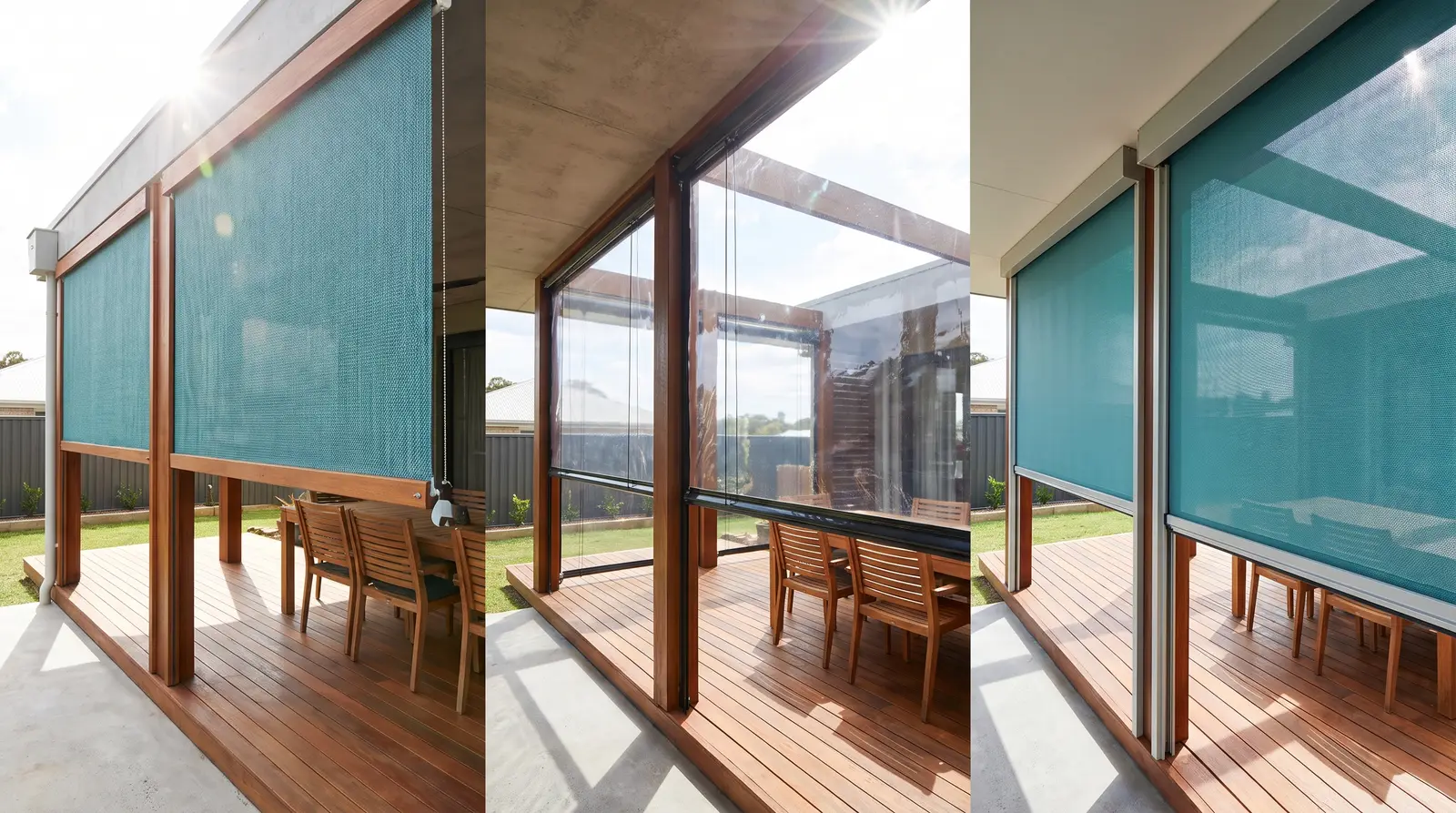
The zip vs strap blinds question is really about how the vertical edge of the panel is restrained. Straps fasten at points and leave gaps. Zips run the full drop in a channel and seal. Track-guided systems achieve the same seal with a welded spline instead of a zip, and have fewer parts to wear out.
Key takeaways
- Strapped edges are cheapest and leave 10mm to 40mm of gap per side.
- Zipped edges seal well but the zip is a wearing part that can derail or shed teeth.
- Track-guided splines seal equally well with no teeth to fail, which is why they dominate in Adelaide.
- Strapped $450 to $900 per opening, zipped and guided $900 to $2,000.
Strapped: how it works and where it fails
A strapped blind (the classic cafe blind) hangs from a rail or roller and is fastened at the base and sides with webbing straps and buckles, eyelets over turn buttons, or bungee hooks. Tension is applied only where you fasten.
That gives you a blind that is cheap, simple, repairable by anyone and easy to understand. It also gives you edge gaps, a panel that bows in the middle on wide spans, and eyelets that carry all the wind load. The classic failure is a pulled eyelet or a torn hem after a run of gusty spring days, usually because the blind was left half-down in wind.
Strapped blinds suit sheltered courtyards and verandahs: Prospect and Unley rear yards boxed in by neighbouring walls, suburban verandahs at Marion or Mitcham where the job is sun and drizzle rather than a seal.
Zipped: how it works and where it fails
A zipped blind welds one half of a heavy-duty zip to each vertical edge of the panel. The mating half sits inside a side channel. As the blind drops, the zip engages progressively down the channel, so the edge is closed continuously rather than at points.
The seal is genuinely good. Wind load transfers into the channel, the panel stays flat, and the light gap effectively disappears. Zipped systems are widely used on commercial screens and on some residential outdoor blinds.
The weakness is that a zip is a mechanical wearing item with hundreds of individual teeth. Grit in the channel, a slightly out-of-plumb track or a forced operation can pop the zip out of engagement. Once a zip derails or sheds teeth mid-run, the repair means unpicking and replacing the zip along the full edge, which is a fabric-shop job rather than an on-site fix. On coastal Adelaide sites at Glenelg, Henley Beach and West Lakes, salt crystals in the channel accelerate that wear.
Track-guided: the spline alternative
A track-guided outdoor blind achieves the same continuous edge restraint with a completely different part. Instead of a zip, a plain continuous bead (a spline or keder) is welded into the panel edge and runs inside a channel too narrow for it to escape.
There are no teeth, no engagement mechanism and no parts that can mis-mesh. Debris in the track causes drag, not derailment, and drag is cleared with a vacuum and a dry silicone spray. That robustness is the main reason track-guided systems have become the default sealed outdoor blind in Adelaide residential work. The mechanics are covered in track-guided outdoor blinds explained and the sealing detail in how track-guided blinds seal against wind and rain.
Side by side
| Strapped | Zipped | Track-guided | |
|---|---|---|---|
| Edge restraint | Point fixings | Continuous zip in channel | Continuous spline in track |
| Edge gap | 10mm to 40mm per side | Effectively sealed | Effectively sealed |
| Stops midway | No | Usually yes | Yes, spring balanced |
| Operation time | 30 to 90 seconds | 5 seconds | 5 seconds |
| Wearing parts at the edge | Straps, eyelets, buckles | Zip teeth and slider | None at the edge |
| Common failure | Torn eyelet or hem | Zip derail or lost teeth | Grit drag, spring fatigue |
| Field repairability | High | Low, fabric-shop job | High |
| Adelaide price per opening | $450 to $900 | $900 to $2,000 | $900 to $2,000 |
Which to choose for an Adelaide opening
Choose strapped if the opening is sheltered on 2 or more sides, the span is under about 4m, the blind is a summer sun and privacy measure, and the budget is firm. A full 3-sided patio in strapped blinds lands around $1,400 to $2,700 against $2,700 to $6,000 guided.
Choose a sealed system (zipped or guided) if the opening is exposed, if you want the space usable in a July southerly with a heater running, if the blind moves most days, or if the span is over 3m. Adelaide's wind is the deciding factor more often than rain: the Bureau of Meteorology's Adelaide records show gusts above 60km/h in every month, and Hills sites at Stirling and Aldgate get funnelled gully wind on top of that.
Between zipped and guided, on price and seal they are close. Guided wins on serviceability and on coastal and dusty sites. Zipped is worth considering where a supplier's particular profile suits an awkward opening, or where the fabric is a fine mesh screen rather than heavy clear PVC. Ask any zipped quote what a zip replacement costs and how long the blind is off site.
Costs and what moves them
- Strapped cafe blind, per opening: $450 to $900
- Zipped or track-guided blind, per opening: $900 to $2,000
- Motorised track-guided blind, per opening: $1,600 to $3,200
- Full alfresco enclosure, 3 to 4 openings: $3,500 to $9,000
- Repair to a track, strap, zip or PVC panel: $120 to $600
Span, PVC gauge, headbox, colour matching and whether an upright has to be built are what move a quote within the band. Whichever edge system you pick, keep the invoice and the written warranty: under Australian Consumer Law, goods must be of acceptable quality and durable for a reasonable time. Ask for the edge system named explicitly. "Guided" in a quote can mean a spline track or a zip channel, and they are not the same product to own.
Mixing systems on one job
There is nothing wrong with a mixed specification, and it is often the smartest use of a budget. Put a sealed system on the exposed western and southern openings where wind and rain arrive, and strapped cafe blinds on the sheltered side. The saving funds better PVC gauge across the whole job.
If you want that decision made for you in 5 questions, use the cafe blind vs track-guided selector, or read the 3-way comparison in cafe blinds vs clear PVC vs track-guided.
Ready for real numbers? Request a free quote. We pass your enquiry to a local Adelaide installer. Ask them to price each opening on its exposure and name the edge system in writing.