Cafe blinds, clear PVC and track-guided
Folding Arm Awnings vs Outdoor Blinds: Which to Choose
6 min read
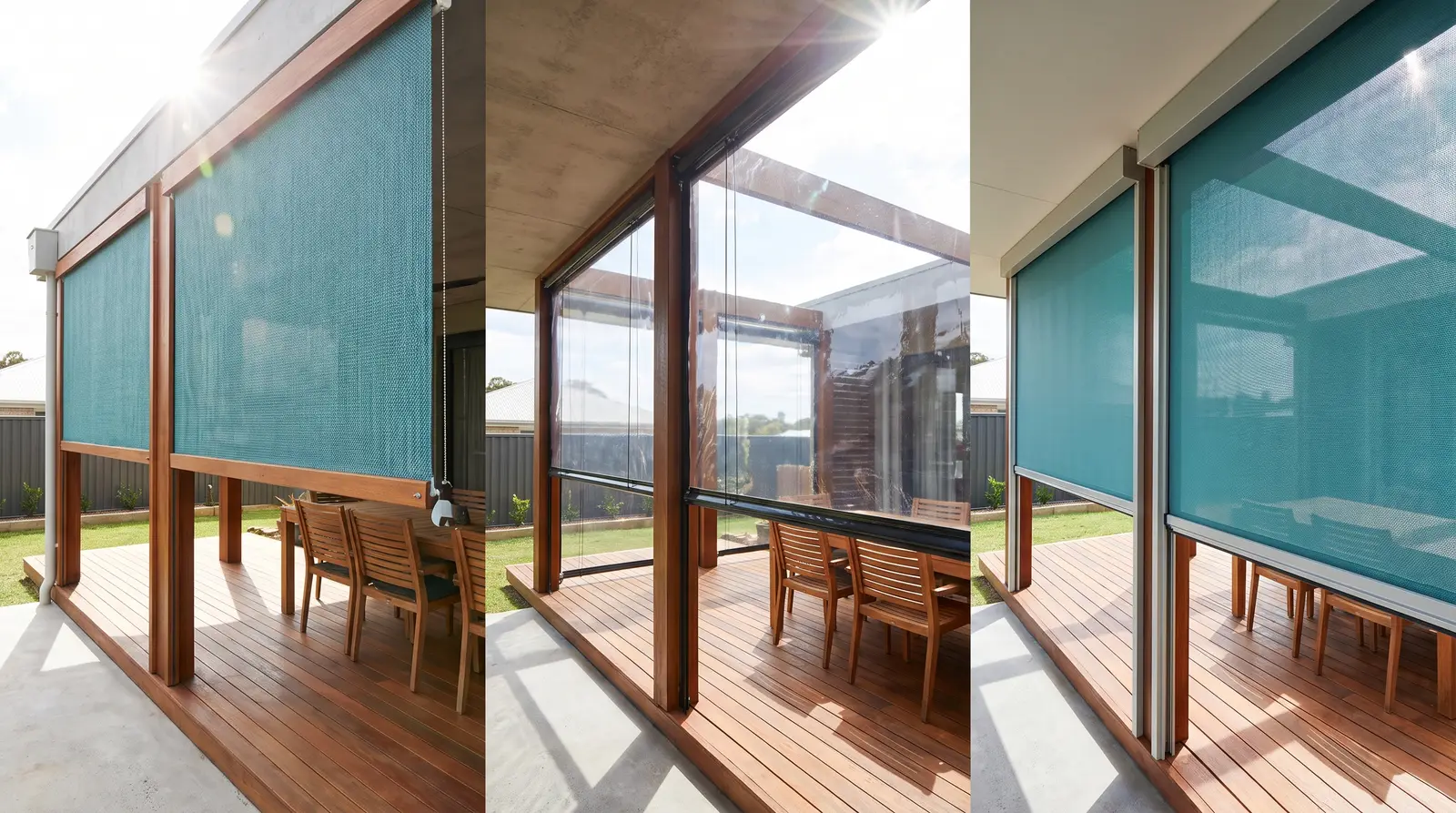
The folding arm awning vs blinds choice is a question of direction. A folding arm awning projects horizontally to create overhead shade where there is no roof. Outdoor blinds drop vertically to close the sides of a space that already has a roof. They solve different problems, and plenty of Adelaide homes need both.
Key takeaways
- Awnings make shade. Blinds make weather protection and enclosure.
- No unroofed deck can be enclosed by blinds alone. You need overhead cover first.
- Awnings must retract in wind. Track-guided blinds tolerate far more.
- Adelaide pricing: awnings $1,400 to $4,500, blinds $450 to $2,000 per opening.
What each product actually does
A folding arm awning is a fabric canopy on articulated arms that fold back against the wall. Extended, it projects out over a deck, courtyard or window, typically 2m to 4m. There are no posts, so the space underneath is completely clear. Retracted, it disappears into a cassette and the deck is open to the sky again.
Outdoor blinds hang vertically from a roof edge, pergola beam or verandah fascia and drop to the floor. Depending on the system they either strap down at the base (cafe blinds) or run in aluminium side tracks (track-guided blinds). They stop wind, rain and low sun. They do nothing about the sun coming from directly overhead.
That is the whole distinction. Overhead versus vertical. Most confusion between the 2 products comes from people describing the same symptom ("the deck is unusable") when the cause is different.
Choose by what is above the space
No roof over the space. You need a folding arm awning, a pergola, a shade sail or a solid roof. Blinds have nothing to hang from and would not help anyway, because the heat is arriving from above. This is the common case for a rear deck at Mitcham or a north-facing courtyard in Prospect.
A roof, but open sides. You need outdoor blinds. The overhead sun is already handled and the problem is wind, driving rain, low western glare and winter cold. This is the classic Adelaide alfresco under a colorbond patio roof.
A roof and you want a year-round room. You need sealed track-guided blinds, at $900 to $2,000 per opening, or $3,500 to $9,000 across a full 3 to 4 opening enclosure. The comparison between systems is in cafe blinds vs clear PVC vs track-guided.
An awning already, and you want the sides closed. Possible but limited. Some awnings accept a drop-down valance blind off the front bar, giving 1m to 2m of low-sun screening. That is glare control, not enclosure. A retractable structure cannot carry a proper track-guided system.
Side by side
| Folding arm awning | Outdoor blinds | |
|---|---|---|
| Shade direction | Overhead | Vertical, side |
| Blocks rain | Light rain only, and only underneath | Yes, fully on a sealed system |
| Blocks wind | No | Yes |
| Encloses a space | No | Yes, with a sealed system |
| Posts required | None | Existing posts or a beam to fix tracks to |
| Typical size | 2m to 4m projection, up to 6m wide | Up to about 5m per opening |
| Wind tolerance | Low. Retract in gusts | High on track-guided systems |
| Adelaide price | $1,400 to $4,500 supplied and installed | $450 to $900 strapped, $900 to $2,000 guided |
| Lifespan | 10 to 15 years for the frame | 10 to 15 years hardware, 7 to 10 years PVC |
Wind is the deciding constraint for awnings
A folding arm awning is a cantilever. Everything the fabric catches is transferred through the arms into the wall fixings, so wind is the limiting factor on the whole product. Manufacturers rate awnings to a wind class and expect retraction above a stated speed, commonly in the range of 30km/h to 50km/h depending on the model and projection.
Adelaide tests that constantly. The Bureau of Meteorology's Adelaide climate records show maximum gusts above 60km/h in every month, and a summer change can go from still to 50km/h in minutes. If nobody is home, an extended awning in a change is the single most common way these units are destroyed.
The practical answer is a wind sensor with automatic retraction. On a motorised awning it typically adds a few hundred dollars, and on an exposed Hills or coastal site it is not optional. Wall fixings matter too: awnings need solid brickwork, a reinforced timber blocking plate or a steel rafter bracket. Fixing a 4m projection into a rendered foam cladding is a warranty claim waiting to happen.
Track-guided blinds are a different proposition, because the load goes into a track and then into a post or wall in compression rather than into a cantilever. They still have a wind limit, but it is far higher, which is the point covered in how track-guided blinds seal against wind and rain.
Fabric and finish
Awning fabrics are solution-dyed acrylic or PVC-coated polyester. Solution-dyed acrylic holds colour far better under Adelaide UV, which matters when the fabric is facing the sky all day. Expect 10 years plus of colour retention on good acrylic against noticeable fade on cheaper dyed polyester within 4 to 5 summers.
Blind fabrics are clear PVC, tinted PVC or acrylic-coated mesh. The gauge and grade decide longevity: 0.8mm marine-grade PVC is the Adelaide standard, covered in clear PVC blinds: pros, cons and care.
Both benefit from the same care habits: operate dry, retract or roll dry, rinse regularly on coastal sites at Glenelg, Henley Beach and West Lakes where salt film builds up, and never use solvent or ammonia cleaners.
Cost, and how a combined budget usually plays out
- Folding arm awning, supplied and installed: $1,400 to $4,500
- Cafe blind, per opening: $450 to $900
- Track-guided blind, per opening: $900 to $2,000
- Motorised track-guided blind, per opening: $1,600 to $3,200
- Full alfresco enclosure across 3 to 4 openings: $3,500 to $9,000
- Repair to a track, strap, arm or PVC panel: $120 to $600
For an unroofed deck, an awning at $2,500 to $3,500 with a wind sensor gives you summer usability immediately. Adding drop blinds later means first adding a fixed roof, so if a year-round room is the end goal it is usually cheaper to build the roof first and fit blinds, rather than buy an awning and rebuild.
For a roofed alfresco already, skip the awning entirely and put the whole budget into the blinds. Where a roofed alfresco also traps heat, a roller shutter on the adjoining west-facing windows does more for indoor comfort than another metre of shade outside.
Under Australian Consumer Law, both products must be of acceptable quality and last a reasonable time. Get the wind rating, the fabric type and the warranty terms in writing for either.
Which is right for you
If the sun is coming from above and you want the space open again in winter, buy the awning. If the roof exists and the problem is wind, rain, glare or cold, buy the blinds. If you want an outdoor room you use in July, buy sealed track-guided blinds and stop considering awnings altogether.
Compare the vertical options with the cafe blind vs track-guided selector, then request a free quote. We pass your enquiry to a local Adelaide installer who quotes both awnings and blinds, so ask them which one your space actually needs.