The complete guide to outdoor blinds
Are Outdoor Blinds Worth It for an Adelaide Home?
6 min read
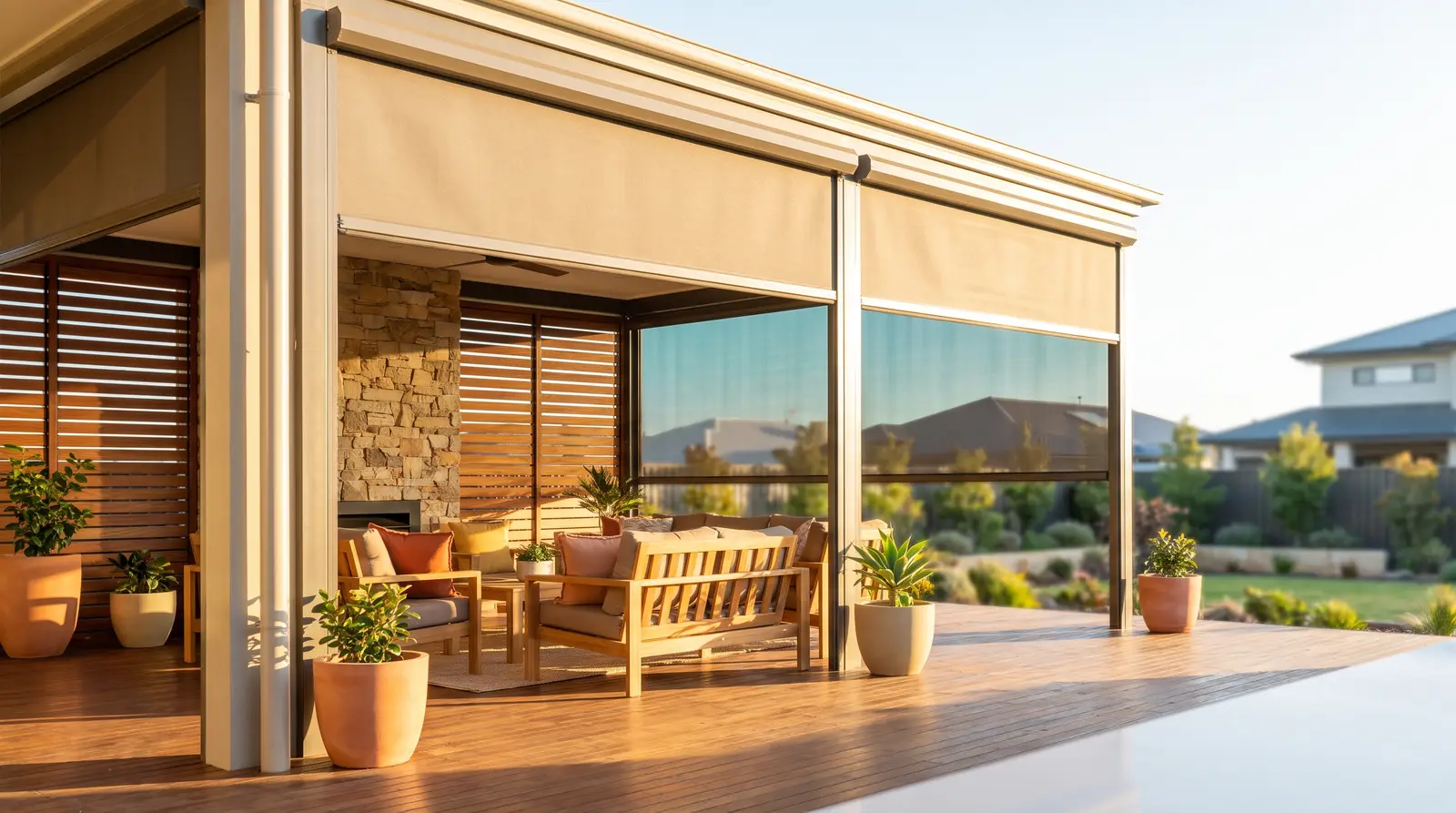
Outdoor blinds are worth it for an Adelaide home when the space they cover is one you would use more if the weather allowed, and they are not worth it when the space is decorative. A $3,500 to $9,000 alfresco enclosure buys back roughly 100 to 140 usable days a year in Adelaide's climate. A $500 mesh blind on a verandah nobody sits under buys nothing.
Key takeaways
- The honest return is usable days, not resale value or energy savings.
- Adelaide's shoulder seasons (April to May, September to October) are where sealed blinds pay for themselves.
- Mesh blinds on a west-facing wall genuinely cut indoor cooling load, and that saving is measurable.
- Skip outdoor blinds entirely if the area is under 6 square metres or already sheltered on 3 sides.
This post takes the sceptical position first and then makes the case, so you can judge your own situation. If you want the category overview, the Adelaide outdoor blinds buyer's guide covers systems and pricing, and our outdoor blinds page passes your enquiry to a local installer.
The case against: 3 situations where they are not worth it
Your alfresco is already sheltered on 3 sides. Plenty of Adelaide project homes from the last 15 years have a recessed alfresco tucked into the building footprint with brick on 2 or 3 sides. If only 1 face is open and it faces south or east, the space is already comfortable most of the year. A single blind on that opening is a $900 to $2,000 marginal improvement, and the honest answer is often that a decent outdoor heater at $400 delivers more comfort per dollar.
The area is small and you use it as a walkthrough. A 2 m by 3 m courtyard that connects the back door to the shed does not benefit from enclosure. You are paying $1,500 to make a corridor slightly warmer.
You are doing it purely for resale. Outdoor blinds do not return their cost at sale as a line item. They help a property present well and they help it sell faster, which is a real but indirect benefit. Do outdoor blinds add value sets out what the evidence actually supports rather than what agents claim.
The case for: usable days in the Adelaide climate
Here is the calculation that matters. Adelaide's climate is genuinely good for outdoor living, but it is punctuated in ways that make an unprotected alfresco unusable more often than people remember.
The Bureau of Meteorology's Adelaide climate averages show roughly 120 days a year with measurable rainfall, concentrated May through September, and summer maximums that push past 38 degrees on 15 to 20 days. Add wind: the afternoon sea breeze on the western suburbs and the gusty conditions on Hills properties knock out plenty of otherwise pleasant evenings.
An unprotected alfresco in Adelaide is comfortably usable maybe 130 to 160 days a year. Add mesh blinds on the sun-facing side and you recover most of the summer afternoons you were losing to heat and glare, worth roughly 30 to 40 days. Add a full sealed track-guided enclosure and you recover the wind-affected evenings and most of the wet-but-mild winter days, which is where the big number comes from.
The shoulder seasons are the real prize. April, May, September and October in Adelaide are frequently 18 to 24 degrees and pleasant, and are also frequently windy or showery. Those are the months a sealed enclosure converts from unusable to usable, and there are a lot of them.
The energy argument, honestly stated
Outdoor blinds are marketed as an energy saver. The truth is narrower than the marketing.
External shading on a west or north-facing glazed wall does genuinely reduce indoor cooling load, and it works better than internal blinds because it stops the solar radiation before it passes through the glass. Australian government guidance on passive cooling and external shading is clear that external shading of glass is one of the higher-impact interventions available.
So: if your alfresco sits in front of a large west-facing sliding door or window, a mesh blind on that opening reduces the heat load on your living room and shows up on the bill. That is a real effect.
If your alfresco is a freestanding pergola over the lawn with no glazing behind it, there is no energy saving, and the pergola roof comparison explains why the roof is the first spend in that situation. Anyone quoting you a payback period in that scenario is selling.
What it costs, and the break-even you should use
| Scope | Adelaide cost |
|---|---|
| 1 mesh blind on the sun-facing side | $350 to $750 |
| 2 strapped PVC cafe blinds | $900 to $1,800 |
| 1 track-guided PVC opening | $900 to $2,000 |
| Full enclosure, 3 to 4 openings | $3,500 to $9,000 |
Spread a $6,000 enclosure over a realistic 12 year life and it costs $500 a year. If it converts your alfresco from a summer-only space into a room you use most weekends of the year, that compares favourably to almost any other way of adding usable floor area to an Adelaide home. A built extension of the same 20 square metres runs well past $60,000.
That is the fairest framing: outdoor blinds are the cheapest square metres you will ever add to a house. They are not an investment, they are a lifestyle purchase with unusually good economics.
The cost of getting it wrong
The scenarios where owners regret the spend are consistent and avoidable.
Buying mesh when the goal was year-round use is the most common. The blinds go up in November, they are wonderful for a summer, and the first winter reveals that the space is still cold and wet. The owner then pays twice.
Buying strapped cafe blinds for an exposed position is the second. On a Stirling or Aldgate deck the strapping loosens, the panel flogs in the wind, and the blind that should have lasted a decade is unserviceable in 4 years.
Buying the cheapest quote is the third. The gap between a $900 and a $1,400 track-guided opening is usually tube diameter, bracket quality and fixing grade, and all 3 show up at year 6, not year 1. The 8 mistakes to avoid when buying outdoor blinds covers the rest.
Coastal and Hills homes: the value case is stronger
Two Adelaide contexts shift the calculation clearly in favour.
On the coast (Glenelg, Henley Beach, Semaphore, West Lakes) the afternoon sea breeze is reliable and strong through summer. A west-facing balcony or deck there is genuinely unusable from about 3pm on a typical January day without wind protection. Track-guided blinds convert that space, and the value is obvious to anyone who has tried to eat dinner on an unprotected Henley balcony in February.
In the Hills, the constraint is different. Wind and cold mean an exposed deck in Stirling or Crafers is a 4 month space at best. Sealing it with track-guided blinds turns it into a 10 month space, and the Hills winter is exactly when a covered outdoor room is most pleasant.
In both cases the specification matters more than in the suburbs, and cheap systems fail fast. Spend once.
The verdict
Outdoor blinds are worth it if you can honestly answer yes to 2 questions: would you use this space more if weather were not a factor, and is the space large enough (8 square metres or more) to be a destination rather than a walkway? If yes to both, the economics are strong and the main decision left is which system, which comes down to whether you need shade or a genuine seal.
If either answer is no, spend the money elsewhere. We would rather tell you that than pass on an enquiry for a job you will regret.
Ready to find out what your space would cost? Request a free quote and we'll pass your enquiry to a local Adelaide installer who measures on site.