The complete guide to outdoor blinds
Outdoor Blinds Adelaide: The Complete 2026 Buyer's Guide
7 min read
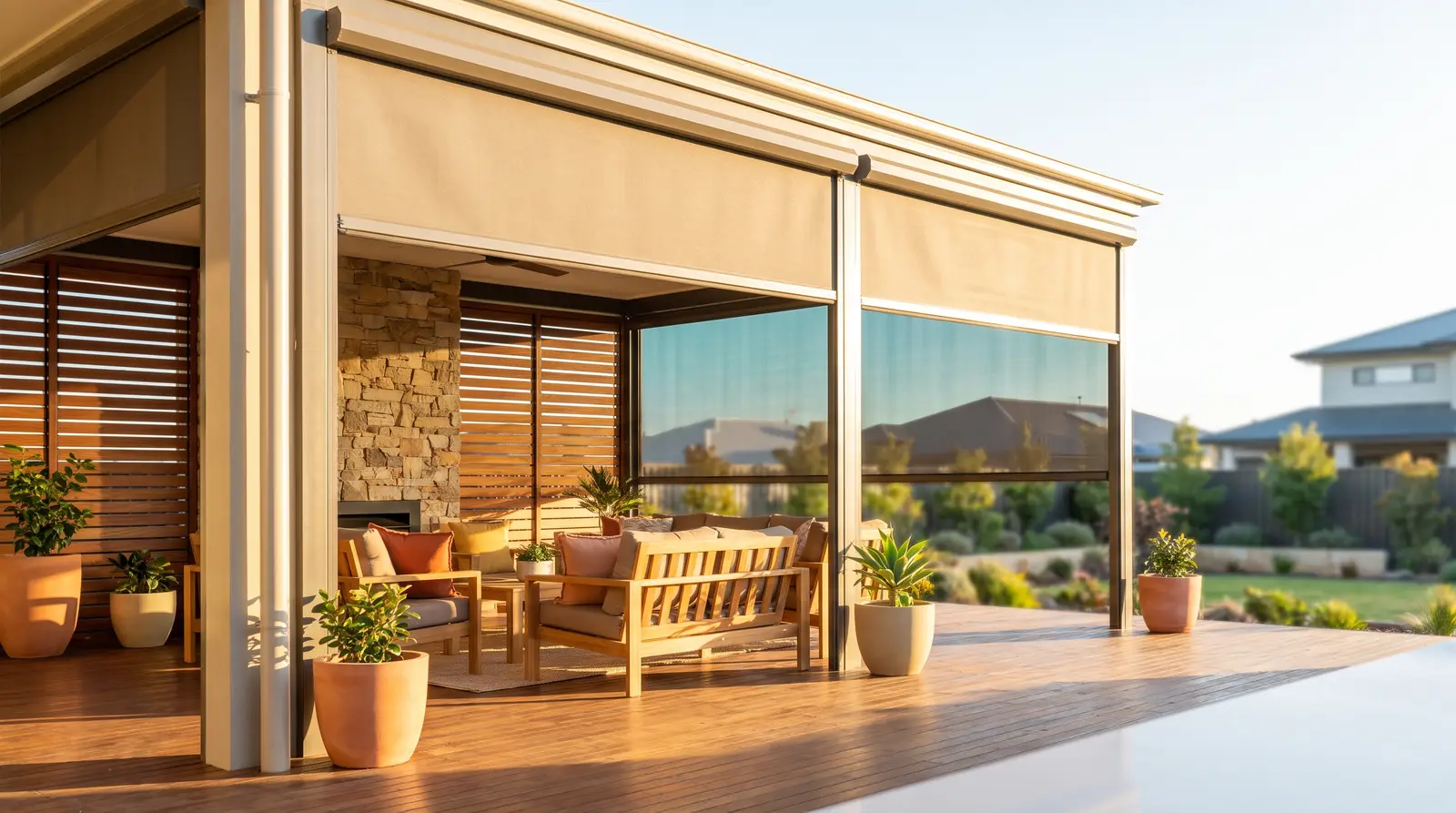
Outdoor blinds in Adelaide cost between $350 and $2,000 per opening supplied and installed, and the right choice comes down to 1 question: are you blocking sun and casual wind, or genuinely sealing the space against rain and a 60 km/h southerly? Mesh and strapped cafe blinds handle the first. Track-guided outdoor blinds handle the second, and they cost roughly double for the privilege.
Key takeaways
- Budget $350 to $750 per mesh opening, $450 to $900 per cafe blind opening, and $900 to $2,000 per track-guided clear PVC opening.
- A full alfresco enclosure across 3 to 4 openings lands at $3,500 to $9,000 in Adelaide.
- Adelaide's climate splits the decision: western coastal salt air, Hills wind exposure and 40-plus degree summer days each push a different specification.
- Span width, not fabric, is the single biggest driver of cost and of long-term reliability.
This guide covers the whole category so you can walk into a quote conversation knowing what you are being sold. When you are ready, our outdoor blinds page explains how we pass your enquiry to a local Adelaide installer for a free quote.
The 3 systems Adelaide installers actually sell
Almost every quote you receive will be one of 3 things, regardless of how it is branded.
Strapped cafe blinds are a flat panel of clear or tinted PVC, rolled down manually and tensioned at the bottom with straps, buckles or turn-buttons fixed to the deck or posts. They are the cheapest weather-capable option at $450 to $900 per opening. The trade-off is the gap: strapped blinds seal at fixed points, not continuously, so wind gets in at the sides and the panel drums in a gust.
Mesh or shade blinds use a knitted PVC-coated polyester with an open weave, typically 90 to 95 per cent block-out. They are the $350 to $750 option and they are genuinely excellent at what they do, which is killing western sun and glare while letting air through. They are not rain protection. A Morphett Vale or Marion family covering a west-facing verandah for summer afternoons is usually best served here and should not be upsold past it.
Track-guided outdoor blinds run the fabric edge inside a continuous side channel so the blind seals top to bottom with no strapping. This is the $900 to $2,000 per opening category, and it is the only one that reliably holds a space against driving rain and sustained wind. It is also the only one that stops the blind flogging itself to death in an exposed position. Our track-guided blinds page goes deeper on how the guided edge works.
For a full breakdown of the fabric and hardware differences, read types of outdoor blinds explained.
What outdoor blinds cost in Adelaide in 2026
These are the bands local Adelaide installers are quoting on standard residential work, supplied and installed.
| Product | Adelaide band per opening |
|---|---|
| Alfresco mesh / shade blind | $350 to $750 |
| Cafe blind (clear or tinted PVC) | $450 to $900 |
| Track-guided clear PVC blind | $900 to $2,000 |
| Motorised track-guided blind | $1,600 to $3,200 |
| Full alfresco enclosure (3 to 4 openings) | $3,500 to $9,000 |
| Folding arm awning | $1,400 to $4,500 |
The spread inside each band is almost entirely span width. A 2.4 m opening and a 4.8 m opening use the same motor, the same brackets and the same install labour, but the wider one needs a heavier tube to resist deflection, and above roughly 5 m most installers will insist on splitting the run with a centre post or a fixed mullion. That split is not an upsell. A 6 m single-span PVC blind sags in the middle within 2 summers and the bottom bar stops tracking cleanly.
Second driver: how the top fixes. A blind that mounts to an existing Colorbond verandah beam is straightforward. A blind that has to span between a heritage bullnose verandah in Unley and a rendered brick wall, or hang off a second-storey balcony slab in Glenelg, adds bracketry, engineering judgement and time. Expect $150 to $400 per opening in extra labour on awkward fixings.
How Adelaide's climate changes the specification
This is where generic advice fails. Adelaide is not one climate for outdoor blinds, it is 4.
The hot dry inland summer. Adelaide regularly runs consecutive days above 38 degrees, and the Bureau of Meteorology's Adelaide climate records show January mean maximums sitting near 29 degrees with extremes well past 44. That heat load matters twice: it dictates that a west-facing opening needs block-out mesh or a tinted PVC rather than fully clear, and it means UV degradation is the primary ageing mechanism on every component, not rain.
Salt air on the coast. Glenelg, Henley Beach, West Lakes and Semaphore sit in a marine corrosion zone. Standard mild-steel fixings and untreated aluminium hardware pit within 3 to 5 years there. Coastal installs need marine-grade stainless fasteners (316, not 304) and powder-coated or anodised componentry. If a quote for a beachside address does not mention fixing grade, that is a red flag worth raising before you sign.
Hills wind. Stirling, Aldgate, Crafers and the escarpment homes above Mitcham catch a very different wind profile to the plains, with gusty, direction-shifting winds channelled by the valleys. Strapped cafe blinds in those positions fail early, not because the fabric tears but because the strapping points work loose and the panel starts flogging. Track-guided is close to mandatory above roughly 300 m elevation on an exposed aspect.
The cold southerly and winter rain. Adelaide's winter is mild but wet and windy, and the value proposition of a sealed enclosure is entirely about the June to August months. A mesh blind gives you back summer evenings. Only a sealed track-guided system gives you back winter. That distinction is what separates a $2,000 project from a $7,000 one, and it is worth being honest with yourself about before you quote.
Motorised or manual
Manual is right for most residential openings. A well-balanced spring-assisted track-guided blind up to about 3.5 m wide operates with 1 hand and has almost nothing to fail. Motorisation adds $700 to $1,200 per opening and earns it in 3 situations: openings above roughly 4 m where the bottom bar is genuinely heavy, second-storey or hard-to-reach positions, and multi-blind runs where you want a single remote or a wind sensor dropping everything at once.
Wind sensors deserve a mention. They are a genuine risk-reduction feature on exposed sites, but they only work on motorised blinds and they need a power supply near the head box. Retrofitting power into a finished alfresco is the expensive part. Decide at quote stage, not later. Motorised vs manual outdoor blinds works through the numbers in detail.
How long they last and what fails first
A quality track-guided blind installed correctly in Adelaide gives 10 to 15 years. Cafe blinds give 7 to 12. Mesh gives 8 to 12 on fabric, longer on hardware.
Nothing fails uniformly. In order of what actually goes first: clear PVC clouds and yellows from UV (5 to 10 years, faster on a north or west aspect), then straps and buckles perish, then track channels collect grit and start binding, then spring tension weakens. Motors are usually the last thing to die, not the first, contrary to what people assume. How long outdoor blinds last breaks the timeline down by component.
The practical upshot: buy the hardware quality, not the fabric grade. Fabric is a consumable you will replace once in the life of the system. Tracks, brackets and tube are not.
Getting quotes that are actually comparable
The most common way Adelaide homeowners overpay is accepting 3 quotes that specify 3 different things and choosing on price. Before you compare, fix these variables in writing: fabric type and weight, whether the edge is guided or strapped, fixing grade (particularly coastal), span treatment above 4 m, warranty term split between fabric, hardware and workmanship, and whether the price includes removing an existing blind.
Under Australian Consumer Law your installer owes you statutory guarantees regardless of what the written warranty says, and the ACCC's guidance on consumer guarantees is worth 5 minutes of reading before any project over $3,000. Also worth knowing: most residential outdoor blinds fixed to an existing verandah do not require development approval in South Australia, but enclosing a structure can change its classification. The SA planning portal is the authority on that, not your installer.
Avoid the traps documented in common outdoor blind buying mistakes and you will already be ahead of most buyers.
Ready to price it properly? Request a free quote and we'll pass your enquiry to a local Adelaide installer who measures on site. Ask them to quote to the same specification.