The complete guide to outdoor blinds
How Long Do Outdoor Blinds Last in the Adelaide Climate?
7 min read
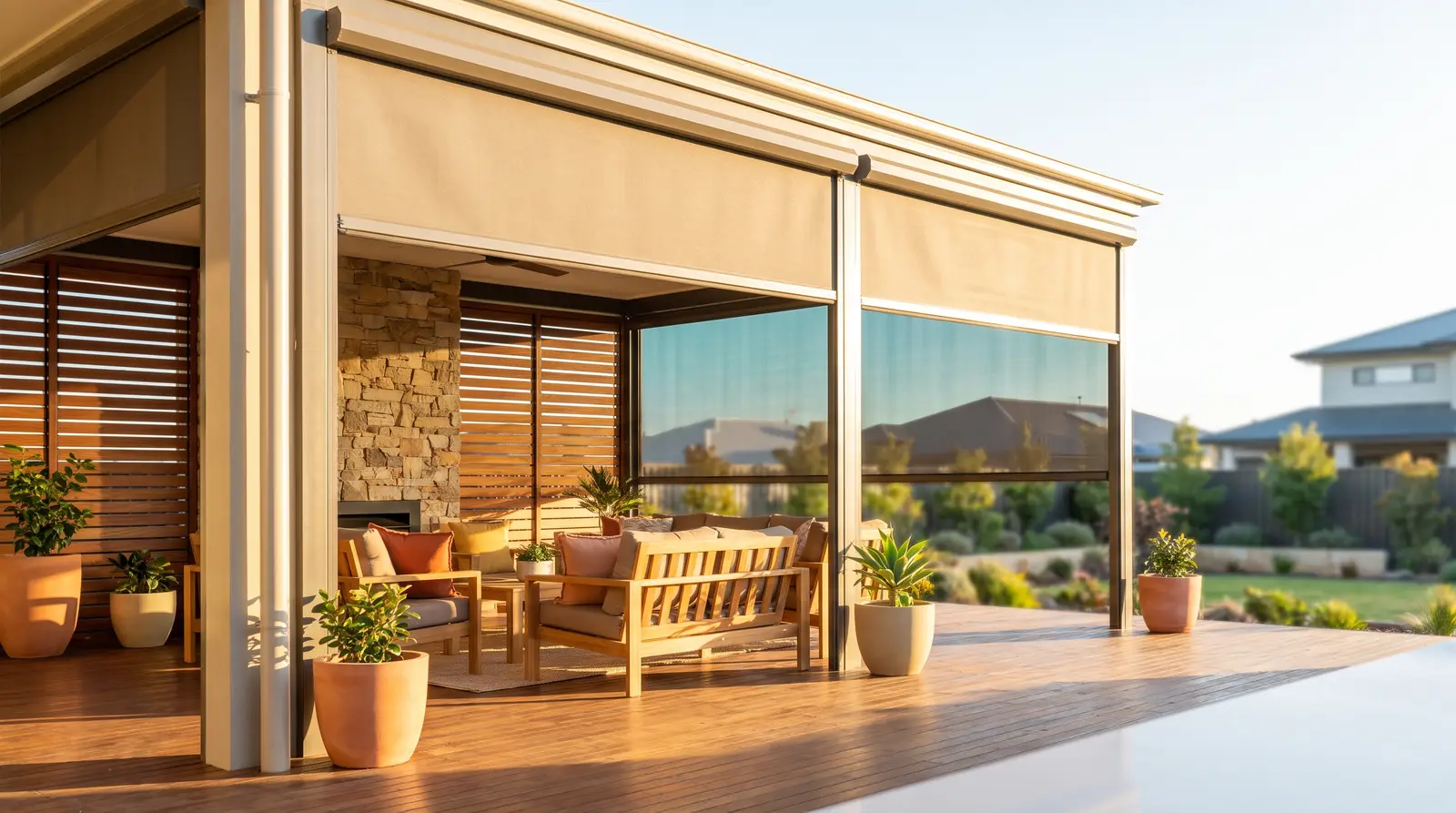
Outdoor blinds last 7 to 15 years in Adelaide: track-guided systems reach 10 to 15 years, cafe blinds 7 to 12, and mesh 8 to 12. The lifespan is set by UV exposure and aspect rather than by how often you use them, and the component that fails first is almost always the clear PVC, at 5 to 10 years, not the hardware.
Key takeaways
- Adelaide's UV load is the primary ageing mechanism. A north or west-facing blind ages 30 to 40 per cent faster than a south-facing one.
- Clear PVC clouds and yellows first, typically at 5 to 10 years. It is replaceable without replacing the system.
- Coastal salt air halves fixing life if standard rather than marine-grade stainless is used.
- Annual track clearing is the single highest-return maintenance action, and skipping it causes most premature failures.
Below is the realistic component-by-component timeline for Adelaide conditions. The complete outdoor blinds guide covers systems and pricing, and our outdoor blinds page passes your enquiry to a local installer.
The realistic lifespan by system
| System | Adelaide lifespan | First component to fail |
|---|---|---|
| Track-guided PVC | 10 to 15 years | Clear PVC panel, 5 to 10 years |
| Track-guided mesh | 12 to 15 years | Fabric, 10 to 12 years |
| Strapped cafe blind | 7 to 12 years | Straps and buckles, 3 to 6 years |
| Mesh / shade blind | 8 to 12 years | Fabric edge stitching, 6 to 9 years |
| Canvas drop blind | 5 to 9 years | Fabric fade and rot, 4 to 7 years |
Notice the pattern: the system lasts far longer than its first failing component. This is the most useful thing to understand about outdoor blind ownership. A track-guided system whose PVC has clouded at year 8 does not need replacing. It needs a new panel in the existing tracks, at roughly 40 to 50 per cent of the cost of a new blind. Owners who do not know this replace whole systems unnecessarily.
Buy hardware quality accordingly. Tracks, tube, brackets and spring or motor are the parts you keep for 15 years. Fabric is a consumable.
Why Adelaide's UV is the main driver
Adelaide receives high solar radiation, and the intensity through summer is what ages outdoor blind materials. The Bureau of Meteorology's UV index data routinely records extreme readings across December to February on the Adelaide plains. It works on 3 materials differently.
Clear PVC yellows and then clouds. The plasticisers that keep it flexible migrate out under UV, so the sheet gradually loses clarity and gains stiffness. On a south-facing opening in Norwood you might get 10 years of acceptable clarity. On a north-west facing opening in Mitcham taking full afternoon sun, 5 to 6 years is realistic. Nothing prevents it entirely, though keeping the blind rolled up when not in use meaningfully slows it, because a rolled blind exposes only the outer wrap.
Mesh and PVC-coated polyester hold up considerably better because the fabric is solution-dyed and the coating is UV-stabilised. Fade is the visible symptom rather than embrittlement, and lighter colours show fade less. Structural life on quality mesh in Adelaide runs 10 to 12 years before the coating starts to chalk.
Powder-coated aluminium is highly stable. Expect colour to hold well past 15 years on a quality coating. Where it fails is at drilled holes and cut ends where the coating is broken, particularly in coastal air.
The practical response is aspect-aware specification: put tinted or mesh on the western opening and save the clear PVC for the openings that need the view most. Best outdoor blind colours covers the reasoning in detail.
Salt air on the coast: the timeline halves
Homes within roughly 1 km of the water at Glenelg, Henley Beach, Grange, Semaphore, Brighton or West Lakes sit in a marine corrosion zone, and the reliable summer sea breeze deposits salt on every metal surface continuously.
With standard specification: zinc-plated fasteners show rust streaks at 2 to 3 years and lose structural integrity around 5 to 7. That is a serious problem, because the fastener is what holds a wind-loaded blind to the post.
With 316 marine-grade stainless fasteners and properly coated aluminium: 12 to 15 years without significant degradation, in line with an inland install.
The cost difference at quote stage is around 5 to 8 per cent of materials. The cost difference at year 6 is a full re-fix, or worse, a blind that pulls off a post in a gust. This is the highest-consequence specification decision on any Adelaide coastal install and it is frequently omitted from quotes.
Rinsing hardware with fresh water 3 or 4 times a year extends coastal life further and costs nothing.
Hills properties: debris, not decay
The Adelaide Hills present a different ageing profile. UV is comparable, salt is absent, but 2 factors shorten life.
Debris in tracks. Properties under eucalypts at Stirling, Aldgate, Crafers and Bridgewater collect leaf litter, bark and gum nuts in the side channels. A partially blocked track makes the blind bind, which forces the operator to pull harder, which racks the bottom bar and wears the fabric edge. This is the single most common Hills service call and it is entirely preventable with an annual clear-out.
Wind cycling. Gusty conditions load and unload the fabric repeatedly. On a track-guided system this is well tolerated because the edge is captive. On a strapped cafe blind it is the mechanism that destroys the blind, working the buckles loose and letting the panel flog. Strapped systems in exposed Hills positions routinely fail at 4 to 5 years against a 10 year expectation.
If you are in the Hills and considering strapped blinds to save money, this is the number to weigh: you may be buying a 5 year product at 55 per cent of the price of a 12 year one.
What actually goes wrong, in order
- Clear PVC clouds (5 to 10 years). Cosmetic first, then it stiffens and creases. Replaceable panel.
- Straps, buckles and turn-buttons perish (3 to 6 years). Cheap to replace, and neglecting them causes flogging damage.
- Tracks bind with grit (any time, unmaintained). Causes secondary damage to the fabric edge.
- Spring tension weakens (8 to 12 years). The blind stops holding position mid-height. Re-tensionable on most systems.
- Fabric edge or stitching fails (6 to 12 years). Often a consequence of 3 rather than an independent failure.
- Motor or receiver fails (10-plus years). Later than most people expect, and replaceable.
The order matters because it tells you what a mid-life service should address. At year 6, check straps, clear tracks and inspect fixings. At year 9, expect a PVC panel conversation. Nothing about this list requires replacing a whole system before year 12 if the hardware was good.
The maintenance that actually extends life
3 actions produce almost all of the available benefit.
Clear the tracks annually. A soft brush and a hose. 10 minutes per blind. Prevents the most common failure chain.
Wash PVC with mild soapy water, never solvents. Household cleaners, methylated spirits and anything abrasive strip the surface and accelerate clouding. Warm water and a small amount of dish soap on a soft cloth. Rinse thoroughly.
Roll blinds up when not in use, especially in summer. A rolled blind exposes a fraction of its surface to UV. Owners who leave clear PVC down all summer for privacy get 5 years of clarity. Owners who roll up get 9 or 10. Two exceptions: never roll a wet PVC blind up tightly and leave it for weeks, because trapped moisture promotes mould at the folds, and never leave blinds down in a wind warning, which is the leading cause of catastrophic rather than gradual failure.
Warranty and what it covers
Australian outdoor blind warranties typically split: 1 to 3 years on fabric, 2 to 5 on hardware, 3 to 7 on motors, and 1 to 2 on workmanship, which what an outdoor blind warranty actually covers breaks down component by component. Read the fabric term carefully, because clear PVC clouding is often specifically excluded as normal wear rather than covered as a defect. Separate to any written warranty, Australian Consumer Law provides statutory guarantees that goods be of acceptable quality and last a reasonable time, and the ACCC's guidance on consumer guarantees can apply well after a written warranty has expired.
Ask 1 question at quote stage that most buyers do not: will replacement fabric panels be available for this system in 8 years. A system built on a proprietary track profile from a supplier who may not be trading in a decade is one you replace entirely rather than refurbish. That trap is one of the buying mistakes worth knowing about.
Want a system specified to last in your particular position? Get a free quote and we'll pass your enquiry to a local Adelaide installer. Ask them to account for aspect, salt exposure and debris load.