The complete guide to outdoor blinds
8 Mistakes to Avoid When Buying Outdoor Blinds in Adelaide
7 min read
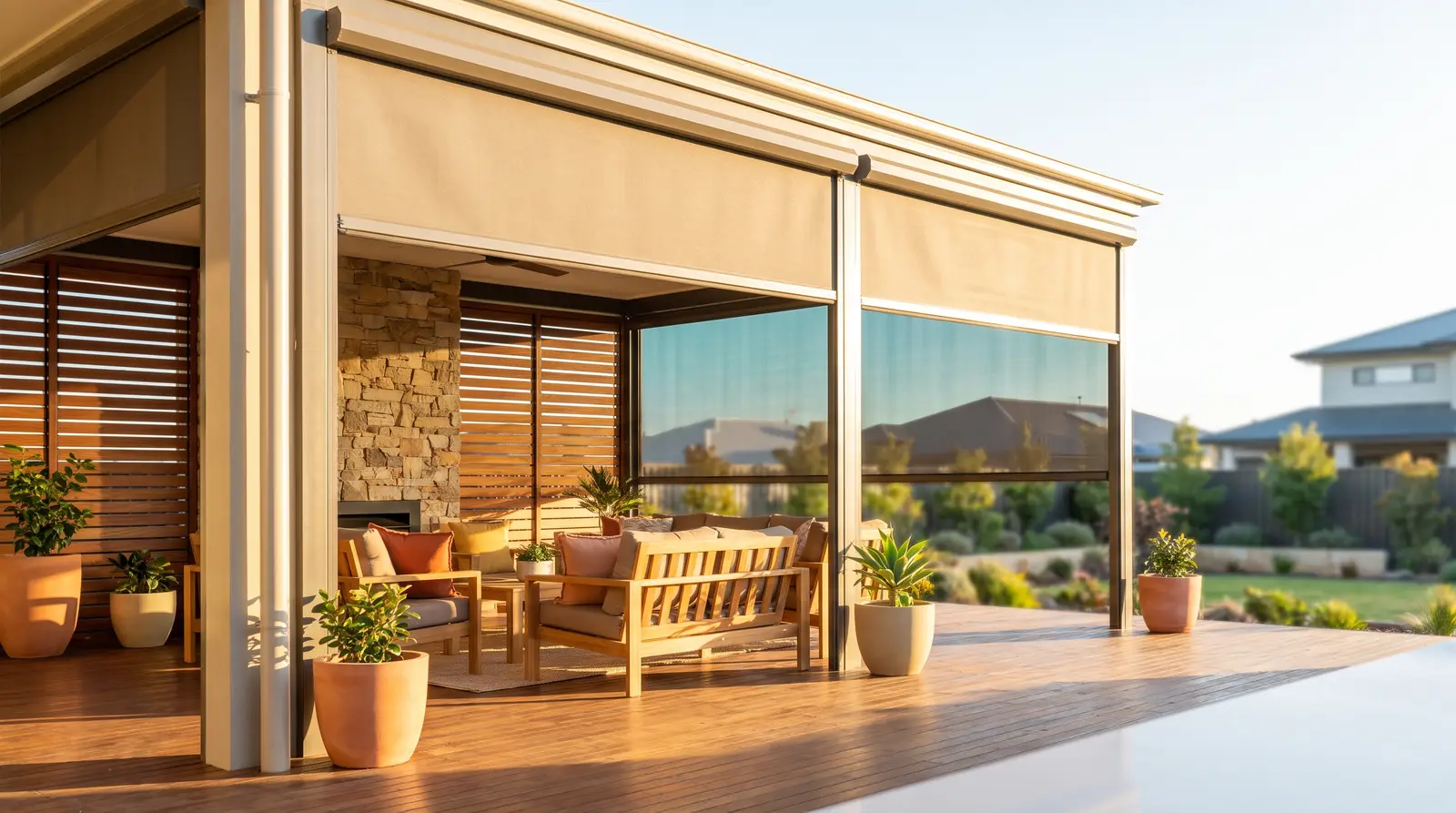
The most expensive mistake Adelaide homeowners make when buying outdoor blinds is choosing mesh when the goal was year-round use, because it means paying twice. Close behind: putting strapped cafe blinds in an exposed Hills or coastal position, and comparing 3 quotes that specify 3 different things. All 8 mistakes below are avoidable at quote stage and expensive afterwards.
Key takeaways
- Mesh blinds do not stop rain. If you want winter use, only a sealed track-guided system delivers it.
- Strapped blinds in exposed positions fail at 4 to 5 years against a 10 to 12 year expectation.
- Coastal addresses need 316 marine-grade stainless fixings. Most low quotes do not include them.
- 3 quotes are only comparable if fabric, edge system, fixing grade and span treatment are fixed in writing first.
Below is what each mistake costs and how to avoid it. The complete outdoor blinds buyer's guide covers the category properly, and our outdoor blinds page passes your enquiry to a local Adelaide installer.
1. Buying mesh when you wanted a year-round room
The pattern is consistent. The buyer's real motivation is using the alfresco in winter. They shop in spring, the showroom demonstrates a beautiful charcoal mesh, it costs $350 to $750 per opening instead of $900 to $2,000, and it is genuinely excellent at killing the western sun. It goes in for summer and it works.
Then June arrives, the southerly pushes rain through the open weave, and the space is exactly as unusable as it was before. The buyer then pays a second time for track-guided PVC.
The fix takes 1 question: which months am I trying to recover? If the answer includes any month between May and September, mesh alone will not do it. Mesh solves heat. Only a continuously guided edge solves wind and rain. The distinction is set out fully in types of outdoor blinds explained.
2. Strapped cafe blinds in an exposed position
Strapped cafe blinds seal at discrete points, not continuously. In a sheltered Prospect or Norwood courtyard that is completely adequate and the $450 to $900 price is good value.
On an exposed Adelaide Hills deck at Stirling, Aldgate or Crafers, or a west-facing coastal balcony at Henley Beach, it is a false economy. Gusty wind loads the strap points unevenly, the buckles work loose over a season, and the panel begins flogging. Flogging is what destroys these blinds, and it happens years before the fabric would have failed on its own. Expect 4 to 5 years from a strapped blind in a genuinely exposed Adelaide position against 10 to 12 from a track-guided one.
The maths: you are not saving 50 per cent, you are buying a product with less than half the life at 55 per cent of the price. Assess your exposure honestly rather than optimistically.
3. Clear PVC on a west-facing opening
Buyers choose clear PVC to keep the view, which is a reasonable instinct, and then apply it to every opening including the west.
Clear PVC provides zero glare control and zero solar reduction. On an Adelaide January afternoon, a clear-enclosed west-facing alfresco is a glasshouse: the sun comes straight through at a low angle from 3pm, lands on the seating area, and the sealed panel prevents the convection that would otherwise carry the heat away.
Tinted PVC retains most of the view and cuts glare and heat substantially, at no meaningful price premium. Dark mesh does more again if weather sealing is not needed on that particular opening. The correct specification on most Adelaide alfrescos is mixed by aspect, and choosing outdoor blind colours works through it opening by opening.
4. Skipping marine-grade fixings on a coastal address
Glenelg, Henley Beach, Grange, Semaphore, Brighton and West Lakes sit in a marine corrosion zone, and the reliable summer sea breeze deposits salt continuously on every metal surface.
Zinc-plated and standard mild steel fasteners show rust streaks at 2 to 3 years and lose structural integrity at 5 to 7. The fastener is what holds a wind-loaded blind to a post, so this is a safety issue as well as a cost one. 316 marine-grade stainless holds 12 to 15 years.
The difference at quote stage is around 5 to 8 per cent of materials. If a quote for a beachside address makes no mention of fixing grade, ask before signing. It is the single clearest indicator of whether the installer works the coast regularly.
5. Comparing quotes that are not comparable
This is how most Adelaide homeowners overpay, and it is entirely procedural.
3 installers attend, each specifies what they prefer, and the buyer chooses on price. But quote A is 0.5 mm PVC strapped, quote B is 0.75 mm track-guided with a centre mullion, and quote C is mesh. They are not 3 prices for the same thing, they are 3 different products.
Fix these variables in writing before you invite quotes: fabric type and gauge, guided or strapped edge, fixing grade, how spans over 4 m are handled, warranty split between fabric, hardware and workmanship, and whether removal of an existing blind is included. Then the price comparison means something.
6. Ignoring span width above 4 m
A 2.4 m opening and a 4.8 m opening use the same motor, the same brackets and similar install labour. What differs is the tube: a wide blind needs a heavier tube to resist deflection, and above roughly 5 m most competent installers will insist on splitting the run with a centre post or a fixed mullion.
Buyers frequently push back on that mullion because it interrupts the view. It is not an upsell. A 6 m single-span PVC blind sags visibly in the middle within 2 summers, the bottom bar stops tracking cleanly, and the fabric edge wears against the track. The blind is then a warranty argument rather than a working product.
If an installer quotes a 6 m single span with no mullion and no mention of a heavier tube, that quote is cheaper for a reason.
7. Leaving power out of the plan
Wired motorised blinds need 240 V at the head box. On a new build or a renovation with the alfresco ceiling open, that is trivial and cheap. On a finished alfresco with a lined ceiling and rendered walls, it is $300 to $800 and involves either visible surface conduit or making good.
All electrical work in South Australia must be carried out by a licensed electrical worker, and SA's licensing requirements are the reference. Your blind installer cannot legally wire it unless they hold the licence, so establish who is doing it and confirm a certificate of compliance is issued.
The preventative move: if there is any chance you will want motorisation, run a capped cable while the ceiling is open, even if you install manual blinds now. Motorised vs manual outdoor blinds covers whether you will actually want it.
8. Assuming no approval is needed, or assuming one is
Both errors happen. Outdoor blinds fitted to an existing compliant structure generally do not require development approval in South Australia, so homeowners who delay a project waiting for council are usually delaying for nothing.
The complication is permanent enclosure. Fully and permanently enclosing a structure can change how it is classified, particularly for a carport, a structure close to a boundary, or a structure that was approved as open. Retractable blinds on a residential alfresco are not normally treated as permanent enclosure, but if your project is unusual, check first. The SA planning portal is the authority, not your installer's opinion.
The 4 questions that prevent most of this
Ask these at every site visit and you eliminate the majority of the risk.
Which months will this space be usable after the work? Forces the mesh-versus-sealed conversation into the open.
What grade are the fixings, and what are the tracks made of? Separates coastal-competent installers from the rest immediately.
How are you handling any span over 4 m? Reveals whether they are engineering the job or just measuring it.
What is the warranty on fabric, on hardware and on workmanship separately, and will replacement fabric be available for this system in 8 years? A proprietary track profile from a supplier who may not be trading in a decade is a system you replace entirely rather than refurbish.
Alongside any written warranty, Australian Consumer Law provides statutory guarantees that goods be of acceptable quality and last a reasonable time, which can apply after a written warranty expires. The ACCC's consumer guarantee guidance is worth reading before committing to anything over $3,000. Realistic component lifespans are set out in how long outdoor blinds last.
Want quotes specified to the same standard so you can compare them properly? Request a free quote and we'll pass your enquiry to a local Adelaide installer who measures on site. Ask them to quote against a fixed specification.