The complete guide to outdoor blinds
Outdoor Blinds vs a Pergola Roof: What to Choose in Adelaide
7 min read
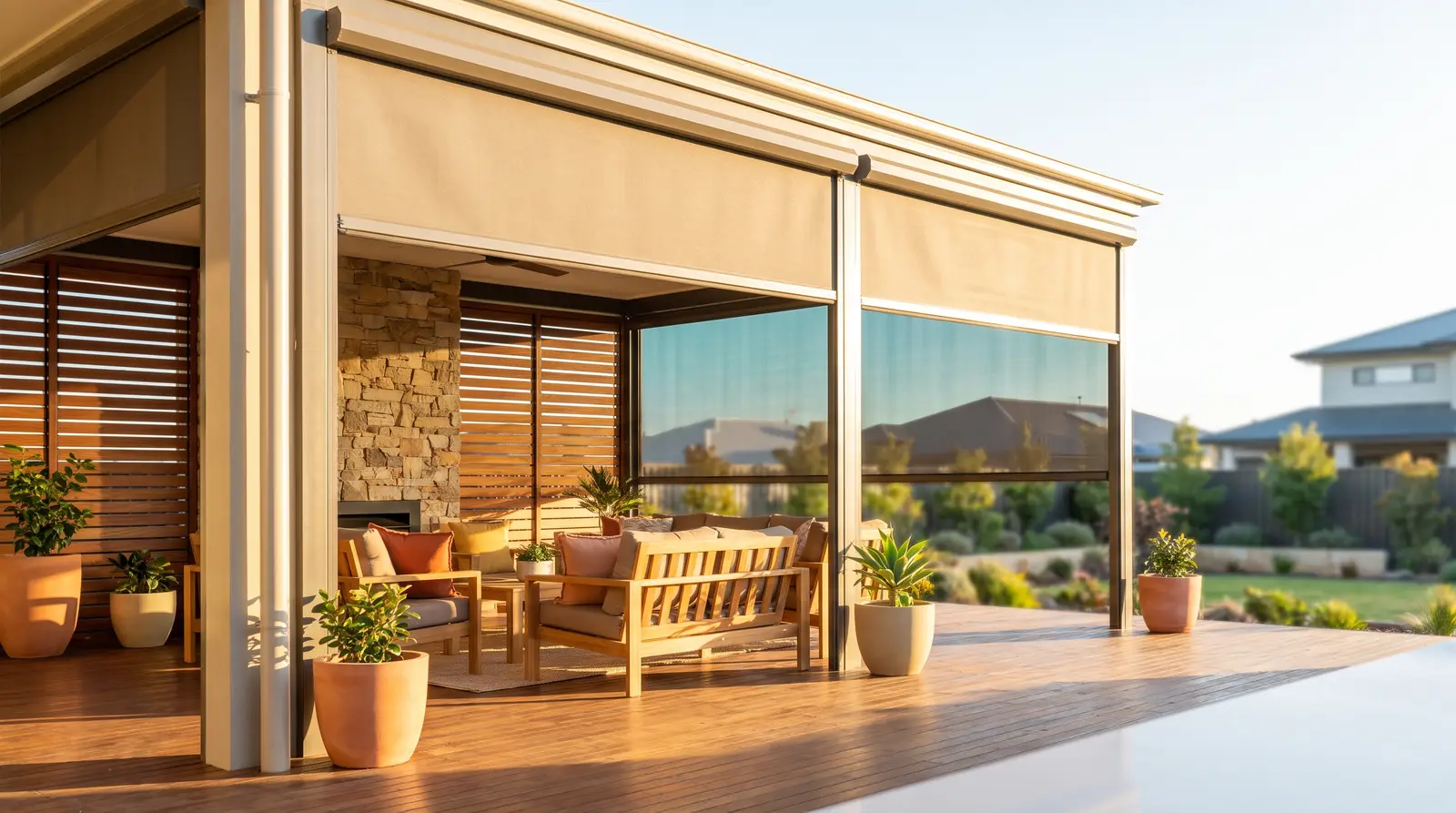
Outdoor blinds and a pergola roof solve different problems and are not genuinely alternatives: a roof stops sun and rain from above, blinds stop them from the sides. In Adelaide, where afternoon sun arrives low from the west and winter rain arrives at an angle on a southerly, a roof alone leaves a space unusable in exactly the conditions people most want to escape. If you have to choose 1, choose based on which direction your discomfort comes from.
Key takeaways
- A roofed pergola in Adelaide runs $4,000 to $15,000 built. Outdoor blinds run $350 to $2,000 per opening.
- Low western sun from 3pm passes under any roof. Only a side blind stops it.
- A roof plus blinds is the combination that produces a year-round room, and it is cheaper than most people assume.
- Roofed structures usually need development approval in South Australia. Blinds on an existing structure usually do not.
This post compares them properly on cost, performance and approvals. The complete outdoor blinds guide covers blind systems, and our outdoor blinds page passes your enquiry to a local Adelaide installer.
What each one actually does
A pergola roof (Colorbond, polycarbonate, insulated panel or louvred) intercepts the overhead sun and sheds rain. Through the middle of an Adelaide summer day, when the sun is high, it is the dominant factor in comfort. It also gives you a dry surface underneath in ordinary vertical rain.
Outdoor blinds close the sides. They intercept low-angle sun, block wind, and stop wind-driven rain entering laterally. They also create the enclosure that lets a heater work in winter.
The mistake is treating them as competing options. Consider a typical Adelaide afternoon in January: at 1pm the sun is high and a roof does the work. At 4pm the sun is at maybe 35 degrees elevation in the west, and it comes in under the roof edge and lands directly on the seating area. A roof does nothing at 4pm. That is why so many Adelaide homeowners with a good Colorbond verandah still find the space unusable at exactly the hour they want to use it.
Now consider a July evening: the roof keeps vertical rain off, but a southerly is pushing rain in horizontally and the wind makes 14 degrees feel like 8. Again, the roof is not the constraint.
The cost comparison
| Option | Adelaide cost |
|---|---|
| Colorbond flat or gable pergola roof, 20 sqm | $4,000 to $9,000 |
| Insulated panel roof, 20 sqm | $7,000 to $15,000 |
| Louvred opening roof, 20 sqm | $12,000 to $25,000 |
| Mesh blind per opening | $350 to $750 |
| Track-guided PVC blind per opening | $900 to $2,000 |
| Full blind enclosure, 3 to 4 openings | $3,500 to $9,000 |
Two observations from these numbers.
If you already have a roof, adding blinds is the cheapest available upgrade to a covered outdoor space, and it produces the largest change in usable days. Recovering winter and windy shoulder-season evenings from an existing roofed patio for $3,500 to $9,000 is strong value.
If you have neither, roof first. Blinds under an open pergola with no roof achieve very little, because water and high sun both come straight down. The exception is a space that sits under an existing eave or a solid neighbouring wall on the sun side.
Where each one wins
Choose the roof when: the space has no overhead cover at all, the main complaint is midday sun in summer, or you need the area dry underneath for furniture and an outdoor kitchen. Where a fixed roof is more than the space needs, folding arm awnings against outdoor blinds covers the retractable overhead option.
Choose blinds when: you already have a verandah, patio or pergola roof, and the complaint is late-afternoon sun, wind, or rain blowing in. This describes the majority of Adelaide homes asking the question, because most established homes and virtually all project builds from the last 20 years already have some form of covered alfresco.
Choose both when: the goal is a genuine year-round room. This is the configuration that converts an outdoor area into something used in July, and it is what the $3,500 to $9,000 enclosure figure buys on top of an existing roof.
Adelaide aspect and orientation change the answer
Orientation matters more here than in most parts of the country because of how strong the western sun is on the Adelaide plains.
West-facing alfresco. The dominant problem is low afternoon sun. A roof helps until about 3pm and then stops helping. A mesh blind on the western opening is the highest-value single purchase available, at $350 to $750, and it will change the space more than a $9,000 roof upgrade would.
North-facing alfresco. The best orientation, and the one Australian government passive design guidance on shading identifies as easiest to control. A roof with adequate overhead depth handles summer sun well, and winter sun penetrates usefully at the low angle. Blinds here are about wind and rain rather than heat, so clear PVC track-guided suits.
South-facing alfresco. Little direct sun, so the roof is about rain and the blinds are about the cold southerly. This is the aspect where blinds matter most for comfort and where a heater plus a sealed enclosure transforms the space.
East-facing alfresco. Morning sun, comfortable most of the year, and the least demanding case. A roof plus a single mesh blind on the eastern opening is usually enough.
Coastal properties at Glenelg, Henley Beach and West Lakes add a wind consideration that overrides aspect: the reliable afternoon sea breeze makes side protection valuable on every orientation. Specify 316 marine-grade stainless fixings for anything within about 1 km of the water. The wider weather-specification logic is in outdoor blinds and weather protection.
Approvals: the practical difference
This is where the 2 options genuinely diverge, and it catches Adelaide homeowners out.
A roofed structure is building work. In South Australia, most new verandahs, carports and pergolas with a roof require development approval, with limited exemptions based on size, height and setback. Requirements vary between councils and by zone, and the authority is the SA planning portal, not your builder's opinion. Expect approval to add several weeks and a few hundred dollars to a roof project.
Outdoor blinds fitted to an existing compliant structure are generally not building work and generally do not require approval. Where it can get complicated is if the blinds fully and permanently enclose a structure, which can change how the structure is classified, particularly for a carport or a structure near a boundary. In practice, retractable blinds on a residential alfresco are not treated as permanent enclosure. If your project is unusual or close to a boundary, confirm with your council before proceeding rather than after.
The timing difference is meaningful: blinds are typically measured and installed within 3 to 6 weeks of order in Adelaide. A roofed pergola with approval is a 3 to 5 month project.
The sequencing advice
If you are building or renovating, do 3 things in this order.
Get the roof structure right first, including adequate posts. Blind tracks fix to posts, and a post that is adequate to hold a roof is not automatically adequate to take the lateral wind load of a 4 m wide blind. Raising this with the builder at framing stage costs nothing. Discovering it later means adding posts.
Run power to the roof beam while the ceiling is open, even if you plan manual blinds. Retrofitting power for motorisation into a lined alfresco ceiling costs $300 to $800 and is disruptive. A capped cable costs almost nothing at framing. Motorised vs manual outdoor blinds covers whether you will want it.
Then quote blinds. Doing it in this order means the blind installer works with a structure built to accept blinds rather than working around one that was not.
The short answer
If you have a roof already, buy blinds. The value is clear and the transformation is larger than any further roof spend.
If you have nothing, build the roof first and budget for blinds as a stage 2 in the same year, because a roofed but open Adelaide alfresco is a 5 month space, and a roofed and enclosed one is a 12 month space. Whether that upgrade pays off for your household is worked through honestly in are outdoor blinds worth it.
Ready to price the blind stage? Request a free quote and we'll pass your enquiry to a local Adelaide installer who assesses your existing structure before quoting.