The complete guide to outdoor blinds
Outdoor Blinds and Weather Protection in Adelaide's Climate
6 min read
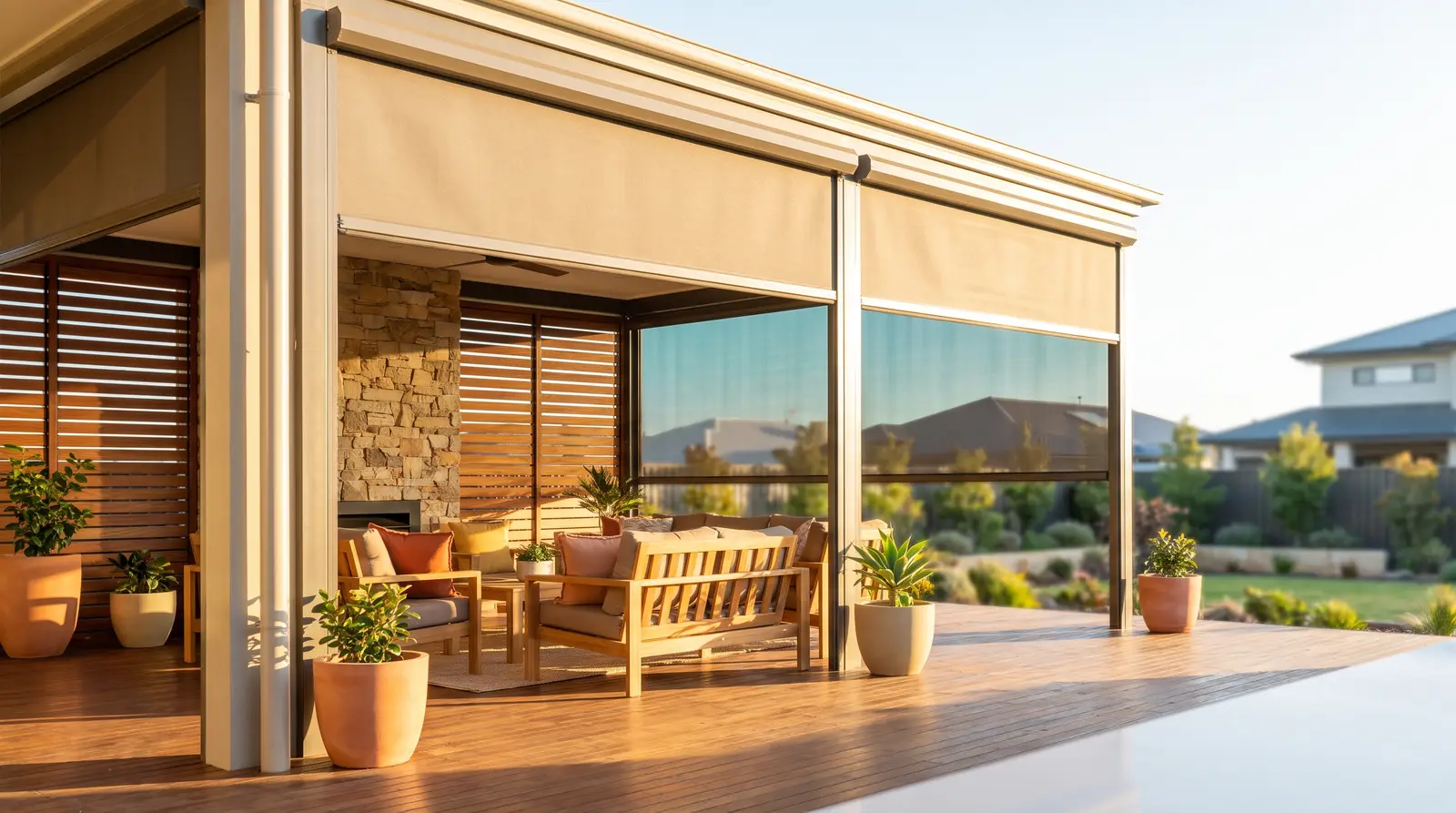
Outdoor blinds deliver weather protection in Adelaide across 4 distinct conditions: extreme summer heat, wind-driven winter rain, coastal salt air and gusty Hills wind. Each demands a different specification, and a system that handles 1 well often handles another badly. Mesh defeats heat and fails against rain. Sealed track-guided PVC defeats rain and wind but traps heat if you specify it clear on a west wall.
Key takeaways
- Only a continuously guided edge seals a space against driving rain and sustained wind.
- Mesh blinds cut 90 to 95 per cent of solar radiation and are the correct answer to Adelaide summer heat.
- Coastal addresses need 316 marine-grade stainless fixings, not 304 or zinc-plated.
- No outdoor blind is rated to stay down in a severe wind warning. Raising them is part of ownership.
Below is what each Adelaide weather condition does to a blind and how to specify against it. The complete buyer's guide covers systems and cost, and our outdoor blinds page passes your enquiry to a local installer.
Adelaide summer heat: 38 degrees and rising
Adelaide's summer is hot and dry, and the heat arrives as direct solar radiation rather than humidity. That distinction shapes everything.
An unshaded west-facing alfresco slab absorbs sun through the afternoon and re-radiates it into the evening, which is why the space is still uncomfortable at 8pm on a January night even after the sun has gone. The fix is stopping the radiation before it lands, which means shading the western face.
Mesh blinds at 3 to 5 per cent openness block 90 to 95 per cent of solar radiation while allowing air movement. That air movement is critical. A sealed clear PVC blind on the same opening blocks radiation too, but it also stops convection, so hot air pools under the roof and the space gets worse. This is the single most common specification error made on Adelaide alfrescos.
Dark mesh outperforms light mesh for glare control and gives better outward visibility, because the eye reads through a dark weave more easily than a light one. Charcoal and slate are the workhorses in Adelaide for exactly this reason. Best outdoor blind colours explains the aspect-by-aspect logic.
For a house with large west-facing glazing behind the alfresco, external shading also cuts indoor cooling load meaningfully. Government guidance on shading and passive design confirms external shading of glass is substantially more effective than internal blinds.
Winter rain and the cold southerly
Adelaide's winter is mild by national standards but wet and windy, with rainfall concentrated May through September and southerly fronts that arrive with real force. The Bureau of Meteorology's Adelaide forecast and warnings service is the practical reference for tracking these.
Rain in Adelaide is rarely vertical. It comes in at an angle on a southerly, which is why a verandah roof alone does not keep a space dry and why a blind that seals only at the bottom does not either. Water tracks in at the sides.
This is the argument for a guided edge. A track-guided outdoor blind holds the fabric inside a continuous side channel, so there is no gap for wind-driven water to enter. Strapped cafe blinds seal at discrete points and let both wind and water in at the sides, which is fine in a sheltered courtyard and inadequate on an exposed face.
The second winter benefit is draught elimination. A sealed enclosure holds heat from a single outdoor heater in a way an open or strapped space never will. Owners who add track-guided blinds to a patio consistently report the space becoming genuinely usable in July, which mesh or strapped systems do not deliver.
Wind: what blinds tolerate and what they do not
This is where honest information is hardest to find, because manufacturers publish wind figures under test conditions that do not resemble a residential install.
The practical position: a well-installed track-guided blind on a properly braced opening handles ordinary Adelaide conditions, including a typical windy afternoon, without drama. It is not rated to remain down in a severe weather warning, and no residential outdoor blind is. The failure mode in extreme wind is either the fabric pulling out of the track or the fixings tearing out of the post, and the second is far more expensive.
Strapped cafe blinds are the more fragile case. The panel is held at points, so a gust loads those points unevenly, the buckles work loose over a season, and the panel begins flogging. Flogging destroys blinds. It is the reason strapped systems in exposed positions fail at 4 to 5 years rather than 10.
Hills properties deserve specific attention. Stirling, Aldgate, Crafers, Bridgewater and the escarpment above Mitcham catch wind channelled by the valleys, gusty and shifting in direction rather than steady. Track-guided is close to mandatory on an exposed Hills aspect, and posts need checking for adequacy before tracks go on. A bowed or under-sized timber post that was fine holding up a roof is not automatically fine taking the lateral load of a 3 m wide blind in a gust.
For motorised systems, a wind sensor that retracts the blinds automatically is genuinely worthwhile on exposed sites. It only works on motorised blinds and needs power at the head box, so it must be decided at quote stage. Motorised vs manual outdoor blinds covers the trade-offs.
Coastal salt air: the specification most quotes get wrong
Adelaide's western beach suburbs, Glenelg, Henley Beach, Grange, Semaphore, West Lakes and Brighton, sit in a marine corrosion environment. The steady afternoon sea breeze carries salt inland, and it deposits on every metal surface.
What that does: zinc-plated and standard mild steel fixings pit and streak within 2 to 3 years. 304 stainless holds up reasonably in a sheltered position but shows tea-staining near the water. Untreated aluminium extrusion develops surface corrosion. Powder-coated aluminium performs well provided the coating is unbroken, which means every drilled hole needs sealing.
The correct coastal specification is 316 marine-grade stainless fasteners throughout, powder-coated or anodised aluminium hardware, and marine-grade PVC or mesh. It adds perhaps 5 to 8 per cent to the material cost and it roughly doubles the hardware life.
If a quote for a beachside address makes no mention of fixing grade, ask before signing. It is the clearest single indicator of whether the installer works the coast regularly or is quoting a suburban job on a coastal address.
What weather protection does not cover
Setting expectations properly avoids disappointment.
Outdoor blinds do not make a space fully waterproof at the roof. If your verandah roof leaks at a flashing, blinds will not fix it, and enclosing the sides makes the leak more noticeable rather than less.
They do not eliminate condensation. A sealed alfresco on a cold Adelaide winter morning will show condensation on the inside of clear PVC. It is normal, it wipes off, and it is the price of a sealed space.
They do not survive neglect. Tracks fill with grit and gum leaves, particularly under Hills eucalypts, and a blocked track binds the blind and eventually damages the edge. An annual clear-out is the whole maintenance requirement, and skipping it is what turns a good system into a repair job. How long outdoor blinds last sets out the realistic timeline for each component.
Matching the specification to your address
| Adelaide condition | What to specify |
|---|---|
| West-facing summer heat | Dark mesh, 3 to 5 per cent openness |
| Winter rain and southerlies | Track-guided PVC, full seal |
| Exposed Hills deck | Track-guided, post adequacy checked, wind sensor if motorised |
| Coastal (within 1 km of water) | 316 stainless, powder-coated hardware, marine-grade fabric |
| Sheltered inner-suburb courtyard | Strapped cafe blinds are adequate |
| Mixed use, all seasons | Track-guided tinted PVC on sun faces, clear elsewhere |
The mixed answer is the most common right answer for a typical Adelaide alfresco: tinted or mesh on the western opening for heat, clear track-guided PVC on the others for weather and view. Any installer quoting an identical fabric across all 4 openings without asking about aspect is not thinking about your house.
Want a specification that matches your actual exposure? Get a free quote and we'll pass your enquiry to a local Adelaide installer. Ask them to assess aspect, wind exposure and salt risk on site.