The complete guide to outdoor blinds
Motorised vs Manual Outdoor Blinds: Which Suits Your Adelaide Home
6 min read
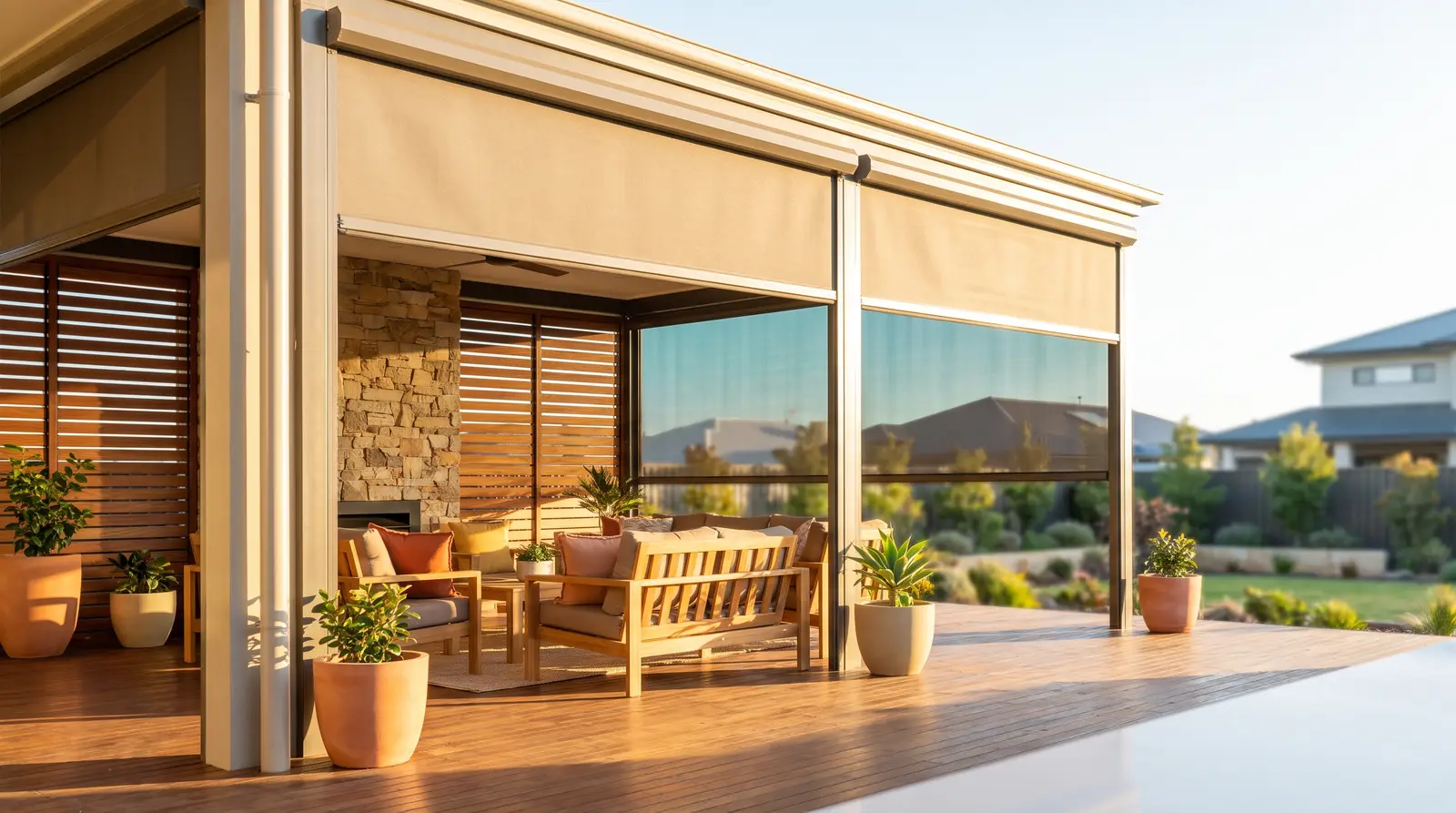
Motorised outdoor blinds cost $1,600 to $3,200 per opening in Adelaide against $900 to $2,000 for the manual equivalent, and the premium is justified in 3 specific situations: spans over 4 m, positions you cannot reach comfortably, and runs of 3 or more blinds you want to operate together. For a single 3 m opening at ground level, manual is the better buy and it has less to go wrong.
Key takeaways
- Motorisation adds $700 to $1,200 per opening on top of the manual price.
- Above roughly 4 m of span, the bottom bar gets heavy enough that motorisation stops being a luxury.
- Wind sensors only work on motorised blinds and are genuinely valuable on exposed Hills and coastal sites.
- Power access at the head box is the hidden cost. Decide before the alfresco is finished, not after.
This post works through the decision on cost, reliability and Adelaide-specific conditions. The complete outdoor blinds guide covers the wider category, and our outdoor blinds page passes your enquiry to a local Adelaide installer for a quote on both options.
What you actually pay
| Configuration | Adelaide band per opening |
|---|---|
| Manual track-guided blind | $900 to $2,000 |
| Motorised track-guided blind | $1,600 to $3,200 |
| Wind sensor (add-on) | $250 to $500 |
| Power run to head box (retrofit) | $300 to $800 |
The motor premium is the gap between those first 2 rows, $700 to $1,200 per opening, depending on brand and whether it is a wired 240 V tubular motor or a rechargeable battery motor. Across a 4 opening alfresco that is $2,800 to $4,800, which is a serious portion of a $9,000 project and worth deciding deliberately rather than at the point of sale.
Battery motors have improved substantially and remove the electrical work, which is the main reason to consider them on a retrofit. The trade-off is recharging, typically every 6 to 12 months per blind depending on use, and on a 4 blind run that becomes a chore. Solar top-up panels reduce but do not eliminate it, and in a shaded southern-side position the solar panel does very little.
When manual is the right answer
Single opening, 3 m or narrower, at ground level. A well-specified spring-assisted track-guided blind at this size operates with 1 hand and takes about 3 seconds. There is no meaningful convenience gain from a remote, and you have removed a motor, a receiver, a power supply and a remote from the list of things that can fail.
You use the space seasonally. If the blinds go down in April and up in November, you are operating them twice a year. Automation solves a problem you do not have.
Budget is constrained and you want to cover more openings. Given $6,000, covering 4 openings manually beats covering 2 motorised. Enclosure is only as good as its weakest gap, and a half-enclosed alfresco does not deliver the winter benefit at all. Spend on coverage first, convenience second.
You want the simplest possible ownership. Manual track-guided blinds have essentially 3 failure points: the fabric, the spring, and the tracks binding with grit. Motorised adds the motor, the receiver, the remote, the power supply and any sensor. None of those fail often, but they are all things that can.
When motorisation earns its money
Spans over 4 m. This is the strongest case. A 4.5 m or 5 m bottom bar on a PVC blind is genuinely heavy, and manual operation stops being a 1-handed action. Worse, uneven manual pull on a wide blind is what causes the bar to rack and the fabric to track off-centre, which is a leading cause of premature wear on wide manual blinds. A motor pulls evenly every time.
High or awkward positions. Second-storey balconies in Glenelg and the Adelaide CBD, blinds above a built-in kitchen bench, or any opening where you would need to lean across furniture. If reaching the bottom bar involves a step or a stretch, the blind stops being used, and an unused blind returns nothing.
Runs of 3 or more. Operating 4 manual blinds means 4 trips around the alfresco. It sounds trivial until it is 6pm, the southerly has arrived, and it is raining. Grouped remote control is where owners of larger enclosures consistently say the money was well spent.
Exposed sites where a wind sensor matters. On a Stirling deck or a Henley Beach balcony, an automatic wind sensor that retracts the blinds when gusts exceed a set threshold is real risk management. Blinds left down in a front are the single most common cause of storm damage, and the sensor removes the human element. It is only available on motorised systems.
The hidden cost nobody quotes for
Power at the head box.
Wired tubular motors need 240 V at the top of each blind, which means a licensed electrician running a circuit into the alfresco roof space or along the beam. On a new build or a renovation where the ceiling is open, this is cheap and easy. On a finished alfresco with a lined ceiling and a rendered wall, it is $300 to $800 and involves either surface conduit (visible) or making good (disruptive).
All electrical work in South Australia must be performed by a licensed electrical worker, and SA's licensing requirements are the reference point. This is not a component your blind installer can legally wire in unless they hold the licence themselves. Ask who is doing it and confirm the certificate of compliance is provided.
The practical lesson: if there is any chance you will want motorisation, run the power when the alfresco ceiling is open, even if you install manual blinds now. A capped cable in the right position costs almost nothing at that stage and saves the entire retrofit problem later.
Reliability in the Adelaide climate
Motors are more robust than owners expect. Quality tubular motors are sealed, rated for outdoor use, and rarely the first component to fail. In practice the failure order on a motorised Adelaide blind runs: clear PVC clouds at 5 to 10 years, tracks bind from accumulated grit well before that if unmaintained, spring or motor issues at 10-plus years.
What does cause motor problems locally is heat and water. A head box mounted in full western sun with no roof overhang runs hot through an Adelaide January and that shortens electronics life. Position the head box under the roof line where possible. Water entry into an inadequately sealed head box is the other cause, and it is an install quality issue rather than a product issue.
Remotes and receivers are the components that genuinely go missing or fail, and they are cheap to replace. Ask at quote stage whether the system uses a common protocol so replacement remotes are available in 8 years, or a proprietary one that ties you to a single supplier. A motor that fails inside a reasonable service life is also covered by the statutory guarantees under Australian Consumer Law regardless of the written warranty term, and the ACCC's consumer guarantee guidance explains how that works.
Full lifespan detail by component is in how long outdoor blinds last.
The mixed approach most Adelaide alfrescos should take
The best value configuration on a typical 3 or 4 opening Adelaide alfresco is rarely all-manual or all-motorised.
Motorise the widest opening and any opening that is hard to reach. Leave the narrow, accessible ones manual. On a common layout of 1 wide 4.5 m front opening and 2 narrower 2.5 m side openings, that means 1 motor rather than 3, saving $1,400 to $2,400 while capturing most of the convenience.
If you go this route, be explicit with the installer that you want matched hardware and matched fabric across all openings so the alfresco reads as one system rather than a mismatched set. Motorised and manual blinds from the same range look identical from the outside.
Getting this wrong in either direction is a common and avoidable expense, and it appears in the mistakes to avoid when buying outdoor blinds.
Want both options priced side by side? Request a free quote and we'll pass your enquiry to a local Adelaide installer. Ask them to quote manual and motorised on the same specification so you can compare properly.