The complete guide to outdoor blinds
Types of Outdoor Blinds Explained: Mesh, PVC and Track-Guided
6 min read
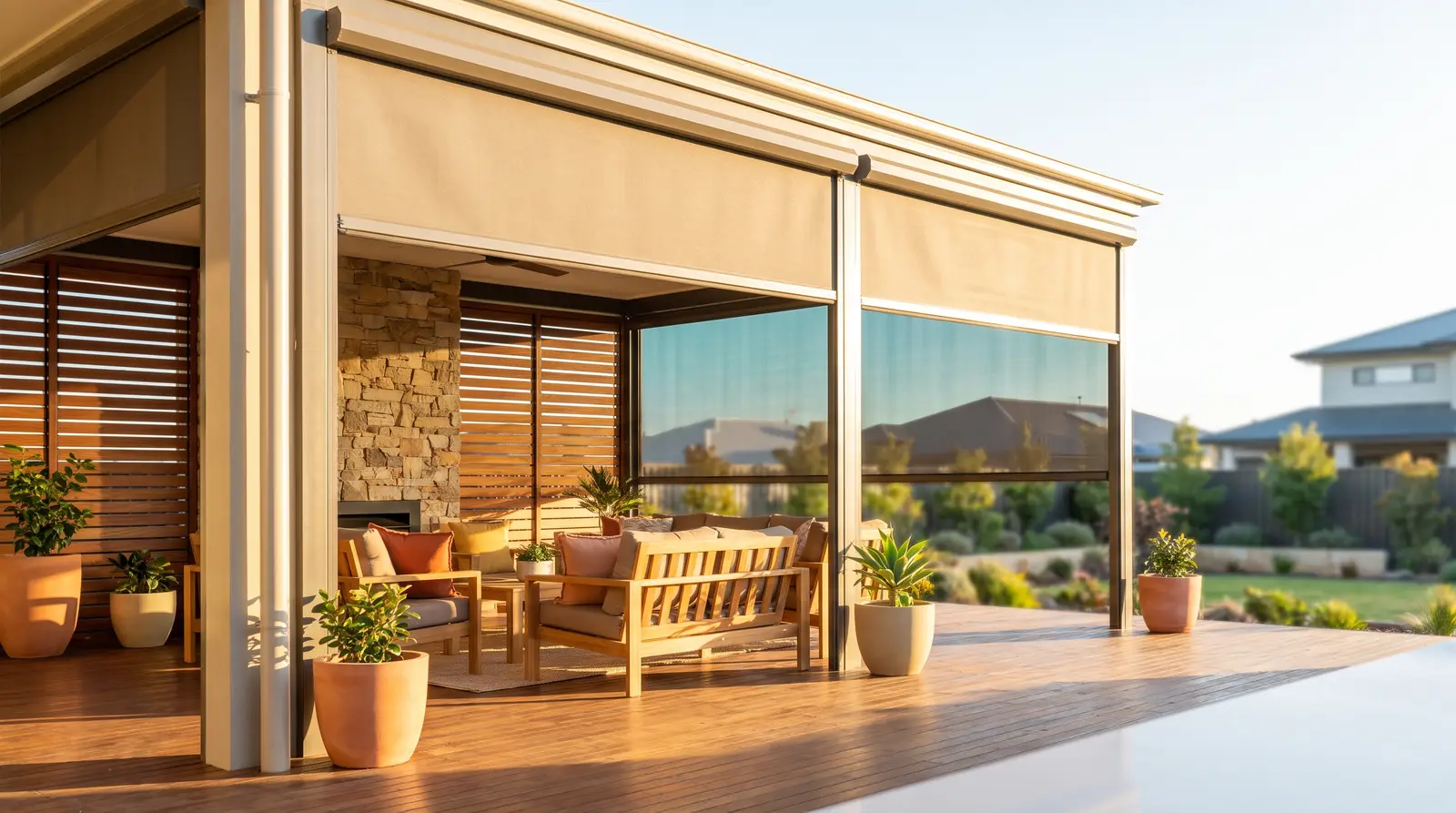
There are 5 types of outdoor blinds sold in Adelaide: mesh or shade blinds, clear PVC cafe blinds, tinted PVC, track-guided systems and canvas or acrylic drop blinds. They differ in 2 ways that matter, what the fabric blocks and how the side edge is held, and the second one decides whether your alfresco is weatherproof or just shaded.
Key takeaways
- Mesh blinds block 90 to 95 per cent of sun and cost $350 to $750 per opening. They do not stop rain.
- Clear and tinted PVC blinds stop rain and wind, at $450 to $900 strapped or $900 to $2,000 track-guided.
- The edge system (strapped versus guided) matters more than the fabric for wind performance.
- Canvas drop blinds are the cheapest option and the shortest-lived in Adelaide's UV.
Below is what each type does, what it costs installed in Adelaide, and where each one fails. For the full category picture, start with the Adelaide outdoor blinds buyer's guide, and see our outdoor blinds service page when you want quotes.
1. Mesh and shade blinds
Mesh blinds use a PVC-coated polyester knitted with an open weave. The openness factor (usually 1 to 5 per cent) tells you how much light passes through. A 3 per cent openness charcoal mesh blocks about 95 per cent of solar radiation while still letting you see out and letting hot air escape.
This is the correct product for a west-facing verandah in Marion, Morphett Vale or Mitcham where the problem is a 4pm summer sun turning the space into an oven. Air movement through the weave is a feature, not a defect: a sealed PVC blind on the same opening in February traps heat and makes the space worse.
Cost: $350 to $750 per opening. Lifespan: 8 to 12 years on fabric, longer on hardware.
Where it fails: rain. Mesh sheds a light shower at an angle but water passes through in sustained rain, and it does nothing for a winter southerly. If your goal is year-round use, mesh alone will not get you there.
2. Clear PVC cafe blinds
Clear PVC (usually 0.5 mm to 0.8 mm marine-grade) gives you full weather protection while keeping the view. In cafe blind form it is a flat panel rolled down manually and tensioned with straps, buckles or turn-buttons at the base.
Cost: $450 to $900 per opening. Lifespan: 7 to 12 years, with the PVC itself clouding at 5 to 10 years depending on aspect.
Where it fails: the seal is at points, not continuous. Wind enters at the sides and the panel drums. On a sheltered Prospect or Norwood courtyard that is a non-issue, and small courtyard blind layouts covers how to enclose that kind of space without boxing it in. On an exposed Adelaide Hills deck it means the straps work loose over a season and the blind starts flogging, which is what actually destroys these blinds well before the fabric would have failed on its own.
Thickness matters more than buyers realise. A 0.5 mm PVC is noticeably more prone to creasing and cold-crack in a Hills winter than 0.75 mm. Ask which gauge is quoted.
3. Tinted PVC
Same construction as clear PVC, with a grey, bronze or smoke tint. It cuts glare and reduces solar gain meaningfully while keeping most of the view. On a north or west-facing Adelaide alfresco this is frequently the smarter buy than fully clear, because a clear PVC blind on a west wall in January turns the space into a glasshouse.
Cost sits in the same $450 to $900 band strapped, or $900 to $2,000 track-guided. There is no meaningful price premium for tint.
Where it fails: on a south-facing opening or in a courtyard that is already dim, tint makes the space gloomy in winter. Match the tint to the aspect, not to the showroom sample. Choosing outdoor blind colours covers how aspect should drive the decision.
4. Track-guided outdoor blinds
The defining feature is the side channel. The fabric edge (mesh or PVC) runs inside a continuous aluminium track fixed to the posts or wall, so the blind is held along its full height rather than at strap points. This is the category that the well known branded track-guided systems belong to.
The practical consequences are significant. The blind stops at any height rather than only fully up or fully down. There is no strapping to undo, so operation is 1-handed and takes about 3 seconds. Wind entry at the sides is effectively eliminated, so the space stays draught-free. And because the fabric cannot flog, the failure mode that kills strapped blinds simply does not occur.
Cost: $900 to $2,000 per opening manual, $1,600 to $3,200 motorised. Lifespan: 10 to 15 years.
Where it fails: the tracks need clearing. Grit, gum leaves and Hills debris collect in the channel and cause binding, which is by far the most common service call on these systems. It is a 10 minute annual job, not a design flaw, but ignore it for 5 years and you buy a repair.
Track-guided also requires straight, plumb, structurally sound posts to fix the channels to. Bowed timber posts on an older pergola need packing or replacing first, which some quotes exclude and others include. Confirm it.
5. Canvas and acrylic drop blinds
The traditional option: a solid canvas or solvent-dyed acrylic panel that drops down for privacy and shade. Cheapest to buy, around $300 to $600 per opening.
Where it fails: solid canvas blocks the view entirely, offers no air movement, and in Adelaide's UV load a cheap canvas fades noticeably inside 4 years. Solvent-dyed acrylic holds colour far better and is worth the premium if you are going down this path at all. Most Adelaide buyers who consider canvas end up better served by a dark mesh, which gives similar shade with retained visibility.
Which type suits which Adelaide home
| Situation | Best fit |
|---|---|
| West-facing verandah, summer heat only | Mesh, 3 to 5 per cent openness |
| Sheltered inner-suburb courtyard, all-season use | Strapped clear or tinted PVC |
| Exposed Hills deck | Track-guided, PVC |
| Coastal balcony (Glenelg, Henley Beach) | Track-guided with 316 stainless fixings |
| Hospitality footpath dining | Clear PVC cafe blinds or track-guided |
| Full year-round alfresco room | Track-guided across all openings |
Salt air deserves its own note. The Bureau of Meteorology's wind observations for the Adelaide coast show consistent afternoon sea breezes through summer, and that steady salt-laden air is what pits standard fixings within 3 to 5 years. On any address within about 1 km of the water, specify marine-grade stainless and treat it as non-negotiable rather than an upgrade.
The honest answer on value
Fabric type is where buyers spend their attention and hardware is where the money should go. A premium PVC on cheap brackets fails at the bracket. A mid-range mesh on quality tracks and tube lasts a decade and takes a fabric swap at year 9 for a fraction of a new system. If a quote is $400 cheaper than the others, ask what the tube diameter and the bracket material are before you assume you found a deal.
Whatever you buy, the statutory guarantees under Australian Consumer Law apply on top of any written warranty, and the ACCC's guidance on consumer guarantees sets out what "acceptable quality" and "reasonable time" mean in practice.
Whether the whole exercise pays off for your home is a separate question, and are outdoor blinds worth it works through the numbers honestly.
Want to know which type your space actually needs? Get a free quote and we'll pass your enquiry to a local Adelaide installer who assesses on site rather than over the phone.