Care, repairs and maintenance
Extending the Life of Your Outdoor Blinds
6 min read
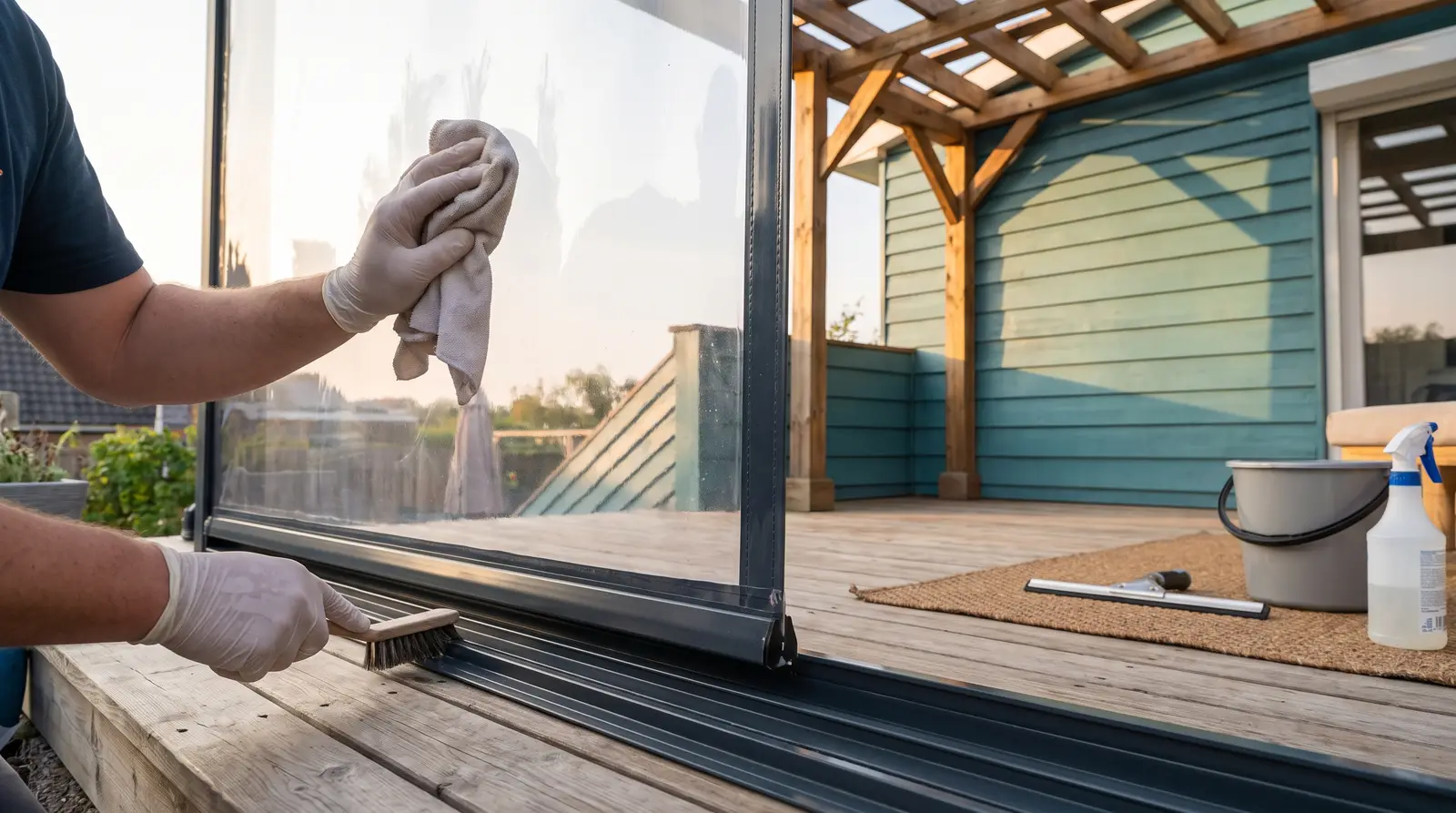
Outdoor blind longevity in Adelaide comes down to controlling UV exposure and keeping grit out of the moving parts. A well-specified track-guided blind that is retracted when not in use, washed quarterly and serviced twice a year reaches 10 to 15 years here. The identical blind left deployed through every summer and never cleaned is finished in 5 to 7.
Key takeaways
- Retraction discipline is the single highest-value habit: UV exposure is cumulative and irreversible.
- Wash quarterly and always hose before retracting, because rolling a dusty panel scratches it permanently.
- Flush the channels twice a year. Grit is what kills tracks, springs and motors.
- Replace embrittled plastic components before they fail, not after, because they take other parts with them.
None of what follows is complicated. It is the same short list of habits repeated, and the reason it works is that Adelaide's failure modes are narrow: UV on the panel, grit in the mechanism, salt on the fixings.
1. Retract them, and mean it
Every hour a panel spends deployed in sun is plasticiser leaving the sheet. It does not come back and it is the mechanism that ends the life of clear PVC.
The Bureau of Meteorology's Adelaide climate averages record January mean maximums near 29 degrees with extremes past 44, and summer UV across South Australia sits in the extreme band for months. A west-facing opening at Marion, Mitcham or Morphett Vale takes hours of direct afternoon sun daily through that period.
The practical rule: down when you are using the space or when the weather requires it, up the rest of the time. On a fully exposed west-facing opening that habit alone is worth 3 to 4 extra years on the panel.
Motorised systems make this easy, which is a legitimate longevity argument for motors beyond convenience. A blind that is genuinely effortless to retract actually gets retracted.
The same discipline applies to weather. Retract fully before a front arrives and leave it retracted. A partly deployed blind presents the largest sail area and can billow hard enough to shock-load fixings that were otherwise fine. Do not cycle a motorised blind during high wind, and do not leave a blind half down to keep the rain off while a storm passes. Watch the Bureau of Meteorology's South Australian warnings through winter and spring, and if damage does occur, the response sequence is in storm damage to outdoor blinds.
2. Wash quarterly, and always before retracting
Two separate reasons, both important.
Washing removes the contaminants that dull and stain: salt film on the coast, dust inland, gum sap and bird mess in the Hills, cooking grease near an outdoor kitchen. Quarterly is right inland, every 6 to 8 weeks within a few kilometres of the water.
More importantly, hosing before retraction stops the mechanical damage. Every time a dusty panel rolls onto the tube, grit on the outer face is pressed and dragged against the wrap above it. Repeated over 3 Adelaide summers that produces uniform fine scratch haze across the entire panel, and people then report that the blind "clouded for no reason". Method and the list of products that destroy PVC are in how to clean clear PVC blinds.
3. Keep the channels clean
Grit in the side channels is the root cause of most mechanical failure on track-guided outdoor blinds. It raises friction, which loads the spring, the tube and the motor on every cycle. Channels chew guide inserts, guide inserts wear the fabric edge bead, and the blind ends up racked.
Twice a year, torch both channels, lift out debris with a plastic or wooden tool (never metal), flush with a hose, let them drain, and apply a dry silicone or PTFE spray. Never a wet oil, which holds the dust you just removed.
Also check that water drains out of the base of each channel rather than sitting in it, and clear the roof drainage above the blind. Gutter overflow down a side channel is the standard Hills failure at Stirling, Aldgate and Crafers. Detail in fixing a jammed outdoor blind track.
4. Replace embrittled components early
UV damages the cheap plastic parts (buckles, clips, guide inserts, end caps) faster than it damages the panel, and those parts do not fail gracefully. They snap suddenly, usually on the first cold windy morning after a hot summer, and the failure typically damages something else on the way: a snapped buckle lets a corner go, the panel flogs, an eyelet tears out of the hem.
Inspect them every September. Surface chalking, colour fade or any hairline cracking means replace now. A $15 buckle replaced early prevents a $350 hem repair, and the sequence is set out in replacing outdoor blind straps and zips.
The same principle applies to strap webbing (stiff and crackly means degraded, even if it looks fine) and to motors that have started cutting out on thermal protection, which means something is dragging.
5. Get the specification right at purchase
Longevity is largely decided before installation, and most of it is invisible in a quote unless you ask.
Panel gauge. Specify 0.8 mm marine-grade clear PVC rather than the 0.5 mm sheet that turns up in budget quotes. The difference in the quote is modest. The difference in service life is roughly double.
Fixing grade. Marine-grade 316 stainless anywhere near the coast, not 304 and certainly not plated steel. Glenelg, Henley Beach, West Lakes, Semaphore, Brighton and Seacliff are all in the marine corrosion zone, and 304 pits within 3 to 5 years there.
System type against exposure. A strapped cafe blind on an exposed Hills deck will keep failing at the strapping no matter how well it is maintained, because the design holds tension at fixed points and that position shock-loads them. Exposed openings belong on track-guided systems.
Span discipline. Above roughly 5 m, a single-span blind deflects, sags and stops tracking cleanly within a couple of summers. A centre post or fixed mullion is not an upsell, it is what makes the blind last.
6. Service it properly, twice a year
Set 2 calendar reminders: late September before summer, late April before the winter fronts. Channels, strapping, fixings, panel, hem, stitching, motor limits. Roughly 30 minutes each time, all of it ground-level work, with anything at height handed to a repairer.
The full sequence is in the outdoor blind maintenance checklist, and it also gives you a dated maintenance record, which matters if you ever need to argue that a failure was a defect rather than neglect. See outdoor blinds warranty in Australia for why that record is worth keeping.
What the habits are actually worth
| Care level | Realistic Adelaide service life |
|---|---|
| Deployed most of the time, never cleaned or serviced | 5 to 7 years |
| Cleaned occasionally, no channel service | 7 to 9 years |
| Retracted when not in use, quarterly wash, twice-yearly service | 10 to 15 years |
On a track-guided clear PVC blind at $900 to $2,000 per opening, that difference is the cost of a second set of blinds. The maintenance itself costs a few hours a year plus the occasional $120 to $220 track service, at the cheap end of what an Adelaide outdoor blind repair costs.
If something on your blinds needs an experienced set of eyes, our outdoor blind repairs page explains how we pass your enquiry to a local Adelaide repairer who services existing systems.