Care, repairs and maintenance
Seasonal Maintenance Checklist for Outdoor Blinds
6 min read
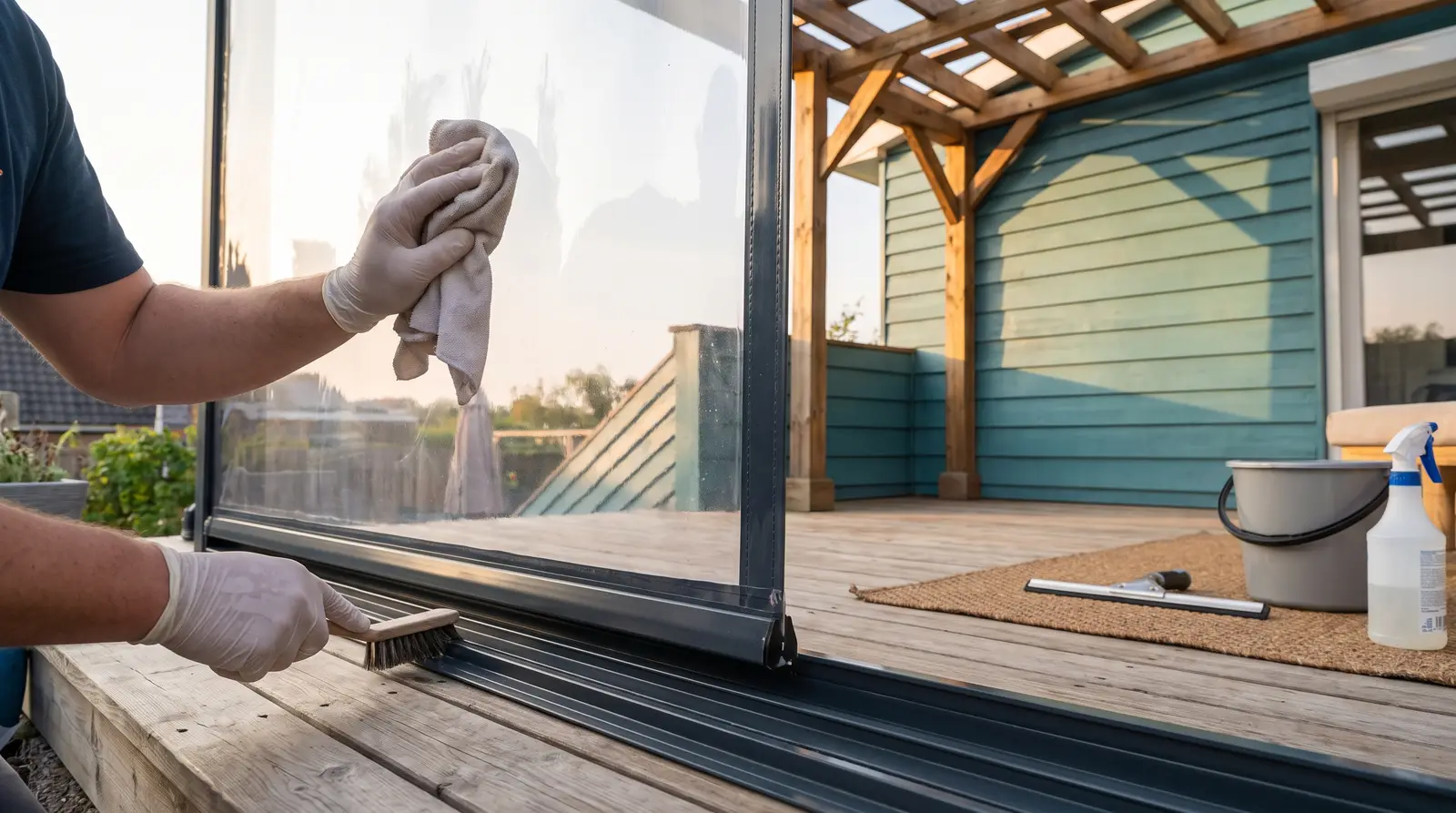
An outdoor blind maintenance checklist for Adelaide comes down to 4 recurring jobs: wash the panel quarterly, flush and lubricate the side channels twice a year, inspect the strapping and fixings twice a year, and retract the blinds before every storm front. That routine takes about 20 minutes each time and prevents the majority of the $120 to $600 repairs that Adelaide repairers are called out for.
Key takeaways
- Quarterly: wash the panel and hardware (every 6 to 8 weeks within a few kilometres of the coast).
- Twice yearly: flush the side channels, re-lubricate with a dry silicone or PTFE spray, and check all strapping.
- Before summer: check for UV embrittlement in plastic components. Before winter: check fixings and drainage.
- Every job here is ground-level work. Anything requiring a ladder belongs with a repairer.
Outdoor blinds fail predictably in this climate, which means the maintenance that prevents failure is equally predictable. Below is the routine set out by season, so you can put it on a calendar rather than remembering it.
The monthly glance (2 minutes)
You are not doing work here, only looking.
- Does the blind run with light, even effort the whole way? Increasing effort is the earliest warning of grit in the channels, and it appears months before an actual jam.
- Any new noise? Grinding, squealing or a click at 1 point in the travel each mean something specific and none of them get better.
- Is the bottom bar sitting square against the sill or deck line?
- Any visible debris in the channel mouth, in the top box, or nesting behind the bracket?
Never force a blind that has become heavy. Heavy is a diagnosis, and the fix at that stage is a hose and a lubricant, not more force. Continuing to operate it is how you get to a jammed track and a $450 channel replacement.
Quarterly: the wash (20 minutes)
Every 3 months inland, every 6 to 8 weeks at Glenelg, Henley Beach, West Lakes and Semaphore where salt aerosol is constant.
- Hose the panel down first to lift the abrasive dust layer. Do not wipe a dry, dusty panel.
- Wash both faces with warm water and a few drops of pure liquid soap on a soft microfibre cloth.
- Rinse with fresh water and dry both faces with a second dry cloth.
- Wash the bottom bar, brackets, straps and fixings with the same solution, then rinse.
- Leave the blind down until it is fully dry before retracting it.
Nothing stronger than soap, ever. Methylated spirits, acetone, bleach, sugar soap, glass cleaner and pressure washers all cause permanent damage to clear PVC, and the full list plus the reasoning is in how to clean clear PVC blinds.
The reason this is quarterly rather than annual is not appearance. It is that every retraction of a dusty panel presses grit against the wrap above it, which is the leading cause of permanent scratch haze.
Twice yearly: tracks, straps and fixings (30 minutes)
Do this in late September before summer, and again in late April before the winter fronts.
Side channels
- Torch both channels top to bottom, looking for packed grit, leaf litter, gum nuts, spider nests or a deformed guide insert.
- Lift out debris with a plastic ruler, a wooden skewer or a stiff brush. Never anything metal, which scores the channel permanently.
- Flush both channels with a garden hose and let them drain fully.
- Apply a dry silicone or PTFE spray. Never a wet oil or general-purpose penetrant, which holds dust and can stain fabric.
Strapping and hardware
- Flex each strap. Supple is healthy, stiff and crackly means the webbing is degraded internally even if it looks intact.
- Press the buckle bodies. Surface chalking or any hairline cracking means the plastic has embrittled under UV and will snap in the first cold gust. Replace before winter, not after.
- Check every eyelet for elongation or a starting tear in the hem. An eyelet tear is the point where a $150 fix becomes a $350 hem repair. Detail is in replacing outdoor blind straps and zips.
- Check all mounting brackets and fasteners for movement, rust weeping or corrosion under the powder coat. Coastal addresses need marine-grade 316 stainless. Anything less pits within 3 to 5 years in the marine zone.
Panel
- Look across the sheet at a low angle for new crazing (fine spider-web cracking). Crazing means the panel is embrittled and near the end of its service life. Context in why clear PVC goes cloudy.
- Check the hem stitching and every welded seam.
- On mesh, press a thumb firmly into the fabric in a couple of places. Chalky fabric that tears under thumb pressure has failed.
Before summer (September)
Adelaide summer is the UV season, and UV is the primary ageing mechanism on every component here. The Bureau of Meteorology's Adelaide climate averages record January mean maximums near 29 degrees with extremes past 44, and it is the plastic components rather than the fabric that quietly take the damage.
- Replace any doubtful buckle, clip or plastic guide insert now. They fail on the first cold windy day, not on the hot ones.
- Confirm the blind retracts fully. A panel that spends summer partly deployed for no reason is burning through its own life.
- On motorised systems, replace remote batteries as a matter of routine and confirm the travel limits are still correct. See motorised outdoor blind not working.
- Clear insect nests from the top box before the season.
Before winter (April)
Winter here is wind and rain rather than cold, and it is when accumulated summer damage cashes out. If any of your panels come off for the season, storing outdoor blinds over winter covers how to roll and keep them without creasing the PVC.
- Check that water drains away from the bottom of each side channel rather than pooling in it. A blocked channel base holds water against the guide inserts all winter.
- Re-check every fixing. Winter is when a marginal bracket lets go.
- Clear gutters and roof drainage above the blind. Overflow down a channel packs debris into it faster than anything else, and it is the standard Hills failure at Stirling, Aldgate and Crafers.
- Confirm your storm routine: retract the blinds before a front arrives, do not leave them part-deployed, and do not cycle them during high wind. The Bureau's South Australian warnings service is the right thing to watch, and the SA State Emergency Service publishes storm preparation guidance for the property generally.
What this routine is worth
Adelaide repair bands run $120 for a track service to $600 for a panel or motor replacement. Nearly every one of those call-outs traces back to something on this list that was not done: a channel never flushed, a buckle never checked, a panel rolled up dirty for 3 summers.
Set 2 calendar reminders (late September, late April) and add the panel wash to the quarterly household routine. That is the entire commitment, and it is the single biggest factor in whether a blind reaches 12 years or 6. More on the long game in extending the life of your outdoor blinds.
If a check turns up something you are not comfortable handling, or anything that needs working at height, our outdoor blind repairs page explains how we pass your enquiry to a local Adelaide repairer for an on-site assessment.