Care, repairs and maintenance
How to Store Outdoor Blinds Over Winter
6 min read
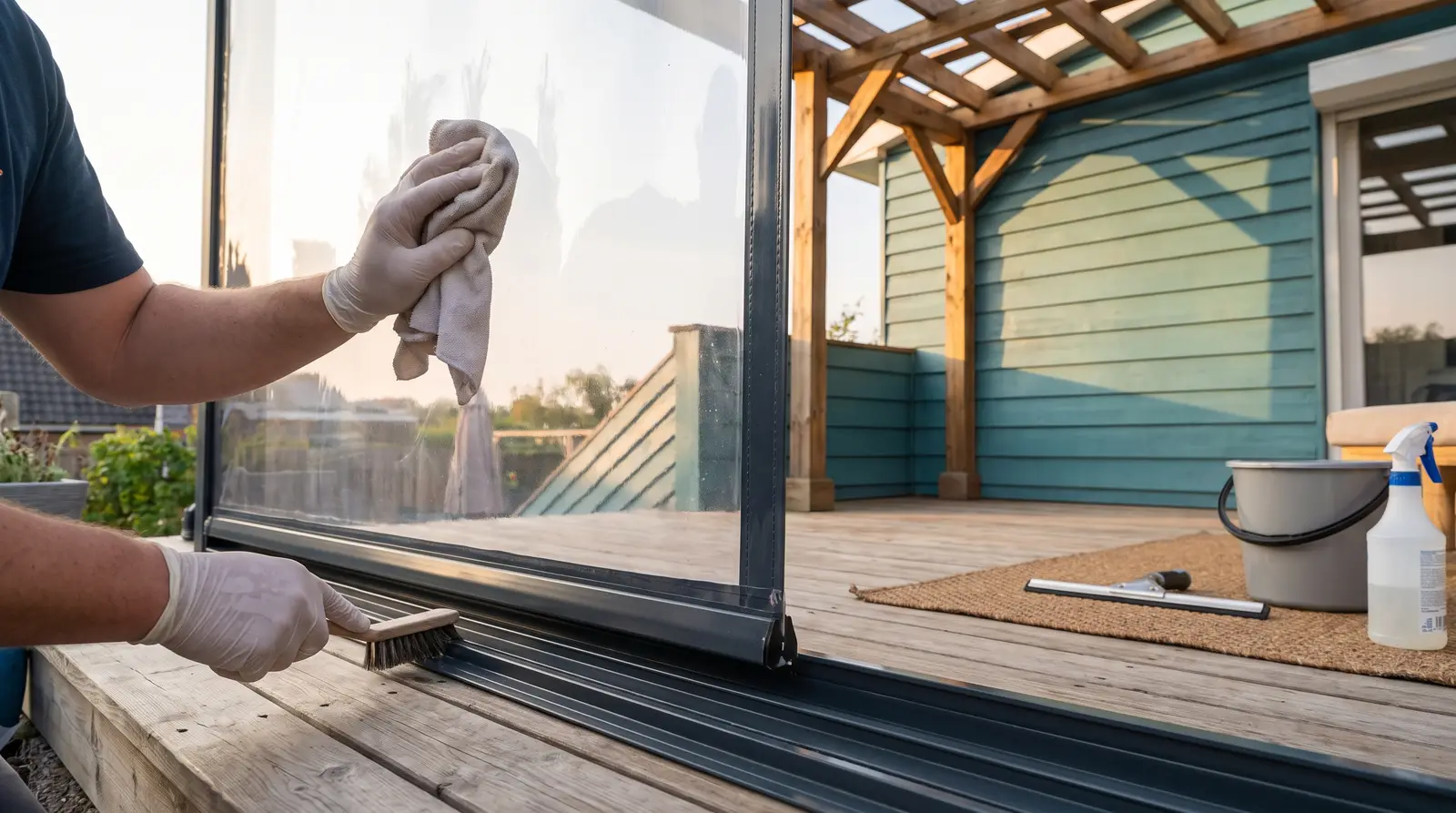
To store outdoor blinds over winter, clean and dry the panel completely, then roll it (never fold it) around a wide tube with a soft interleaving layer, and keep it flat, dry and out of direct sun above 5 degrees. In most of Adelaide the better answer is not to store them at all: fixed blinds are designed to stay up, and winter is exactly when an alfresco enclosure earns its keep.
Key takeaways
- Fixed track-guided and cafe blinds should stay installed over winter. Removing them causes more damage than leaving them up.
- Only fully removable panels (clip-on cafe blinds, some drop-in cafe screens) are worth storing.
- Roll, never fold. A crease in clear PVC is permanent and becomes a split.
- Never store a panel damp or dirty. Mould in the hem and grit against the sheet both do their damage in storage.
The storage question comes up most from people who have moved from a colder climate, or who have inherited a set of clip-on cafe blinds from a previous owner. It is worth answering carefully, because incorrect storage ruins more PVC panels than an Adelaide winter ever would.
Most Adelaide blinds should stay up
Winter is the season outdoor blinds do their real work here. The Bureau of Meteorology's Adelaide climate averages show the wettest months falling between May and September, and those are exactly the months an enclosed alfresco is worth having. Adelaide's cold months bring the rain and the southerly wind, and an enclosed alfresco with the blinds down is 5 to 8 degrees warmer and genuinely usable when the same space open is not. Taking blinds down in May means giving up the months you paid for.
There are also mechanical reasons.
Track-guided systems are not designed to be removed seasonally. Getting the fabric edge bead in and out of the channel is a workshop operation and repeated removal damages the bead. Leave them installed and simply retract them when you are not using the space.
Fixed cafe blinds on straps and eyelets can technically be unhooked, but the hardware wears with each cycle, and the panel spends 4 months rolled in a shed instead of tensioned in a frame. On balance it is worse for the blind.
Blinds left up are still protected when retracted. A retracted blind sits inside its top box or wrapped on the tube, which is the least UV-exposed state it can be in.
The genuine exception is the fully removable panel: clip-on cafe blinds on turn-buttons, drop-in courtyard screens, and any panel a manufacturer explicitly designed to come down. Those are worth storing properly, particularly on a west-facing opening where 4 months out of the sun is 4 months of plasticiser you keep.
Preparing a panel for storage
Do not skip any of this. Every common storage failure comes from putting a panel away dirty or damp.
- Wash both faces with warm water and a few drops of pure liquid soap, using a soft microfibre cloth. Hose the panel first so you are not grinding dust into it. The full method is in how to clean clear PVC blinds.
- Rinse with fresh water. Soap film left on the sheet dries to a haze over 4 months.
- Dry both faces completely with a clean dry cloth, then leave the panel hanging in the shade until there is no moisture anywhere, including in the hem, the stitching and around every eyelet. Trapped moisture in a hem is where mould starts.
- Wash and dry the hardware. Straps, buckles and turn-buttons. On coastal addresses at Glenelg, Henley Beach and West Lakes, rinsing salt off the hardware before storage prevents 4 months of quiet corrosion.
- Check and note any damage while the panel is down and easy to inspect: frayed webbing, elongated eyelets, hem tears, early crazing. Better to book a repair over winter than discover it in October. See replacing outdoor blind straps and zips. Keep dated photos of the condition, because South Australia's Consumer and Business Services notes that maintenance records support any later claim about a product's durability.
Roll, do not fold
This is the rule that matters most. A fold in clear PVC creates a permanent crease line where the material has been stressed past its elastic limit. It never flattens out, it reads as a white line across the panel, and it becomes the point where the sheet splits under wind load.
How to roll it properly:
- Use a wide-diameter core: a cardboard concrete-form tube, a carpet core or a length of 100 mm PVC pipe. Wide is the whole point, because a tight roll on a narrow core sets a curl into the sheet.
- Lay a clean cotton sheet, calico or a length of soft interleaving over the panel and roll them together so no PVC face touches another PVC face. Clear PVC will block (stick to itself) in Adelaide summer heat, and a blocked panel tears when you separate it.
- Roll evenly, without tension. Snug, not tight.
- Tie with soft fabric ties or wide webbing. Never rope, cable ties or elastic straps, all of which emboss the sheet.
- Label each roll with which opening it came from. Panels that look identical are rarely interchangeable, and matching them up in spring wastes an afternoon.
Mesh and shade fabric is more forgiving and can be folded loosely, but rolling is still better.
Where to store it
- Flat and horizontal, off the floor, on a shelf or across rafters. Standing a roll on end lets the weight of the sheet settle onto the bottom edge.
- Out of direct sunlight. A hot Adelaide shed roof drives radiant temperatures well past ambient, and UV through a translucent skylight panel will age a stored sheet.
- Above 5 degrees. PVC stiffens as it gets cold and unrolling a cold panel can crack it. Hills addresses at Stirling and Aldgate see genuine overnight cold, so an insulated space beats an open carport there.
- Dry, with airflow. Not sealed in plastic, which traps condensation. A breathable cover is better than a sealed bag.
- Nothing stacked on top. Anything resting on a rolled panel presses a mark into it.
Bringing them back out
Give yourself a mild day rather than a cold morning. Unroll the panel in the shade, let it relax flat for an hour so it returns to shape, and inspect it before rehanging: check the hem, the eyelets, the stitching and the sheet for new crazing.
Rehang with even tension across all fixing points rather than tightening 1 corner first, which is what tears eyelets. Then run through the pre-season items in the outdoor blind maintenance checklist before the first hot week.
The alternative that suits most Adelaide homes
If the reason you are storing blinds is to keep them out of the weather, the better long-term answer is usually a system that does not need storing. Track-guided outdoor blinds retract fully into a top box, seal the space when they are down, and handle Adelaide's winter fronts without anyone climbing around unhooking panels. That is one of the practical arguments in extending the life of your outdoor blinds.
If a stored panel has come out of the shed creased, hazed or split, our outdoor blind repairs page explains how we pass your enquiry to a local Adelaide repairer for a quote on panel replacement, typically $350 to $600 per opening, rather than pushing a whole new system.